Which machine should a seed shop add next, and does a greedy rule find it?
research/selfrep-nextmachine
Which machine a printer-only seed shop should add next under a budget: greedy closure-per-price vs exhaustive search; same choice on the real 3-machine instance, optimal in 72–94% of 500 synthetic instances. Machine prices assumed. Stylised.
What it found
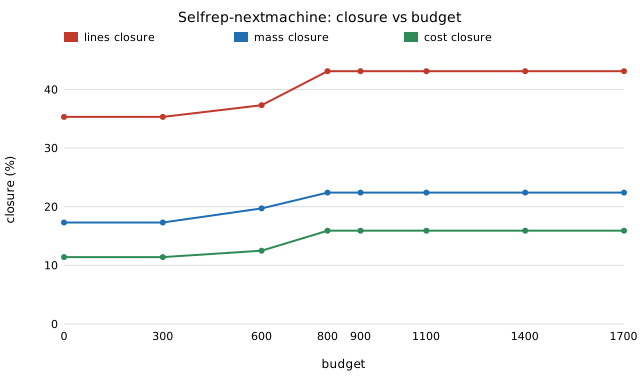
Builds on the selfrep-closure part model. Choosing among a CNC router, laser cutter and casting setup under a budget, a greedy closure-per-price rule matches exhaustive search at every tested budget on the real three-machine instance (router first, then casting only if brass bushings replace LM8UU). On 500 random synthetic instances greedy is optimal in 72–94% of cases and loses up to about 38% of the closure gain in the worst case. Stylised: machine prices, masses and costs are assumed placeholders, machines have no bills of materials of their own, and the synthetic instances are random.
A figure from its own output
Paper, code and results
More in Self-replicating manufacturing
- How fast does a replicating printer shop grow when its vitamins must be bought?Discrete-event and fluid growth of a replicating printer shop with imported vitamins: doubling time falls roughly as 1/budget until machine time binds (about 53 h in the simulation), failed builds cost about 1/(1-f), and closure helps most when imports bind. All inputs assumed; Lackner and Wendt comparison not done. Stylised.
- When should a replicating shop stop copying itself and start making goods?Optimal split of a replicating printer shop's time between copies and goods: copy flat out, then switch one e-folding time (about 50 h) before the horizon; constant splits get 9–27% of that value, smooth ramps no better. Cash-limited cases switch about 50 h from the end. All inputs assumed. Stylised.
- How much imported material can recycling save a self-replicating printer shop?Mass and energy balance of plastic and aluminium recycling for one RepRap copy (stylised, assumed process parameters): vitamins stay about 75% of imported mass, recycling the shop's own scrap cuts imports a median 3%, and only retired-machine plastic changes the plastic import much.
- How many printer copies does it take for a shop's recycling machines to repay their own imports?Payback of recycling machines with their own assumed part lists (stylised): about 100 printer copies on the shop's own scrap, 12–31 if retired machines' plastic is recycled.
- Does pricing a shop’s imports, instead of weighing them, change when its recycling machines repay themselves?Recycler payback priced instead of weighed (stylised, assumed prices): plastic pair 98–111 printer copies on own scrap, furnace 203, 10–26 with retired plastic.
- What is the closed form of a replicating shop’s smooth switch from copying to goods, and does it match dynamic programming?Closed-form optimal copy share for a replicating printer shop with a saturating goods market (Pontryagin singular arc: goods output grows linearly, last 1/k hours all goods); earns 99.96–100% of the dynamic-programming policy's value. Necessary conditions only; all inputs assumed. Stylised.
All 34 Self-replicating manufacturing projects →
Other research topics
Proper scoring & elicitation28Effort & peer prediction9Verification games & slashing19Detection & tolerances14Markets as routers13Prediction-market design9Paying contributors8Decentralised training systems23Digital twins & sim-to-real164LLM chip design loops40Robot manufacturing loops53Ambient AI assistant46Self-replicating manufacturing34Simulation-first design64Engineered clothing45Task-specific AI accelerators40Algorithmic chip-design loops42Open-source purpose-built robots44The software-engineering loop43Adversarial human imitation41Open-source residential construction41Autonomous multi-angle capture34Sensing, imaging and 3D31Energy supply and dense energy storage39Robot societies among people31Agentic co-design of low-cost robots27Laundry-hanging robots25Machine learning on qualitative data23Robots on the building site27Civilizations & group psychology1History & human sciences1
Produced with AI assistance (Claude). Results are from the code in this repository and are simulated or stylised unless the abstract says otherwise; nothing here implies affiliation with or endorsement by any lab, researcher or company cited. MIT licensed.