How many printer copies does it take for a shop's recycling machines to repay their own imports?
research/selfrep-recyclers
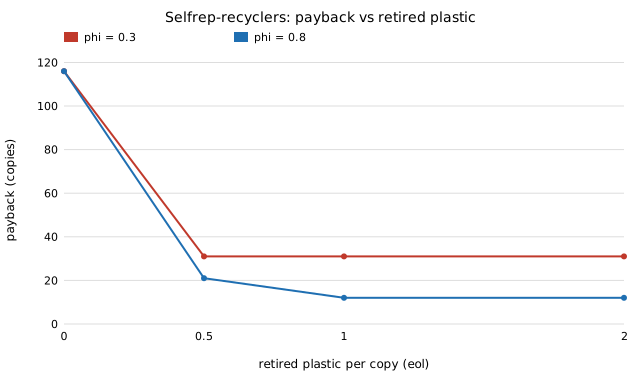
Payback of recycling machines with their own assumed part lists (stylised): about 100 printer copies on the shop's own scrap, 12–31 if retired machines' plastic is recycled.
What it found
Builds on selfrep-materials. A shredder, a filament extruder and an aluminium furnace are given assumed part lists, split into vitamins and parts the shop can make. With the shop’s own scrap only, the plastic pair needs 99–116 printer copies to avoid as much imported mass as it costs (91–164 over part-mass draws) and the furnace about 94. Plastic from retired machines cuts this to about 12–31 copies, depending on an assumed recycled-share cap. Limitations: part lists and masses are placeholders, mass is the only currency (cost, time and energy are ignored), and retirement is a scenario knob. Stylised.
A figure from its own output
Paper, code and results
More in Self-replicating manufacturing
- Does pricing a shop’s imports, instead of weighing them, change when its recycling machines repay themselves?Recycler payback priced instead of weighed (stylised, assumed prices): plastic pair 98–111 printer copies on own scrap, furnace 203, 10–26 with retired plastic.
- What is the closed form of a replicating shop’s smooth switch from copying to goods, and does it match dynamic programming?Closed-form optimal copy share for a replicating printer shop with a saturating goods market (Pontryagin singular arc: goods output grows linearly, last 1/k hours all goods); earns 99.96–100% of the dynamic-programming policy's value. Necessary conditions only; all inputs assumed. Stylised.
- When the goods market saturates, does a replicating shop’s bang-bang switch turn smooth?Reinvestment of a replicating printer shop when the goods market saturates, checked by dynamic programming: bang-bang is optimal with linear revenue, but with market capacity below about 10^4 machine-hours per hour the optimum ramps the copy share down over 90–300 h and bang-bang loses 4.5–7%. All inputs assumed. Stylised.
- What fleet can a replicating printer shop sustain when its machines wear out?Fleet a replicating printer shop sustains when machines wear out (stylised, assumed inputs): short-lived machines die out from one seed; recycling gains need a correction for builds cut short.
- Can an exactly solvable birth-death chain explain why short-lived printer fleets die out?Exact mean extinction time of a wearing-out printer fleet as a birth-death chain (stylised, assumed inputs): explains the die-outs in kind, within about 35% only after a post-hoc fix.
- Does paying for spares late rescue the long repair queue of a printer shop?Does paying for spares at service start rescue the long repair queue of a printer shop (stylised, assumed inputs): yes, an unbounded queue then beats never repairing (488 against 458 at one bench) and queue caps stop mattering.
All 34 Self-replicating manufacturing projects →
Other research topics
Proper scoring & elicitation28Effort & peer prediction9Verification games & slashing19Detection & tolerances14Markets as routers13Prediction-market design9Paying contributors8Decentralised training systems23Digital twins & sim-to-real164LLM chip design loops40Robot manufacturing loops53Ambient AI assistant46Self-replicating manufacturing34Simulation-first design64Engineered clothing45Task-specific AI accelerators40Algorithmic chip-design loops42Open-source purpose-built robots44The software-engineering loop43Adversarial human imitation41Open-source residential construction41Autonomous multi-angle capture34Sensing, imaging and 3D31Energy supply and dense energy storage39Robot societies among people31Agentic co-design of low-cost robots27Laundry-hanging robots25Machine learning on qualitative data23Robots on the building site27Civilizations & group psychology1History & human sciences1
Produced with AI assistance (Claude). Results are from the code in this repository and are simulated or stylised unless the abstract says otherwise; nothing here implies affiliation with or endorsement by any lab, researcher or company cited. MIT licensed.