When the goods market saturates, does a replicating shop’s bang-bang switch turn smooth?
research/selfrep-satmarket
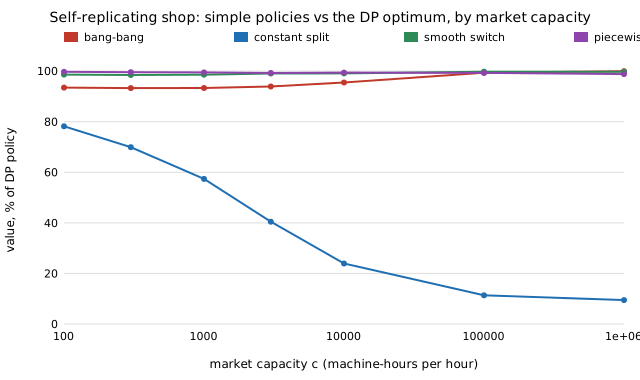
Reinvestment of a replicating printer shop when the goods market saturates, checked by dynamic programming: bang-bang is optimal with linear revenue, but with market capacity below about 10^4 machine-hours per hour the optimum ramps the copy share down over 90–300 h and bang-bang loses 4.5–7%. All inputs assumed. Stylised.
What it found
Builds on the selfrep-reinvest fluid model, with concave goods revenue a c(1 − e−g/c) and a backward dynamic programme (Bellman) as a check on the local-search policies. With a large market the optimum is still copy-then-switch; once market capacity c is below about 104 machine-hours per hour the optimal copy share ramps down over 90–300 h, bang-bang loses 4.5–7% of the optimum and a logistic ramp recovers all but 1–1.5%. Slower growth from failed builds sharpens the switch again. Every input is assumed and the saturation form is a convenient choice; cash never binds. The DP value is the optimum of a discretised problem, within a few tenths of a percent of its simulated policy where it is accurate and several percent in near-linear cases. Stylised.
A figure from its own output
Paper, code and results
More in Self-replicating manufacturing
- What fleet can a replicating printer shop sustain when its machines wear out?Fleet a replicating printer shop sustains when machines wear out (stylised, assumed inputs): short-lived machines die out from one seed; recycling gains need a correction for builds cut short.
- Can an exactly solvable birth-death chain explain why short-lived printer fleets die out?Exact mean extinction time of a wearing-out printer fleet as a birth-death chain (stylised, assumed inputs): explains the die-outs in kind, within about 35% only after a post-hoc fix.
- Does paying for spares late rescue the long repair queue of a printer shop?Does paying for spares at service start rescue the long repair queue of a printer shop (stylised, assumed inputs): yes, an unbounded queue then beats never repairing (488 against 458 at one bench) and queue caps stop mattering.
- What happens to a repairing printer shop when repairs need labour?Repair labour as a limit on a repairing printer shop (stylised, assumed inputs): with few repair benches an unbounded queue of broken machines is dead stock and does worse than never repairing; capping the queue recovers most of the gain.
- When is repairing a printer worth more than building a new one?Repair versus replacement in a replicating printer shop (stylised, assumed inputs): repair wins iff its cost share is below its success probability, but only if spares are held back from new builds.
- How much does making its own spare parts cut the cost of repairing a printer?How much making its own spare parts cuts a printer shop's repair cost (stylised, assumed inputs): the printer alone makes none of the wear parts, so in-house spares barely move the fleet; the breakdown rate matters more.
All 34 Self-replicating manufacturing projects →
Other research topics
Proper scoring & elicitation28Effort & peer prediction9Verification games & slashing19Detection & tolerances14Markets as routers13Prediction-market design9Paying contributors8Decentralised training systems23Digital twins & sim-to-real164LLM chip design loops40Robot manufacturing loops53Ambient AI assistant46Self-replicating manufacturing34Simulation-first design64Engineered clothing45Task-specific AI accelerators40Algorithmic chip-design loops42Open-source purpose-built robots44The software-engineering loop43Adversarial human imitation41Open-source residential construction41Autonomous multi-angle capture34Sensing, imaging and 3D31Energy supply and dense energy storage39Robot societies among people31Agentic co-design of low-cost robots27Laundry-hanging robots25Machine learning on qualitative data23Robots on the building site27Civilizations & group psychology1History & human sciences1
Produced with AI assistance (Claude). Results are from the code in this repository and are simulated or stylised unless the abstract says otherwise; nothing here implies affiliation with or endorsement by any lab, researcher or company cited. MIT licensed.