What happens to a repairing printer shop when repairs need labour?
research/selfrep-repairlabour
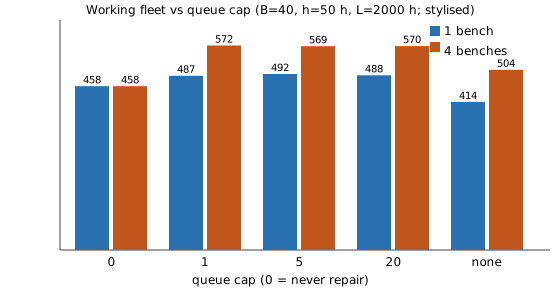
Repair labour as a limit on a repairing printer shop (stylised, assumed inputs): with few repair benches an unbounded queue of broken machines is dead stock and does worse than never repairing; capping the queue recovers most of the gain.
What it found
Follow-up to selfrep-repair. Repairs need one of K benches; broken machines queue after buying spares. The pre-run prediction that the working fleet is about min(import limit, K·L/h) fails: with B = 40 and one bench the fleet is 414 against a cap of 40, because most breakdowns are never served and the queue (2915 machines) is dead stock. An unbounded queue with one bench is worse than never repairing (414 against 458); retiring a breakdown when 1–20 machines already wait gives 487–492. Stylised: assumed inputs, benches are a count with no wages, no corrected closed form.
A figure from its own output
Paper, code and results
More in Self-replicating manufacturing
- When is repairing a printer worth more than building a new one?Repair versus replacement in a replicating printer shop (stylised, assumed inputs): repair wins iff its cost share is below its success probability, but only if spares are held back from new builds.
- How much does making its own spare parts cut the cost of repairing a printer?How much making its own spare parts cuts a printer shop's repair cost (stylised, assumed inputs): the printer alone makes none of the wear parts, so in-house spares barely move the fleet; the breakdown rate matters more.
- Does a printer shop lose its printed-bushing gain once a printed spare takes print hours?Does charging printed spares their print hours erase the printed-bushing gain (stylised, assumed inputs): the fleet ignores waits up to ~500 h per repair because it is import-limited, and the gain was within noise anyway.
- Is the lone-printer die-out an early birth-death accident?Exact Markov-chain test of why a lone replicating printer dies out (stylised, assumed inputs): about a fifth die before a fleet forms at 500 h mean life; wear-out lives remove it.
- Can a quasi-stationary approximation predict how long a small printer fleet lasts?Quasi-stationary approximation of how long a small replicating-printer fleet lasts (stylised, assumed inputs): within 5% of the exact mean time once a correction for early die-out is applied, poor for the shortest lives.
- Why do two exact extinction chains of the same printer shop disagree?Reconciles the two exact extinction chains of the lone printer shop (stylised, assumed inputs): the fleet-size chain is 1.5 to 7 times longer; adding the kit wait fixes small fleets but over-corrects large ones.
All 34 Self-replicating manufacturing projects →
Other research topics
Proper scoring & elicitation28Effort & peer prediction9Verification games & slashing19Detection & tolerances14Markets as routers13Prediction-market design9Paying contributors8Decentralised training systems23Digital twins & sim-to-real164LLM chip design loops40Robot manufacturing loops53Ambient AI assistant46Self-replicating manufacturing34Simulation-first design64Engineered clothing45Task-specific AI accelerators40Algorithmic chip-design loops42Open-source purpose-built robots44The software-engineering loop43Adversarial human imitation41Open-source residential construction41Autonomous multi-angle capture34Sensing, imaging and 3D31Energy supply and dense energy storage39Robot societies among people31Agentic co-design of low-cost robots27Laundry-hanging robots25Machine learning on qualitative data23Robots on the building site27Civilizations & group psychology1History & human sciences1
Produced with AI assistance (Claude). Results are from the code in this repository and are simulated or stylised unless the abstract says otherwise; nothing here implies affiliation with or endorsement by any lab, researcher or company cited. MIT licensed.