Does a printer shop lose its printed-bushing gain once a printed spare takes print hours?
research/selfrep-sparehours
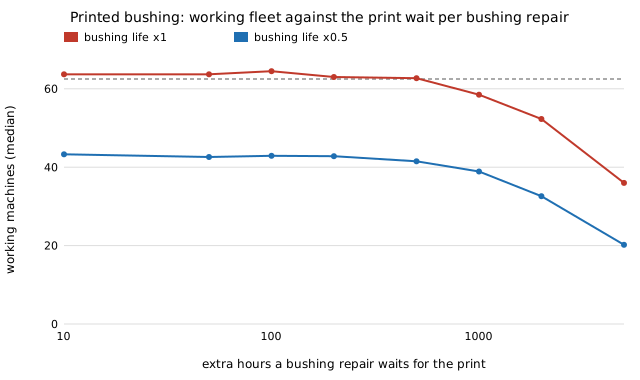
Does charging printed spares their print hours erase the printed-bushing gain (stylised, assumed inputs): the fleet ignores waits up to ~500 h per repair because it is import-limited, and the gain was within noise anyway.
What it found
Follow-up to selfrep-spares. A repair that needs a printed bushing waits extra print hours (mean-downtime approximation in the unchanged selfrep-repair simulation). At the assumed inputs the working fleet is flat up to about 500 h of wait per repair (62.7 vs 64.2 machines with none) and falls at 1000 h (58.5) to 36.0 at 5000 h, because the fleet is import-limited, not downtime-limited. The bushing’s gain over stock bearings (+1.8) was already inside the run-to-run spread. Stylised, assumed inputs; printing does not compete with building for machine time.
A figure from its own output
Paper, code and results
More in Self-replicating manufacturing
- Is the lone-printer die-out an early birth-death accident?Exact Markov-chain test of why a lone replicating printer dies out (stylised, assumed inputs): about a fifth die before a fleet forms at 500 h mean life; wear-out lives remove it.
- Can a quasi-stationary approximation predict how long a small printer fleet lasts?Quasi-stationary approximation of how long a small replicating-printer fleet lasts (stylised, assumed inputs): within 5% of the exact mean time once a correction for early die-out is applied, poor for the shortest lives.
- Why do two exact extinction chains of the same printer shop disagree?Reconciles the two exact extinction chains of the lone printer shop (stylised, assumed inputs): the fleet-size chain is 1.5 to 7 times longer; adding the kit wait fixes small fleets but over-corrects large ones.
- Which part substitutions cut a printer's vitamins most, within a performance budget?Which assumed part substitutions (printed bushings and nuts, wooden rods) cut the Prusa Mendel's vitamins most under a penalty budget: all seven take closure from 43/22/16% to 60/36/48% (lines/mass/cost); best set depends on the assumed penalties. Stylised.
- What does a wooden rod cost a printer in stiffness?Beam model of the Prusa Mendel's smooth rods: a wooden rod sags 20 times a steel one at 8 mm and needs about 17 mm to match it, and
selfrep-redesign's assumed dowel mass was twice the geometric one (stylised). - What natural-frequency target does a printer’s rod have to meet, and what does a wooden rod cost?Carriage natural frequency on the Prusa Mendel's smooth rods: a vibration target, not a sag limit, sets the rod diameter; hardwood needs about twice steel's diameter (stylised).
All 34 Self-replicating manufacturing projects →
Other research topics
Proper scoring & elicitation28Effort & peer prediction9Verification games & slashing19Detection & tolerances14Markets as routers13Prediction-market design9Paying contributors8Decentralised training systems23Digital twins & sim-to-real164LLM chip design loops40Robot manufacturing loops53Ambient AI assistant46Self-replicating manufacturing34Simulation-first design64Engineered clothing45Task-specific AI accelerators40Algorithmic chip-design loops42Open-source purpose-built robots44The software-engineering loop43Adversarial human imitation41Open-source residential construction41Autonomous multi-angle capture34Sensing, imaging and 3D31Energy supply and dense energy storage39Robot societies among people31Agentic co-design of low-cost robots27Laundry-hanging robots25Machine learning on qualitative data23Robots on the building site27Civilizations & group psychology1History & human sciences1
Produced with AI assistance (Claude). Results are from the code in this repository and are simulated or stylised unless the abstract says otherwise; nothing here implies affiliation with or endorsement by any lab, researcher or company cited. MIT licensed.