Which part substitutions cut a printer's vitamins most, within a performance budget?
research/selfrep-redesign
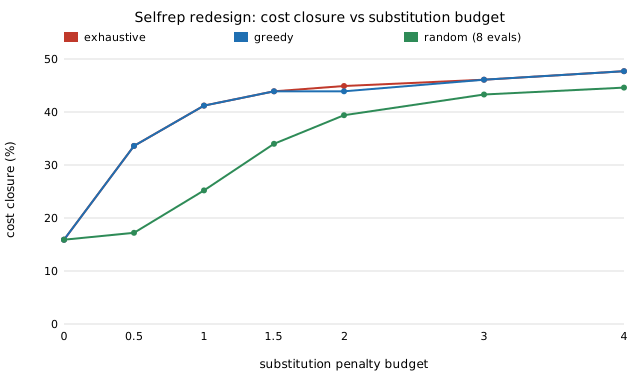
Which assumed part substitutions (printed bushings and nuts, wooden rods) cut the Prusa Mendel's vitamins most under a penalty budget: all seven take closure from 43/22/16% to 60/36/48% (lines/mass/cost); best set depends on the assumed penalties. Stylised.
What it found
Follow-up to selfrep-closure that changes the machine instead of the shop. Seven assumed substitutions (printed bushings and nuts, wooden rods, a printed drive) are searched exhaustively, greedily and at random under an assumed penalty budget. All seven together take the Prusa Mendel’s vitamin lines from 29 to 19 and closure from 43/22/16% to 60/36/48% (lines/mass/cost) for the printer, router and laser shop; mass closure stays below 36% because motors, electronics and threaded rods remain. Cost closure responds most, and the best set depends on the assumed penalties. Stylised: substitutions, masses and penalties are all assumed and no part was tested.
A figure from its own output
Paper, code and results
More in Self-replicating manufacturing
- What does a wooden rod cost a printer in stiffness?Beam model of the Prusa Mendel's smooth rods: a wooden rod sags 20 times a steel one at 8 mm and needs about 17 mm to match it, and
selfrep-redesign's assumed dowel mass was twice the geometric one (stylised). - What natural-frequency target does a printer’s rod have to meet, and what does a wooden rod cost?Carriage natural frequency on the Prusa Mendel's smooth rods: a vibration target, not a sag limit, sets the rod diameter; hardwood needs about twice steel's diameter (stylised).
- Does an aluminium rod fit the printer where a wooden one cannot?Aluminium rods in the printer redesign: matching a steel rod's sag takes 10.4 mm aluminium (fits the assumed 12 mm holders) against 16.9 mm hardwood (does not), at 39.5% vs 37.8% mass closure (stylised).
- How stiff a rod does a frequency target need, in aluminium and in wood?Sizing printer rods to a first-mode frequency target instead of a sag spec: at 0.3 kg aluminium reaches 40 Hz with 10.0 mm (fits the assumed 12 mm holders) where hardwood needs 16.0 mm (stylised).
- How thick must a printer rod be to keep carriage ringing small at a given acceleration?Rod diameter from an acceleration and ringing budget: at 3 m/s² with abrupt steps steel needs 7.3 mm, aluminium 9.6 mm, hardwood 15.5 mm; a 20 ms force ramp cuts aluminium at 5 m/s² from 10.9 to 8.9 mm (stylised).
- Which assumed input of the replicating-printer growth model does the doubling time depend on most?Which assumed input of the replicating-printer growth model moves its doubling time (Sobol indices, stylised, assumed ranges): budget and vitamin cost together carry ~90% of the variance when imports bind; when machine time binds, failure, print rate, budget and price are comparable.
All 34 Self-replicating manufacturing projects →
Other research topics
Proper scoring & elicitation28Effort & peer prediction9Verification games & slashing19Detection & tolerances14Markets as routers13Prediction-market design9Paying contributors8Decentralised training systems23Digital twins & sim-to-real164LLM chip design loops40Robot manufacturing loops53Ambient AI assistant46Self-replicating manufacturing34Simulation-first design64Engineered clothing45Task-specific AI accelerators40Algorithmic chip-design loops42Open-source purpose-built robots44The software-engineering loop43Adversarial human imitation41Open-source residential construction41Autonomous multi-angle capture34Sensing, imaging and 3D31Energy supply and dense energy storage39Robot societies among people31Agentic co-design of low-cost robots27Laundry-hanging robots25Machine learning on qualitative data23Robots on the building site27Civilizations & group psychology1History & human sciences1
Produced with AI assistance (Claude). Results are from the code in this repository and are simulated or stylised unless the abstract says otherwise; nothing here implies affiliation with or endorsement by any lab, researcher or company cited. MIT licensed.