How much of a RepRap printer can a growing seed shop make itself?
research/selfrep-closure
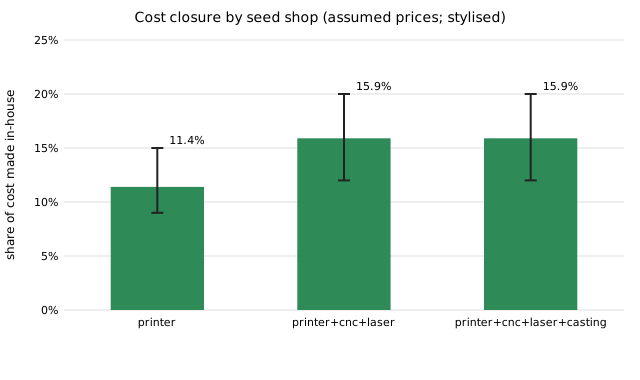
Part, mass and cost closure of the RepRap Prusa Mendel (iteration 2) for three seed shops: printer alone makes 18 of 51 part lines (35%), plus router and laser 43%, assumed-mass closure 22%; casting helps only with brass bushings. Mass and cost inputs assumed. Stylised.
What it found
The RepRap Prusa Mendel (iteration 2) bill of materials (51 part lines, from the RepRap wiki) against three seed shops. A printer alone makes 18 of 51 lines (35%); adding a CNC router and laser cutter reaches 43% of lines and, under assumed masses and costs, about 22% of mass and 16% of cost; casting helps only if brass bushings replace LM8UU bearings (45% of lines, 24% of mass). Motors, electronics, rods, bearings and fasteners stay vitamins. Stylised: the wiki gives no masses or prices, so those inputs are assumed and shown with a sensitivity range, process assignments are judgement, and only the printer is decomposed.
A figure from its own output
Paper, code and results
More in Self-replicating manufacturing
- Which machine should a seed shop add next, and does a greedy rule find it?Which machine a printer-only seed shop should add next under a budget: greedy closure-per-price vs exhaustive search; same choice on the real 3-machine instance, optimal in 72–94% of 500 synthetic instances. Machine prices assumed. Stylised.
- How fast does a replicating printer shop grow when its vitamins must be bought?Discrete-event and fluid growth of a replicating printer shop with imported vitamins: doubling time falls roughly as 1/budget until machine time binds (about 53 h in the simulation), failed builds cost about 1/(1-f), and closure helps most when imports bind. All inputs assumed; Lackner and Wendt comparison not done. Stylised.
- When should a replicating shop stop copying itself and start making goods?Optimal split of a replicating printer shop's time between copies and goods: copy flat out, then switch one e-folding time (about 50 h) before the horizon; constant splits get 9–27% of that value, smooth ramps no better. Cash-limited cases switch about 50 h from the end. All inputs assumed. Stylised.
- How much imported material can recycling save a self-replicating printer shop?Mass and energy balance of plastic and aluminium recycling for one RepRap copy (stylised, assumed process parameters): vitamins stay about 75% of imported mass, recycling the shop's own scrap cuts imports a median 3%, and only retired-machine plastic changes the plastic import much.
- How many printer copies does it take for a shop's recycling machines to repay their own imports?Payback of recycling machines with their own assumed part lists (stylised): about 100 printer copies on the shop's own scrap, 12–31 if retired machines' plastic is recycled.
- Does pricing a shop’s imports, instead of weighing them, change when its recycling machines repay themselves?Recycler payback priced instead of weighed (stylised, assumed prices): plastic pair 98–111 printer copies on own scrap, furnace 203, 10–26 with retired plastic.
All 34 Self-replicating manufacturing projects →
Other research topics
Proper scoring & elicitation28Effort & peer prediction9Verification games & slashing19Detection & tolerances14Markets as routers13Prediction-market design9Paying contributors8Decentralised training systems23Digital twins & sim-to-real164LLM chip design loops40Robot manufacturing loops53Ambient AI assistant46Self-replicating manufacturing34Simulation-first design64Engineered clothing45Task-specific AI accelerators40Algorithmic chip-design loops42Open-source purpose-built robots44The software-engineering loop43Adversarial human imitation41Open-source residential construction41Autonomous multi-angle capture34Sensing, imaging and 3D31Energy supply and dense energy storage39Robot societies among people31Agentic co-design of low-cost robots27Laundry-hanging robots25Machine learning on qualitative data23Robots on the building site27Civilizations & group psychology1History & human sciences1
Produced with AI assistance (Claude). Results are from the code in this repository and are simulated or stylised unless the abstract says otherwise; nothing here implies affiliation with or endorsement by any lab, researcher or company cited. MIT licensed.