What does a good die cost, and at what area do chiplets beat one big die?
research/infra-yield
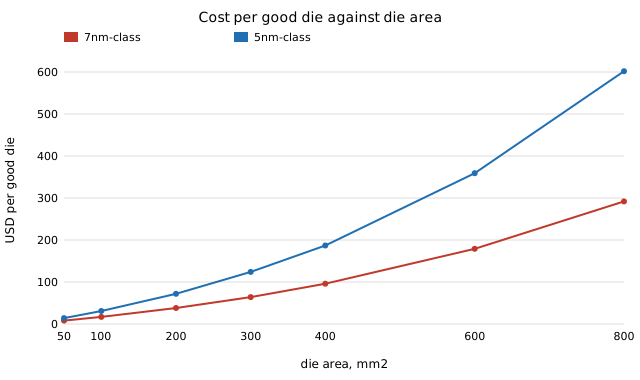
Cost per good die from five yield models, a dies-per-wafer count and sourced wafer prices and defect densities: a 600 mm² die costs about $179 on a 7nm-class and $359 on a 5nm-class wafer, the yield model moves the 5nm figure by 16%, and two chiplets beat one die from about 300 mm² of logic (range 126-728 mm² over packaging cost and defect density).
What it found
Poisson, Murphy, Seeds, Bose-Einstein and negative-binomial yield models, a closed-form dies-per-wafer count checked against an exact grid count, and a chiplet cost model with known-good-die testing and assembly yield. Inputs: CSET's 2020 estimates of TSMC 300 mm wafer prices (9,346 USD at 7 nm, 16,988 USD at 5 nm) and the defect densities TSMC gave in 2020 (0.09 and 0.10–0.11 /cm2, via AnandTech). At negative-binomial α = 3 a 600 mm2 die yields 61 % and costs 179 USD at 7 nm, 55 % and 359 USD at 5 nm; the choice of yield model moves the 5 nm figure from 328 to 382 USD. The closed-form dies-per-wafer count undercounts square dies by 1–12 % (100 to 800 mm2). Two chiplets beat one die from about 300 mm2 of logic at 0.11 /cm2 (assembly 30 USD plus 5 per chiplet), from 126 to 728 mm2 across the swept defect densities and assembly costs; the yield model moves the crossing by 15 %. The cost CSET quotes for a 600 mm2 die is not reproduced (the 5 nm figure is about 238 against 359 here); their die sizes are not known. Assumed, not sourced: the clustering parameter α, the 10 % die-to-die overhead, assembly costs and bond yield (swept). Prices are a 2020 snapshot.
A figure from its own output
Paper, code and results
More in Algorithmic chip-design loops
- How much of an open-source chip design search can cheap fidelity rungs and proof prediction save, with a guarantee?Milestones 1 to 3 done: on 10 designs x 60 ABC pass sequences, the generic-gate score does not rank like routed SKY130 area x delay (tau-b median -0.04), and liberty mapping mis-ranks too when the clock is tight (tau 0.59); at equal wall-clock a one-shot cheap-rung screen does not beat random or hill-climbing search on the cached table; successive halving across rungs does not beat random routed search on mean regret either (plain halving from the generic-gate rung is worst; a 6-point routed pilot to pick the start rung fixes most of that, H3), a 10-point routed pilot plus a conformal bound on the mapped rung keeps the routed optimum 0.99 of the time (nominal 0.90) at 42 to 57% of the routed runs, but on the generic-gate rung coverage fails (0.65 against 0.80, H4 refuted there); proof-success prediction (H5): pooled AUC 0.96 to 0.998 across 15 designs is just design size (an oracle knowing only each design's success rate scores the same), and inside the one design with variation it is 0.65 to 0.78, so H5 is not supported; milestone 6 proves that halving's routed regret is at most the sum of the cut rungs' largest ranking inversions (vacuous for the generic-gate rung, loose for the mapped ones); milestone 7a adds a distribution-free pilot quantile of pair inversions (16-point pilots hold the nominal 0.8 coverage in all 60 group-rung cells, median 0.32 of the maximum), whose summed bound is under 0.1 on 9 of 10 groups for the mapped rungs at a relaxed clock but is violated by realised halving regret in 1 of 40 cells, so it is a heuristic, not a guarantee
- Can one harness check, score, cache and log candidate chip designs for any proposer?Unattended design loop (lint, bit-exact RTL sim, gate-netlist check, Yosys synthesis, hash cache, JSONL log, pluggable proposers) run on
chip-accel's 40-design grid: synthesis and the gate check are 99% of wall time (stylised, generic-gate counts, no place and route). - Does a space-filling grid order beat the harness's lexicographic order on other chip-design families, or was that luck of one table?Does a space-filling grid order beat the harness's lexicographic one on other families? Lexicographic is arbitrary (worst on MAC, best on FIR); farthest-point beat random from about 6 evaluations on every table, and
eda-harnessnow offers it as an option (stylised, two 36-design families). - Does the order a grid proposer walks a chip-design space change how quickly it finds the Pareto front?Does the order a grid walks a design space matter? The harness's lexicographic grid trails every random order to 30 evaluations; Halton reaches 90% of the front in 7 evaluations against 17 for random (stylised, one table, deterministic orders are single draws).
- Which search method finds a chip design's Pareto front with the fewest evaluations?Random, grid, annealing, GA, NSGA-II and TPE at equal budgets by Pareto hypervolume on an 80-design logged space: TPE and NSGA-II lead random from about 16 to 30 evaluations, annealing trails it (stylised, tiny space, untuned).
- Do cheap rungs of the chip-design tool ladder rank designs like synthesis, and how much synthesis time does screening save?A three-rung fidelity ladder (analytic model, RTL simulation, synthesis) over 40 logged designs: the free rung ranks the objective at Spearman 0.74, and successive halving finds the optimum at 20 s of tool time against 205 s to synthesise everything (stylised, toy design family, no place and route).
All 42 Algorithmic chip-design loops projects →
Other research topics
Proper scoring & elicitation28Effort & peer prediction9Verification games & slashing19Detection & tolerances14Markets as routers13Prediction-market design9Paying contributors8Decentralised training systems23Digital twins & sim-to-real164LLM chip design loops40Robot manufacturing loops53Ambient AI assistant46Self-replicating manufacturing34Simulation-first design64Engineered clothing45Task-specific AI accelerators40Algorithmic chip-design loops42Open-source purpose-built robots44The software-engineering loop43Adversarial human imitation41Open-source residential construction41Autonomous multi-angle capture34Sensing, imaging and 3D31Energy supply and dense energy storage39Robot societies among people31Agentic co-design of low-cost robots27Laundry-hanging robots25Machine learning on qualitative data23Robots on the building site27Civilizations & group psychology1History & human sciences1
Produced with AI assistance (Claude). Results are from the code in this repository and are simulated or stylised unless the abstract says otherwise; nothing here implies affiliation with or endorsement by any lab, researcher or company cited. MIT licensed.