Does a space-filling grid order beat the harness's lexicographic order on other chip-design families, or was that luck of one table?
research/eda-gridxfer
Does a space-filling grid order beat the harness's lexicographic one on other families? Lexicographic is arbitrary (worst on MAC, best on FIR); farthest-point beat random from about 6 evaluations on every table, and eda-harness now offers it as an option (stylised, two 36-design families).
What it found
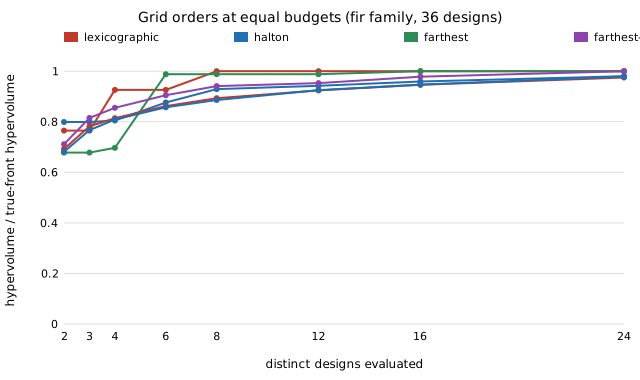
The grid orders from eda-gridorder are replayed on the MAC and FIR design families of eda-surrogate (36 designs each, Yosys cell count against analytic cycles; nothing new synthesised). Lexicographic is not reliably bad but arbitrary: worst on MAC (90% of the front’s hypervolume after 25 evaluations against 3–4 for the others), best on FIR (4 against 5–9), because it wins exactly when the front sits at the first corner of the leading axis. Farthest-point beat random from about 6 evaluations on every table and found FIR’s full front in 16 evaluations against 28 for random; Halton was mixed. The harness gains an order option on its grid proposer. Stylised: two small families, two objectives, deterministic orders are single draws.
A figure from its own output
Paper, code and results
More in Algorithmic chip-design loops
- Does the order a grid proposer walks a chip-design space change how quickly it finds the Pareto front?Does the order a grid walks a design space matter? The harness's lexicographic grid trails every random order to 30 evaluations; Halton reaches 90% of the front in 7 evaluations against 17 for random (stylised, one table, deterministic orders are single draws).
- Which search method finds a chip design's Pareto front with the fewest evaluations?Random, grid, annealing, GA, NSGA-II and TPE at equal budgets by Pareto hypervolume on an 80-design logged space: TPE and NSGA-II lead random from about 16 to 30 evaluations, annealing trails it (stylised, tiny space, untuned).
- Do cheap rungs of the chip-design tool ladder rank designs like synthesis, and how much synthesis time does screening save?A three-rung fidelity ladder (analytic model, RTL simulation, synthesis) over 40 logged designs: the free rung ranks the objective at Spearman 0.74, and successive halving finds the optimum at 20 s of tool time against 205 s to synthesise everything (stylised, toy design family, no place and route).
- Can cheap word-level RTL features predict synthesised cell counts well enough to screen a design search, and does that survive a new design family?A cell-count surrogate from cheap word-level RTL features over 133 designs in four generator families: 3.9% median error on families it saw (non-negative linear model), 11% to 210% on a held-out family with rank agreement staying at Spearman 0.75 to 1.00, and it cuts syntheses to find a near-best design in a 36-design pool from 12.4 to 1-5 (stylised, synthesis-only target, no place and route).
- How many synthesised designs from a new family does a cell-count surrogate need before it is usable, and is it better to pool them with old families or train on them alone?Few-shot adaptation of the
eda-surrogatecell-count model to an unseen design family: one synthesised design from the new family cuts the linear model's median error from 49% to 18%, training on the new family alone beats pooling from about three designs, boosted trees need about 12 (stylised, synthesis-only target, no place and route). - Which few designs of a new family should you synthesise to adapt a cell-count surrogate, and should they count for more?Which few designs of a new family to synthesise when adapting a cell-count surrogate: a farthest-point spread in feature space roughly halves the linear model's error against random draws at 5 designs (5.3% against 8.5%), the smallest designs are worst, and upweighting new points helps linear and ridge but not boosted trees (stylised, synthesis-only target).
All 42 Algorithmic chip-design loops projects →
Other research topics
Proper scoring & elicitation28Effort & peer prediction9Verification games & slashing19Detection & tolerances14Markets as routers13Prediction-market design9Paying contributors8Decentralised training systems23Digital twins & sim-to-real164LLM chip design loops40Robot manufacturing loops53Ambient AI assistant46Self-replicating manufacturing34Simulation-first design64Engineered clothing45Task-specific AI accelerators40Algorithmic chip-design loops42Open-source purpose-built robots44The software-engineering loop43Adversarial human imitation41Open-source residential construction41Autonomous multi-angle capture34Sensing, imaging and 3D31Energy supply and dense energy storage39Robot societies among people31Agentic co-design of low-cost robots27Laundry-hanging robots25Machine learning on qualitative data23Robots on the building site27Civilizations & group psychology1History & human sciences1
Produced with AI assistance (Claude). Results are from the code in this repository and are simulated or stylised unless the abstract says otherwise; nothing here implies affiliation with or endorsement by any lab, researcher or company cited. MIT licensed.