How much grinding energy does a classifier loop save at the same product size, and does a ball-mill population balance agree with Bond's law?
research/infra-grind
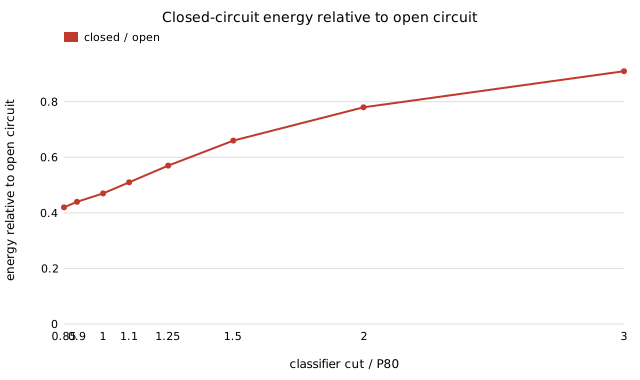
Ball-mill population balance (Austin form): at the same 100 um P80 a closed circuit at 278% circulating load uses 0.47 of the open-circuit energy, 1.8 to 3.7 times better across the swept mill and classifier inputs, far above Bond's 1.2 open-circuit factor and a vendor's ~10% for cement; the model's size exponent matches Bond's only at a selection exponent near 0.5.
What it found
A size-by-size ball-mill model (selection function Si = S1(xi/1 mm)α, Austin breakage function, three perfectly mixed tanks in series) with a Whiten classifier loop, solved by forward substitution and fixed-point iteration in the standard library. At the same 100 µm P80 from a 1500 µm feed, a closed circuit with the cut at P80 and 278 % circulating load uses 0.47 of the open-circuit energy (53 % saving); a coarser cut saves less (0.78 at cut = 2×P80, 35 % load). The saving is 1.8 to 3.7 times in energy ratio over tank number 1 to 10, classifier sharpness 2 to 8, bypass 0 to 0.3 and the breakage parameters; it does not collapse to the published figures: Bond’s open-circuit factor EF2 is 1.2 at 80 % passing and a vendor guide gives about 10 % for cement mills. That is reported as a discrepancy, with likely causes (slowing of fines, tested, does not close it; a mill flow limit of 1.5 to 2 times the open circuit’s feed, with that limit assumed rather than sourced, brings the fixed-power capacity advantage to 1.2 to 1.4; auxiliary power) rather than tuned away. The local size exponent of energy (E ∝ P80−m, 50 to 200 µm) runs from 0.60 to 1.27 over α 0.4 to 1.2 against Bond’s 0.68, so Bond’s law corresponds to α near 0.5 in this model. Absolute kWh/t is in model units (S1 was not fitted to a mill); every shape parameter is a typical value from memory of the Austin literature, swept, not measured.
A figure from its own output
Paper, code and results
More in Energy supply and dense energy storage
- How much rooftop PV can the IEEE 13-node feeder take before voltage binds, and which cheap measure adds the most?Stochastic PV hosting capacity of the IEEE 13-node feeder in OpenDSS on 300 random placements: median 1,015 kW at midday minimum load, voltage binds first in 75% of placements; a 2 V lower regulator set-point adds +310 kW, while inverter fixed power factor and volt-var add about nothing once the regulators respond (modelled, not a measured feeder).
- Does regulator set-point still beat inverter volt-var for PV hosting on the IEEE 34- and 123-node feeders?PV hosting capacity of the IEEE 34- and 123-node feeders in OpenDSS (200 random placements): on the 123-node feeder a 2 V lower regulator set-point adds +790 kW to a 1,160 kW median (every placement better), inverter volt-var +100 kW and fixed power factor +180 kW; the published 34-node case has no headroom at all because its source is set to 1.05 pu (modelled, not measured feeders); over a one-minute day the set-point trades overvoltage for undervoltage while inverter reactive power cuts tap operations about 30 %.
- How much does model-predictive heating and cooling save over a thermostat on a time-of-use tariff, when the model and forecast are wrong?Does MPC beat a thermostat for a heat pump on a time-of-use tariff? On real TMY3 weather with a deliberately wrong model and yesterday's weather as the forecast it pays 10.7% less in Greensboro (4.1% in cold Sand Point), saves more with more thermal mass (6.5% to 25%), and loses the gain at an 8 K forecast error; the envelope is from published values, not a fit to measured data.
- Does a DC screen find the N-1 outages an AC power flow flags?DC against AC N-1 screening on IEEE 14-, 30-, 39-, 57- and 118-bus cases (every line and transformer outage, modelled, ratings swept): at 25 % rating headroom the DC screen misses 13 to 40 % of the outages an AC power flow calls insecure; flagging at 0.8 of rating misses none, at the cost of 102 false alarms on case118 (186 outages).
- Do nodal loss penalty factors repair the DC OPF's merit order on the IEEE 30-, 39- and 118-bus cases?Nodal loss penalty factors (AC loss sensitivities) in a DC OPF on the IEEE 30-, 39- and 118-bus cases: on the 118-bus case they recover 23 to 38 % of plain DC's excess cost at 0.6 to 1.0 of load, but the iteration does not converge at 0.8 and above and at 1.1 of load the dispatch is worse than plain DC (modelled benchmark, not a measured system).
- Which freight modes can run on batteries or hydrogen, and what does it cost in payload?Freight energy per tonne-km from first principles for truck, unit train, bulk carrier and 747 freighter, then diesel swapped for batteries or hydrogen at the same gross mass and range: at 250 Wh/kg a truck keeps 79% of its payload, a train 93%, a ship 55% and the freighter cannot fly the route; 90% needs ~510, 180, 990 and 5,600 Wh/kg (most inputs assumed and swept).
All 39 Energy supply and dense energy storage projects →
Other research topics
Proper scoring & elicitation28Effort & peer prediction9Verification games & slashing19Detection & tolerances14Markets as routers13Prediction-market design9Paying contributors8Decentralised training systems23Digital twins & sim-to-real164LLM chip design loops40Robot manufacturing loops53Ambient AI assistant46Self-replicating manufacturing34Simulation-first design64Engineered clothing45Task-specific AI accelerators40Algorithmic chip-design loops42Open-source purpose-built robots44The software-engineering loop43Adversarial human imitation41Open-source residential construction41Autonomous multi-angle capture34Sensing, imaging and 3D31Energy supply and dense energy storage39Robot societies among people31Agentic co-design of low-cost robots27Laundry-hanging robots25Machine learning on qualitative data23Robots on the building site27Civilizations & group psychology1History & human sciences1
Produced with AI assistance (Claude). Results are from the code in this repository and are simulated or stylised unless the abstract says otherwise; nothing here implies affiliation with or endorsement by any lab, researcher or company cited. MIT licensed.