Which freight modes can run on batteries or hydrogen, and what does it cost in payload?
research/infra-propulsion
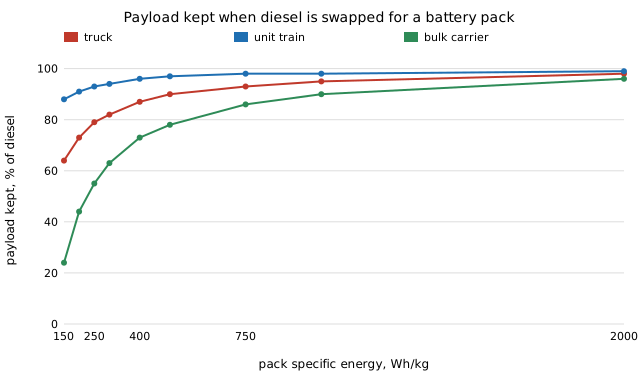
Freight energy per tonne-km from first principles for truck, unit train, bulk carrier and 747 freighter, then diesel swapped for batteries or hydrogen at the same gross mass and range: at 250 Wh/kg a truck keeps 79% of its payload, a train 93%, a ship 55% and the freighter cannot fly the route; 90% needs ~510, 180, 990 and 5,600 Wh/kg (most inputs assumed and swept).
What it found
A force-balance model of four freight modes (truck rolling plus air drag, Davis train resistance, Admiralty-law ship, aircraft at L/D) gives the cruise-only floor of 0.50, 0.10, 0.035 and 4.4 MJ of fuel per net tonne-km. Swapping the store at fixed gross mass and range: a 250 Wh/kg pack leaves a truck (800 km) 79 % of its diesel payload, a unit train (1,500 km) 93 %, a Panamax bulk carrier (20,000 km) 55 %, and a 747-400F cannot reach 8,250 km (669 km at zero payload). Keeping 90 % of the payload needs about 510, 180, 990 and 5,600 Wh/kg; 700-bar hydrogen keeps 95, 98 and 90 % on the first three, liquid hydrogen 90 % on the aircraft. Checks: a Semi-like truck gives 1.76 against a rated 1.7 kWh/mile (+4 %, assumed inputs); the diesel truck floor is 7.6 mpg against 5.5–6.5 for fleets; the train model reaches 0.46–0.61 of the FHWA rail figure because grades, stops and idling are not modelled. Limits: most drag, efficiency and tank-fraction inputs are assumed and only partly swept; vehicle structure mass is held fixed; no reserves, volume limits, cost or charging.
A figure from its own output
Paper, code and results
More in Energy supply and dense energy storage
- How much of a pump-scheduling saving survives when one hot day sets the month's demand charge?Net3 pump schedules billed on PG&E B-19 over a month of varying days: with every day the same the best schedule saves 56 to 67 %, but the lowest feasible peak jumps from 63 kW to the 310 kW booster at only 1.5 % more demand, and one day at +20 % cuts the saving to 44 % (summer) and 19 % (winter, spring) (simulated; one network, list prices).
- Does a real demand charge change when a water utility should run its pumps?Net3 pump scheduling billed on PG&E's published B-19 tariff with demand charges at a 15-minute step: the lake-pump schedules that idle the 310 kW booster cut the monthly bill 56 to 67 % (peak 373 to 63 kW), and the demand charge, 60 to 64 % of the shipped bill, does not move the optimal schedule at any size from 0 to 20 times (simulated; one network, list prices).
- When should a water utility run its lake pump, and how much of the saving is the tariff?Pump scheduling on EPANET's Net3 (WNTR): running the lake pump 21 h from 01:00 cuts pumping energy 52 % at a flat tariff because it idles the booster pump; the time-of-use tariff adds 3 to 16 % of cost at a ratio of 3 or less, and hourly on/off schedules (21,806 simulated, plus a GA) add almost nothing beyond one window once tank drawdown is priced (simulated, assumed tariff shapes).
- How much heat-pump and EV load growth wears out a distribution transformer, and how much does smart charging buy back?Distribution transformer ageing under heat-pump and EV growth: an IEEE C57.91-form thermal model on TMY weather and a standard load profile; loss of life stays under 0.01%/yr until ~50% of homes electrify, then 5.6%/yr at 100% with uncoordinated charging against 1.07%/yr with valley-filled charging (constants swept, not verified).
- How big should a home's solar array and battery be, and at what installed price does the battery pay?How big should a home's solar array and battery be, and at what price does the battery pay? Hourly model on synthetic weather (assumed inputs): a 6 kW array meets 35% of an 8,000 kWh/yr load, a 10 kWh battery lifts it to 59%, and the battery pays only below about $451/kWh installed at $0.05 export (assumed price $800).
- Does time-of-use pricing make a home battery pay, and which size?Does time-of-use pricing make a home battery pay, and which size? On an assumed tariff with the flat tariff's average, a 10 kWh battery behind 6 kW PV breaks even at $641/kWh installed against $444 flat (assumed price $800); only 2.5 to 5 kWh clears $800, and the peak price steers the answer (
energy-homewith hourly prices).
All 39 Energy supply and dense energy storage projects →
Other research topics
Proper scoring & elicitation28Effort & peer prediction9Verification games & slashing19Detection & tolerances14Markets as routers13Prediction-market design9Paying contributors8Decentralised training systems23Digital twins & sim-to-real164LLM chip design loops40Robot manufacturing loops53Ambient AI assistant46Self-replicating manufacturing34Simulation-first design64Engineered clothing45Task-specific AI accelerators40Algorithmic chip-design loops42Open-source purpose-built robots44The software-engineering loop43Adversarial human imitation41Open-source residential construction41Autonomous multi-angle capture34Sensing, imaging and 3D31Energy supply and dense energy storage39Robot societies among people31Agentic co-design of low-cost robots27Laundry-hanging robots25Machine learning on qualitative data23Robots on the building site27Civilizations & group psychology1History & human sciences1
Produced with AI assistance (Claude). Results are from the code in this repository and are simulated or stylised unless the abstract says otherwise; nothing here implies affiliation with or endorsement by any lab, researcher or company cited. MIT licensed.