How much of an optimal home-battery controller's gain survives a realistic forecast?
research/energy-tou-lp-forecast
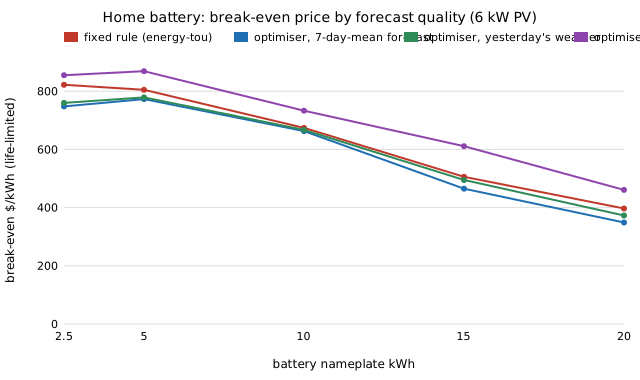
How much of an optimal home-battery controller's gain survives a realistic forecast? With yesterday's weather or a 7-day mean as the forecast, a rolling LP saves $726 or $691 a year against the fixed rule's $694 (perfect forecast: $892); 84–101% of the gain is lost (energy-tou-lp with forecasts).
What it found
Re-runs the rolling 36 h linear program of energy-tou-lp with forecasts built only from hours already observed (yesterday's weather, or the mean of the last seven days) and executes the plan on the actual PV and load, over 10 seeded synthetic weather years and the same assumed tariff. For 10 kWh behind 6 kW PV the perfect-forecast optimiser saves $892 a year against the best fixed rule's $694; with yesterday's weather it saves $726 and with a seven-day mean $691, so 84–101% of the optimiser's gain over the rule is lost. Life-limited break-even is $667 and $663/kWh against the rule's $674 and the perfect $733. Forecasts of the truth with 10% and 25% multiplicative noise keep 75% and 39% of the gain; at 100% noise the optimiser is worse than the rule. Stylised: assumed tariff, synthetic weather and load, forecast methods naive, noise abstract, crude cycle-count life.
A figure from its own output
Paper, code and results
More in Energy supply and dense energy storage
- How much of the home-battery optimiser's forecast loss does re-planning every few hours recover?How much of the home-battery optimiser's forecast loss does re-planning every few hours recover? On PVGIS typical-year data for three US sites, re-planning the LP every 3–12 h instead of daily adds $10–36 a year and closes at most 17 points of the gap to a perfect forecast (10 kWh, assumed tariff);
energy-tou-lp-tmywith receding-horizon re-planning. - Does a clear-sky-index forecast rescue the optimal home-battery controller on real weather?Does a clear-sky-index forecast rescue the optimal home-battery controller on real weather? On PVGIS typical-year data for three US sites, a rolling LP fed yesterday's weather or a clear-sky-index forecast keeps 25–55% of the perfect-forecast gain over the fixed rule at Phoenix and Seattle and none of it at Golden (10 kWh, assumed tariff);
energy-tou-lp-forecaston measured-derived irradiance. - How wrong is the DC approximation of optimal power flow on the IEEE 30-, 39- and 118-bus cases?DC against AC optimal power flow in pandapower on the IEEE 30-, 39- and 118-bus cases: the DC model's cost is 1 to 3 % below the AC optimum (it ignores losses); on the 118-bus case its dispatch is feasible but costs 0.7 to 1.7 % more than the AC optimum once losses are paid, and on the 39-bus case it breaks voltage limits (15 buses at 0.6 of load) at almost no cost difference (modelled benchmark, not a measured system; tightened-limit runs often had no solution). Feeding the AC losses back into the DC model (a loss-adjusted DC) brings the 118-bus cost estimate to within 0.6 to 1.2 % of the AC optimum, but repairs only 13 to 32 % of the dispatch's excess cost and none of case39's voltage violations.
- How much grinding energy does a classifier loop save at the same product size, and does a ball-mill population balance agree with Bond's law?Ball-mill population balance (Austin form): at the same 100 um P80 a closed circuit at 278% circulating load uses 0.47 of the open-circuit energy, 1.8 to 3.7 times better across the swept mill and classifier inputs, far above Bond's 1.2 open-circuit factor and a vendor's ~10% for cement; the model's size exponent matches Bond's only at a selection exponent near 0.5.
- How much rooftop PV can the IEEE 13-node feeder take before voltage binds, and which cheap measure adds the most?Stochastic PV hosting capacity of the IEEE 13-node feeder in OpenDSS on 300 random placements: median 1,015 kW at midday minimum load, voltage binds first in 75% of placements; a 2 V lower regulator set-point adds +310 kW, while inverter fixed power factor and volt-var add about nothing once the regulators respond (modelled, not a measured feeder).
- Does regulator set-point still beat inverter volt-var for PV hosting on the IEEE 34- and 123-node feeders?PV hosting capacity of the IEEE 34- and 123-node feeders in OpenDSS (200 random placements): on the 123-node feeder a 2 V lower regulator set-point adds +790 kW to a 1,160 kW median (every placement better), inverter volt-var +100 kW and fixed power factor +180 kW; the published 34-node case has no headroom at all because its source is set to 1.05 pu (modelled, not measured feeders); over a one-minute day the set-point trades overvoltage for undervoltage while inverter reactive power cuts tap operations about 30 %.
All 39 Energy supply and dense energy storage projects →
Other research topics
Proper scoring & elicitation28Effort & peer prediction9Verification games & slashing19Detection & tolerances14Markets as routers13Prediction-market design9Paying contributors8Decentralised training systems23Digital twins & sim-to-real164LLM chip design loops40Robot manufacturing loops53Ambient AI assistant46Self-replicating manufacturing34Simulation-first design64Engineered clothing45Task-specific AI accelerators40Algorithmic chip-design loops42Open-source purpose-built robots44The software-engineering loop43Adversarial human imitation41Open-source residential construction41Autonomous multi-angle capture34Sensing, imaging and 3D31Energy supply and dense energy storage39Robot societies among people31Agentic co-design of low-cost robots27Laundry-hanging robots25Machine learning on qualitative data23Robots on the building site27Civilizations & group psychology1History & human sciences1
Produced with AI assistance (Claude). Results are from the code in this repository and are simulated or stylised unless the abstract says otherwise; nothing here implies affiliation with or endorsement by any lab, researcher or company cited. MIT licensed.