Does a rewritten adder or multiplier still beat the reference once the ABC script is allowed to vary?
research/chip-ppa-script
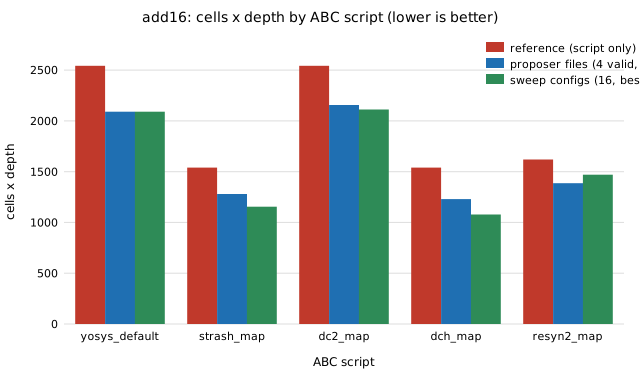
Re-scores the chip-ppa-loop rewrites and sweep under five ABC scripts with every mapped netlist proved equivalent: the adder rewrite gain survives (0.80–0.86× the reference per script) but the multiplier's whole gain is the script (stylised, generic-gate).
What it found
A follow-up to chip-abc-sweep and chip-ppa-loop: the earlier proposer files and a 16-adder and 8-multiplier sweep are scored under five ABC scripts, and every mapped netlist is proved equivalent to its reference (none failed). For the adder the best rewrite is 0.80–0.86× the reference under the same script, but the reference under its best script is already 0.61× its default score, so much of the headline gain was the script. For the multiplier no rewrite beats a * b under any script; the only gain (0.90×) is from the script. Stylised: two designs, one Yosys version, a session-written proposer, generic-gate counts rather than layout.
A figure from its own output
Paper, code and results
More in LLM chip design loops
- Does an equivalence-gated rewrite loop beat a parameter sweep on popcount, leading-zero count and absolute difference?Equivalence-gated rewrites of 16-bit popcount, 16-bit leading-zero count and 8-bit |a−b| against a no-model sweep: popcount 0.98×, |a−b| 0.86×, but on leading-zero count the sweep (0.56×) beats the session-written rewrites (0.80×) in 168 of 200 equal-budget draws (stylised, gate counts).
- Does the rewrite-versus-sweep verdict for a 16-bit leading-zero count survive five ABC scripts?Re-scores
chip-ppa-logic's popcount, leading-zero-count and |a−b| candidates under five ABC scripts with every mapped netlist proved equivalent: the clz16 sweep-versus-rewrite verdict flips with the script (best 0.35× the reference); stylised, generic gates. - Does fusing the accumulate into the partial-product tree beat multiply-then-add once the ABC script varies?A fused 4×4 multiply-accumulate: no written rewrite beats
a*b+cunder the default or three of five ABC scripts, but carry-save forms win by up to 9% cells×depth underdchandresyn2(stylised, generic-gate). - Do the carry-save multiply-accumulate rewrites still win once mapped to real SKY130 cells, and does the generic-gate score predict that?The
chip-ppa-maccarry-save MAC rewrites mapped to SKY130 HD cells: the plaina*b+cunder its best script is the overall best, the generic-gate score ranks candidates only weakly like cell areaxdelay (Spearman 0.20; stylised, ABC delay estimate). - How rugged is the landscape of SKY130 area×delay over ABC pass sequences for a multiply-accumulate, and do simple searches beat random at 10–40 evaluations?An exhaustive 800-point table of SKY130 areaxdelay over ABC pass sequences for the MAC (optimum 11% below the best earlier script; needle-like landscape), with random search, hill climbing and session-written proposals compared at equal budget (stylised, preliminary).
- How do MAC-lane count and bit width trade area against latency in a tiny quantised-MLP accelerator?Parameterised MAC-lane accelerator for an 8-8-4 quantised MLP, bit- and cycle-exact against NumPy in Icarus; lanes x bit-width sweep puts the cells-times-cycles minimum at 4 lanes (stylised, generic-gate counts).
All 40 LLM chip design loops projects →
Other research topics
Proper scoring & elicitation28Effort & peer prediction9Verification games & slashing19Detection & tolerances14Markets as routers13Prediction-market design9Paying contributors8Decentralised training systems23Digital twins & sim-to-real164LLM chip design loops40Robot manufacturing loops53Ambient AI assistant46Self-replicating manufacturing34Simulation-first design64Engineered clothing45Task-specific AI accelerators40Algorithmic chip-design loops42Open-source purpose-built robots44The software-engineering loop43Adversarial human imitation41Open-source residential construction41Autonomous multi-angle capture34Sensing, imaging and 3D31Energy supply and dense energy storage39Robot societies among people31Agentic co-design of low-cost robots27Laundry-hanging robots25Machine learning on qualitative data23Robots on the building site27Civilizations & group psychology1History & human sciences1
Produced with AI assistance (Claude). Results are from the code in this repository and are simulated or stylised unless the abstract says otherwise; nothing here implies affiliation with or endorsement by any lab, researcher or company cited. MIT licensed.