How much does a smooth copy-then-sell policy beat a single switch for the replicating shop, certified without interpolation?
research/selfrep-exactdp
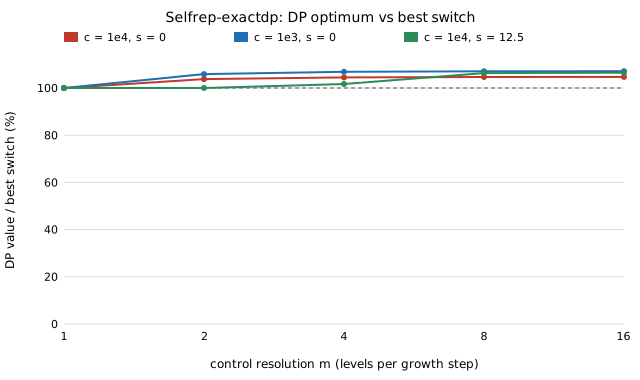
An interpolation-free DP (the table equals its own policy's value to 1e-14): with no resale value and a saturating market a three-phase policy beats the best single switch by 4.7% (c = 1e4) to 7.1% (c = 1e3), while a resale value of 50 makes one switch optimal; a stylised fluid model, preliminary.
What it found
Follow-up to selfrep-dpgrid, whose DP table sat 2–13% below the value of its own policy. This project chooses a control set whose steps land exactly on a geometric fleet grid, so no interpolation is needed and the table equals the policy value to 1e-14. On the same fluid model (W = 50 h, failure 0, horizon 600 h, all inputs assumed) a single copy-then-goods switch is optimal when machines keep a resale value of 50 each. With no resale value and a saturating goods market, a three-phase policy (full copying, an intermediate share, then goods) beats the best switch by 4.7% (capacity 1e4) and 7.1% (capacity 1e3); with a resale value of 12.5 and capacity 1e4 the gain is 6.5%, and only appears once the control set is fine enough. Stylised, with a fixed Euler step and no cash constraint; preliminary.
A figure from its own output
Paper, code and results
More in Self-replicating manufacturing
- How does a falling resale price for the finished fleet change when the shop stops copying?A resale price for the finished fleet that falls with market depth
m(stylised): with an unsaturated goods market the switch moves from 574 h (linear) to 549 h (m = 1e3) and a single switch matches the DP; with a saturating goods market the DP beats the best switch by up to 14%. - How much do the RepRap closure numbers depend on which parts a shop is judged able to make?How much the RepRap closure numbers depend on which parts a shop is judged able to make (stylised, assumed inputs): buying all optimistic lines cuts mass closure from 22% to 17%; making the motors in-house would add 22 points.
- Does sharing part jobs across printers make a replicating printer shop double faster than one copy per printer?Does sharing part jobs across printers beat one copy per printer (stylised, assumed inputs): a pool serving the oldest copy first doubles in 43.2 h against 51.1 h with no import limit, about half the gap to the fluid 34.7 h; with imports binding all policies agree.
- How many parts should a replicating printer print per plate to double its shop fastest?How many parts per print plate double a replicating printer shop fastest (stylised, assumed inputs): with no changeover one part per plate wins (43.2 h doubling), with 0.25 h per plate four parts (46.4 h), with 0.5 to 1 h eleven parts; pooled fleets stay 7.6 to 15.5% ahead of one copy per printer.
- How much of a RepRap printer can a growing seed shop make itself?Part, mass and cost closure of the RepRap Prusa Mendel (iteration 2) for three seed shops: printer alone makes 18 of 51 part lines (35%), plus router and laser 43%, assumed-mass closure 22%; casting helps only with brass bushings. Mass and cost inputs assumed. Stylised.
- Which machine should a seed shop add next, and does a greedy rule find it?Which machine a printer-only seed shop should add next under a budget: greedy closure-per-price vs exhaustive search; same choice on the real 3-machine instance, optimal in 72–94% of 500 synthetic instances. Machine prices assumed. Stylised.
All 34 Self-replicating manufacturing projects →
Other research topics
Proper scoring & elicitation28Effort & peer prediction9Verification games & slashing19Detection & tolerances14Markets as routers13Prediction-market design9Paying contributors8Decentralised training systems23Digital twins & sim-to-real164LLM chip design loops40Robot manufacturing loops53Ambient AI assistant46Self-replicating manufacturing34Simulation-first design64Engineered clothing45Task-specific AI accelerators40Algorithmic chip-design loops42Open-source purpose-built robots44The software-engineering loop43Adversarial human imitation41Open-source residential construction41Autonomous multi-angle capture34Sensing, imaging and 3D31Energy supply and dense energy storage39Robot societies among people31Agentic co-design of low-cost robots27Laundry-hanging robots25Machine learning on qualitative data23Robots on the building site27Civilizations & group psychology1History & human sciences1
Produced with AI assistance (Claude). Results are from the code in this repository and are simulated or stylised unless the abstract says otherwise; nothing here implies affiliation with or endorsement by any lab, researcher or company cited. MIT licensed.