How much error in a cheap objective can design-search proposers tolerate before they stop beating random search?
research/eda-noisy
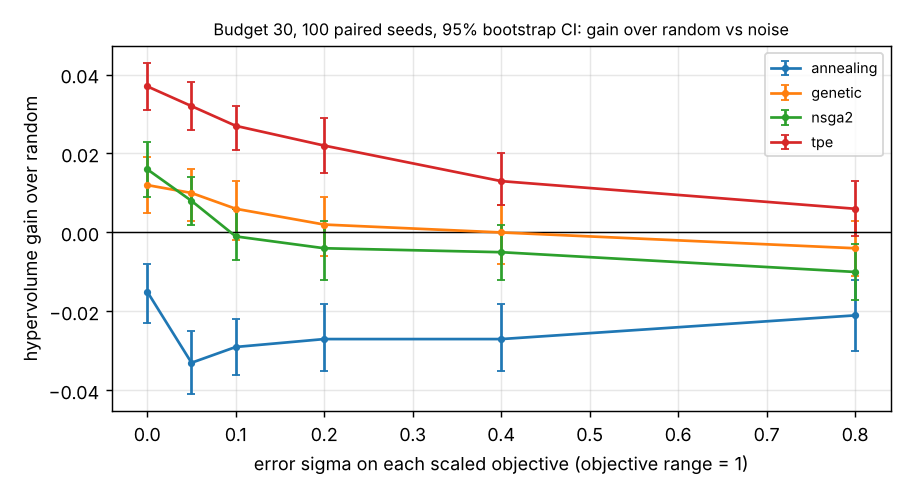
With Gaussian error on the objectives a proposer sees, TPE's budget-30 lead over random falls from +0.037 to +0.006 (gone at error 0.8 of the objective range), NSGA-II and the genetic method lose theirs by 0.1, annealing is never better (stylised, synthetic noise, one 80-design space).
What it found
The proposers of eda-proposers are shown objectives with Gaussian error (sigma 0 to 0.8 of each objective’s range, fixed per design) and scored on the true objectives, 100 paired seeds. At budget 30 TPE’s gain over random falls from +0.037 to +0.022 (sigma 0.2), +0.013 (0.4) and +0.006 (0.8, interval includes 0). NSGA-II and the genetic method are no better than random from sigma 0.1; annealing is worse than random at every sigma. Stylised: synthetic independent noise, one 80-design table, generic-gate cell counts, no place and route.
A figure from its own output
Paper, code and results
More in Algorithmic chip-design loops
- Does the ranking of design-search proposers survive a change of hypervolume reference point or quality indicator?TPE stays best under five hypervolume reference points, recall, IGD+ and epsilon, but its lead over random at budget 30 ranges from +0.045 to +0.002 with the reference point (stylised, one 80-design space).
- How much of a surrogate screen’s lead over random search comes from the free objectives?A random search that uses the free cycles/error objectives reaches 0.901 of the true front's hypervolume at 12 syntheses (random 0.860, screen 0.990), so +0.04 of the screen's lead is the free objectives and +0.09 the cell-count surrogate (stylised, one 80-design space).
- Can a cost model trained on other chip-design families screen a new family’s Pareto front with a handful of syntheses?A Pareto screen whose cell-count model was trained only on other design families reaches 0.94 to 0.98 of the true front's hypervolume with 3 Yosys syntheses (random about 0.65), though the model's absolute error is large; ranking is what matters (stylised, MAC and FIR spaces of 27 designs).
- Does the best ABC recipe for one design transfer to another?All 400 ABC pass sequences on eight small SKY130-mapped designs: one design's best recipe scores a mean 1.31× the other's optimum, and a transferred warm start helps only one design (stylised, toy designs, no place and route).
- How many injected RTL bugs do random, coverage-directed and formal checks catch, and at what cost?Mutation study of random, coverage-directed and bounded-formal RTL checks on the MAC accelerator: 64 random vectors kill 99% of killable mutants, formal 71% (timeouts), at ~50x the CPU cost (stylised).
- In what order should an automated design loop run random, directed and formal checks?Replays the eda-verify mutation log to cost check cascades: random simulation before formal cuts CPU by 54% with more kills; the order among cheap stages barely matters (stylised re-analysis).
All 42 Algorithmic chip-design loops projects →
Other research topics
Proper scoring & elicitation28Effort & peer prediction9Verification games & slashing19Detection & tolerances14Markets as routers13Prediction-market design9Paying contributors8Decentralised training systems23Digital twins & sim-to-real164LLM chip design loops40Robot manufacturing loops53Ambient AI assistant46Self-replicating manufacturing34Simulation-first design64Engineered clothing45Task-specific AI accelerators40Algorithmic chip-design loops42Open-source purpose-built robots44The software-engineering loop43Adversarial human imitation41Open-source residential construction41Autonomous multi-angle capture34Sensing, imaging and 3D31Energy supply and dense energy storage39Robot societies among people31Agentic co-design of low-cost robots27Laundry-hanging robots25Machine learning on qualitative data23Robots on the building site27Civilizations & group psychology1History & human sciences1
Produced with AI assistance (Claude). Results are from the code in this repository and are simulated or stylised unless the abstract says otherwise; nothing here implies affiliation with or endorsement by any lab, researcher or company cited. MIT licensed.