Does the best ABC recipe for one design transfer to another?
research/eda-flowtune
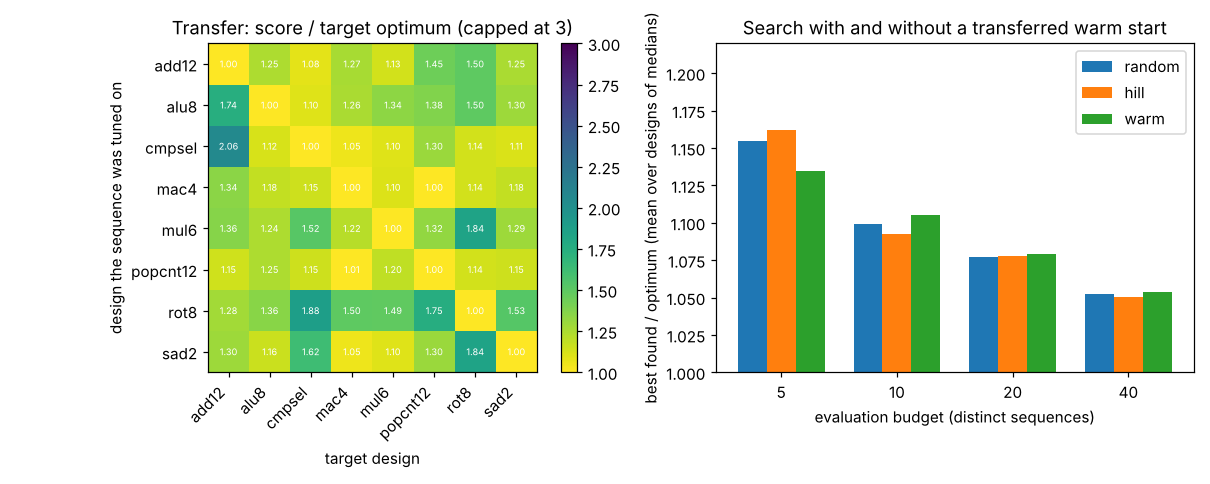
All 400 ABC pass sequences on eight small SKY130-mapped designs: one design's best recipe scores a mean 1.31× the other's optimum, and a transferred warm start helps only one design (stylised, toy designs, no place and route).
What it found
All 400 ABC pass sequences (up to three passes of seven) mapped to SKY130 on eight small datapath designs, so every optimum is known. The best recipe differs per design and transfers badly: one design’s best recipe scores a mean 1.31× (worst 2.06×) the other’s optimum, and score rankings of recipes correlate only weakly across designs (Spearman −0.51 to 0.46). A leave-one-out consensus recipe is only slightly better than a median sequence (1.22× against 1.26×), and warm-starting a hill climber with it helps one design (mac4) but is within noise of random search on average at budgets 10 to 40. Stylised: eight hand-picked toy designs, ABC’s static delay, no place and route; the OpenROAD-settings half of the milestone is not done.
A figure from its own output
Paper, code and results
More in Algorithmic chip-design loops
- How many injected RTL bugs do random, coverage-directed and formal checks catch, and at what cost?Mutation study of random, coverage-directed and bounded-formal RTL checks on the MAC accelerator: 64 random vectors kill 99% of killable mutants, formal 71% (timeouts), at ~50x the CPU cost (stylised).
- In what order should an automated design loop run random, directed and formal checks?Replays the eda-verify mutation log to cost check cascades: random simulation before formal cuts CPU by 54% with more kills; the order among cheap stages barely matters (stylised re-analysis).
- When can a check cascade stop formal verification early without losing kills?Replays the eda-verify log with a time cap on formal: a 170 s cap loses no kill and saves 41% of cascade CPU but forfeits every equivalence proof; a 230 s cap keeps 15 of 16 proofs and saves 23% (stylised re-analysis).
- Can cheap features say which simulation survivors formal can prove equivalent?Predicts from the mutated source line which simulation survivors formal can prove equivalent: nearest-line prediction cuts formal CPU 55% and finds 14 of 16 proofs on one design (stylised, 27 mutants).
- How sure is the 93% nearest-line equivalence predictor?Puts a line-clustered interval on eda-equivpredict's 93%: 25 of 27 survivors right, 95% CI 76.5–100% over 11 distinct lines, permutation p = 0.012 (stylised, one design).
- Does "the mutant synthesises to the golden netlist" predict formal equivalence on a second design family?Tests whether an identical post-synthesis netlist predicts formal equivalence on a second design (systolic array) as well as the MAC engine: right 3 of 3 times but finds only 3 of 28 proved equivalents (stylised, two designs).
All 42 Algorithmic chip-design loops projects →
Other research topics
Proper scoring & elicitation28Effort & peer prediction9Verification games & slashing19Detection & tolerances14Markets as routers13Prediction-market design9Paying contributors8Decentralised training systems23Digital twins & sim-to-real164LLM chip design loops40Robot manufacturing loops53Ambient AI assistant46Self-replicating manufacturing34Simulation-first design64Engineered clothing45Task-specific AI accelerators40Algorithmic chip-design loops42Open-source purpose-built robots44The software-engineering loop43Adversarial human imitation41Open-source residential construction41Autonomous multi-angle capture34Sensing, imaging and 3D31Energy supply and dense energy storage39Robot societies among people31Agentic co-design of low-cost robots27Laundry-hanging robots25Machine learning on qualitative data23Robots on the building site27Civilizations & group psychology1History & human sciences1
Produced with AI assistance (Claude). Results are from the code in this repository and are simulated or stylised unless the abstract says otherwise; nothing here implies affiliation with or endorsement by any lab, researcher or company cited. MIT licensed.