Can a library-free delay estimate rank accelerator designs by SKY130 critical-path delay better than logic depth?
research/eda-delayproxy
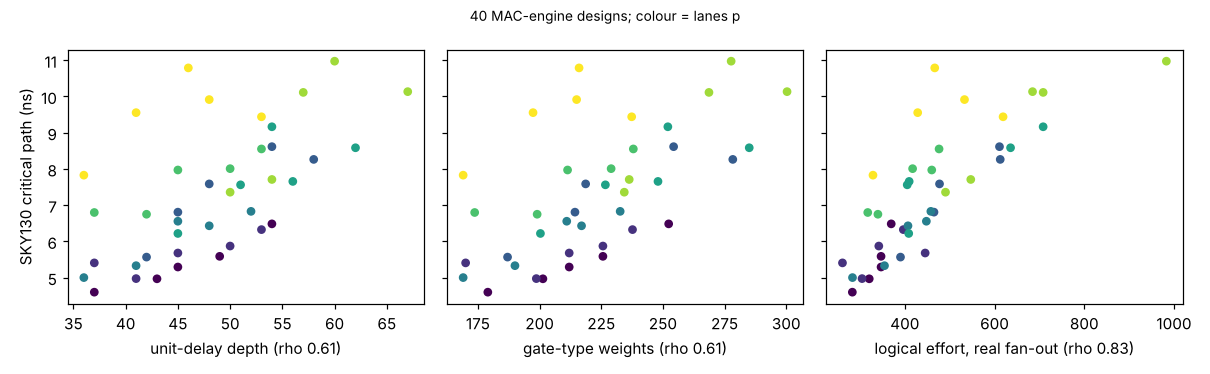
Library-free delay proxies on the generic gate netlist of the 40 MAC engines: gate-type weights leave depth's Spearman 0.611 against SKY130-mapped delay unchanged (0.609), adding fan-out lifts it to 0.83 to 0.90, but gate count alone reaches 0.911, and no proxy recovers the true (area, latency) front.
What it found
eda-sky130rung found that generic logic depth ranks SKY130-mapped critical-path delay at only Spearman 0.611 over 40 MAC-engine designs. This project computes cheap delay proxies on the same generic gate netlist (Yosys 0.33 write_json) and ranks them against the mapped delay: weighting gates by type (logical-effort constants from Sutherland, Sproull and Harris 1999) changes nothing (0.609), while adding fan-out lifts agreement to 0.83 (logical effort with real fan-out) and 0.90 (a type-blind fan-out model). Gate count alone reaches 0.911, so on this family delay is largely size. All 200 random re-weightings of gate types beat unit depth (0.667 to 0.911). Replacing the mapped delay by any proxy in area × cycles × delay finds the same best design but misses the 5-bit design the true (area, latency) front gains (3 of 4 front members for every proxy). Limits: one design family, one ABC script, mapped delay from ABC stime without wires or place and route; the 0.5 fan-out coefficient is not sourced; not sign-off.
A figure from its own output
Paper, code and results
More in Algorithmic chip-design loops
- How many random vectors does it take to see an RTL bug, and what can 1,280 clean vectors not rule out?Per-vector detection probabilities of the eda-verify mutants: a geometric model fits the random-vector miss rate within 0.005, predicts 45 vectors for a 1% miss, and 1,280 clean vectors cannot rule out a bug rarer than 0.0023 per vector (stylised re-analysis).
- Can RTL checks that need no golden reference model catch the bugs a design loop injects?Five golden-free properties (latency, done pulse, output hold, start-glitch and reset-abort invariance) kill 22 of the 66 killable eda-verify mutants, all control-flow bugs, and none of the 15 ROM or other datapath bugs; the 16 directed vectors catch all 22 too.
- How many SKY130 mappings does a generic-gate screen need to find the best area × latency design?A generic-gate cells × cycles screen puts the best SKY130 area × latency design first among 40 MAC engines; over random pools of 20, mapping 3 designs finds the pool's best 97% of the time, against 15% for random choice.
- Does ABC's pre-layout delay and area view of 40 MAC engines survive placement and timing repair on SKY130?The 40 MAC engines placed with the pip OpenROAD wheel: ABC area still ranks placed area (Spearman 0.997+), ABC delay only 0.61 to 0.80, wires add a median 36% to the period, and no design ABC calls feasible at 5 ns meets it after placement.
- Does a cheap rung's rank correlation with the expensive rung predict how well it works as a top-k screen?Across 207 cheap screens of 40 MAC engines, Spearman agreement with SKY130-mapped latency does not predict top-k screening payoff (−0.13 at k = 1): the highest-Spearman screen (0.958) maps the best design first 32% of the time, gate count (0.551) 69%; for area × latency it does (0.60).
- If a design search only sees generic-gate numbers, does it find a worse SKY130 Pareto front?Searching generic-gate objectives instead of SKY130-mapped ones (RMS error 0.036 on area, 0.123 on latency) costs within 0.01 of hypervolume on the 40 MAC-engine designs, and TPE's +0.037 lead over random at budget 20 is unchanged.
All 42 Algorithmic chip-design loops projects →
Other research topics
Proper scoring & elicitation28Effort & peer prediction9Verification games & slashing19Detection & tolerances14Markets as routers13Prediction-market design9Paying contributors8Decentralised training systems23Digital twins & sim-to-real164LLM chip design loops40Robot manufacturing loops53Ambient AI assistant46Self-replicating manufacturing34Simulation-first design64Engineered clothing45Task-specific AI accelerators40Algorithmic chip-design loops42Open-source purpose-built robots44The software-engineering loop43Adversarial human imitation41Open-source residential construction41Autonomous multi-angle capture34Sensing, imaging and 3D31Energy supply and dense energy storage39Robot societies among people31Agentic co-design of low-cost robots27Laundry-hanging robots25Machine learning on qualitative data23Robots on the building site27Civilizations & group psychology1History & human sciences1
Produced with AI assistance (Claude). Results are from the code in this repository and are simulated or stylised unless the abstract says otherwise; nothing here implies affiliation with or endorsement by any lab, researcher or company cited. MIT licensed.