Does letting Yosys share a common a + b make adders smaller under every ABC script?
research/chip-sharesign
Tests whether letting Yosys share a common a + b shrinks adders: fewer cells in 54 of 55 design/script pairs but often deeper; stylised, Yosys 0.33.
What it found
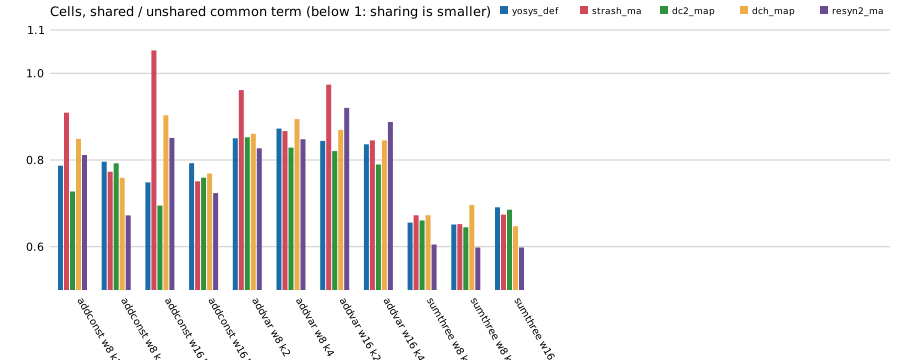
Eleven small adder-shaped designs whose outputs all contain a + b are written once so opt_merge shares the sum and once so it cannot (each pair proved equivalent). Scored under five ABC scripts, sharing gives fewer cells in 54 of 55 pairs (median ratio 0.76–0.85), but is deeper in 6–9 of 11 designs, so cells × depth favours it in 7–9 of 11. The sign flip seen on the 16-bit carry-select adder in chip-abc-orderpass does not appear. Stylised: generic gates, Yosys 0.33, no place and route.
A figure from its own output
Paper, code and results
More in LLM chip design loops
- Does writing the shared a + b sum of a carry-select adder explicitly change what Yosys and ABC synthesise?Writing the shared
a + bsum of a carry-select adder by hand (explicitly, or as an incrementer) gives the same netlist Yosys already finds; attaching the constant tobfirst defeats the sharing and is 17-22% smaller under ABC's optimising scripts (stylised, Yosys 0.33). - Does a rewritten adder or multiplier still beat the reference once the ABC script is allowed to vary?Re-scores the
chip-ppa-looprewrites and sweep under five ABC scripts with every mapped netlist proved equivalent: the adder rewrite gain survives (0.80–0.86× the reference per script) but the multiplier's whole gain is the script (stylised, generic-gate). - Does an equivalence-gated rewrite loop beat a parameter sweep on popcount, leading-zero count and absolute difference?Equivalence-gated rewrites of 16-bit popcount, 16-bit leading-zero count and 8-bit |a−b| against a no-model sweep: popcount 0.98×, |a−b| 0.86×, but on leading-zero count the sweep (0.56×) beats the session-written rewrites (0.80×) in 168 of 200 equal-budget draws (stylised, gate counts).
- Does the rewrite-versus-sweep verdict for a 16-bit leading-zero count survive five ABC scripts?Re-scores
chip-ppa-logic's popcount, leading-zero-count and |a−b| candidates under five ABC scripts with every mapped netlist proved equivalent: the clz16 sweep-versus-rewrite verdict flips with the script (best 0.35× the reference); stylised, generic gates. - Does fusing the accumulate into the partial-product tree beat multiply-then-add once the ABC script varies?A fused 4×4 multiply-accumulate: no written rewrite beats
a*b+cunder the default or three of five ABC scripts, but carry-save forms win by up to 9% cells×depth underdchandresyn2(stylised, generic-gate). - Do the carry-save multiply-accumulate rewrites still win once mapped to real SKY130 cells, and does the generic-gate score predict that?The
chip-ppa-maccarry-save MAC rewrites mapped to SKY130 HD cells: the plaina*b+cunder its best script is the overall best, the generic-gate score ranks candidates only weakly like cell areaxdelay (Spearman 0.20; stylised, ABC delay estimate).
All 40 LLM chip design loops projects →
Other research topics
Proper scoring & elicitation28Effort & peer prediction9Verification games & slashing19Detection & tolerances14Markets as routers13Prediction-market design9Paying contributors8Decentralised training systems23Digital twins & sim-to-real164LLM chip design loops40Robot manufacturing loops53Ambient AI assistant46Self-replicating manufacturing34Simulation-first design64Engineered clothing45Task-specific AI accelerators40Algorithmic chip-design loops42Open-source purpose-built robots44The software-engineering loop43Adversarial human imitation41Open-source residential construction41Autonomous multi-angle capture34Sensing, imaging and 3D31Energy supply and dense energy storage39Robot societies among people31Agentic co-design of low-cost robots27Laundry-hanging robots25Machine learning on qualitative data23Robots on the building site27Civilizations & group psychology1History & human sciences1
Produced with AI assistance (Claude). Results are from the code in this repository and are simulated or stylised unless the abstract says otherwise; nothing here implies affiliation with or endorsement by any lab, researcher or company cited. MIT licensed.