Which dataflow should a small keyword-spotting accelerator use, and does the answer survive allowing an input buffer?
research/accel-dataflow
Weight-, output-, input-stationary and reduction-tree dataflows of a P-lane MAC array on the 40 accel-kws models, from a cycle-by-cycle schedule simulator that matches closed forms exactly and the P = 1 RTL cycles; output-stationary wins on SRAM energy at batch 4 until an input buffer is allowed, then input-mapped flows win at 32 lanes (stylised, assumed energy constants, no RTL for more than one lane).
What it found
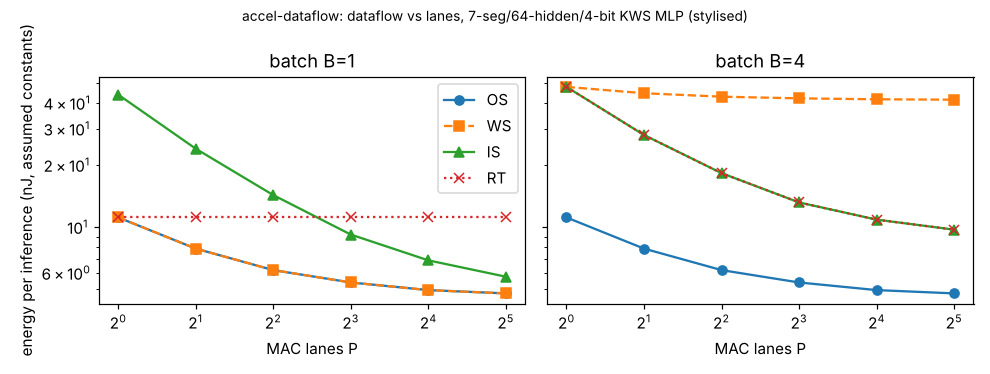
Four dataflows (output-, weight-, input-stationary and reduction-tree) of a P-lane MAC array, as schedules walked cycle by cycle on the 40 accel-kws models, with SRAM-access counts that match closed forms exactly and, at P = 1, the measured RTL cycles of accel-kws. At batch 1 output-stationary is best (input-stationary is a median 1.2× to 4.1× worse, falling with lanes); at batch 4 it wins every model while weight-stationary is a median 4.5–9.0× worse through partial-sum traffic. Allowing an activation buffer flips the batch-4 winner to the input-mapped flows at 32 lanes (1.37× better), so the ranking rests on a modelling choice. Stylised: assumed energy constants, a one-cycle register model, no RTL beyond one lane, Timeloop not tried.
A figure from its own output
Paper, code and results
More in Task-specific AI accelerators
- How large must an activation buffer be before the best dataflow for a small keyword-spotting accelerator changes?How large a bounded LRU activation buffer must be before output-stationary stops being the best dataflow for the 40
accel-kwsmodels at batch 4: 32, 64 and 128 words at 8, 16 and 32 lanes (for 10 to 30 of 40 models, input-stationary wins), and not at all at batch 1; buffer-read energy is assumed and no area is charged (stylised). - Does a loop-nest cycle model of a P-lane MAC array match RTL at more than one lane, tails included?P-lane output-stationary and reduction-tree matrix-vector engines in Verilog, bit-exact against NumPy at 1 to 32 lanes, with RTL cycles equal to
accel-dataflow's schedule model plus a constant 2 or 3 at every point, tails included (stylised, generic-gate area, batch 1, no memories). - Does the weight-stationary advantage in the dataflow model survive RTL at batch above 1, and what does it cost in gates?Output- and weight-stationary batched RTL engines at batch 1 to 16: bit-exact, cycles and operand-fetch counts equal
accel-dataflow's schedule model, and weight-stationary's saved weight fetches cost up to 4x the generic gates (stylised, P = 8, no memories). - How cheap must idle flops be, relative to a weight fetch, for register-file weight-stationary to beat output-stationary?Breakeven price ratios from accel-planebatch's RTL counts: register-file weight-stationary beats output-stationary only if an idle flop costs under ~1% of a weight fetch per cycle at batch 4 (falling ~1/B); no energy constant measured (stylised).
- At SKY130's own energy prices, does register-file weight-stationary scheduling beat output-stationary?Places accel-fetchprice's breakevens against SKY130 liberty energies (idle flop 46 fJ per cycle; OpenRAM macro 10 to 90 pJ per access): with weights packed into SRAM words register-file weight-stationary loses to output-stationary at nearly every batch; partial sums in SRAM lose everywhere. Library values, not measurements.
- Does clock-gating the extra accumulators make register-file weight-stationary scheduling beat output-stationary?Prices clock-gated register-file weight-stationary scheduling from SKY130 and GF180 liberty files: an idle clock gate costs 0.86 of an idle flop (SKY130; 0.99 to 1.02 in GF180), so one gate per 24-bit accumulator cuts the idle cost about 28-fold and flips register-file WS from losing to winning against packed SRAM weight fetches in 35 of 64 cells, in all but one cell at 24 flops per gate. Library values, not measurements.
All 40 Task-specific AI accelerators projects →
Other research topics
Proper scoring & elicitation28Effort & peer prediction9Verification games & slashing19Detection & tolerances14Markets as routers13Prediction-market design9Paying contributors8Decentralised training systems23Digital twins & sim-to-real164LLM chip design loops40Robot manufacturing loops53Ambient AI assistant46Self-replicating manufacturing34Simulation-first design64Engineered clothing45Task-specific AI accelerators40Algorithmic chip-design loops42Open-source purpose-built robots44The software-engineering loop43Adversarial human imitation41Open-source residential construction41Autonomous multi-angle capture34Sensing, imaging and 3D31Energy supply and dense energy storage39Robot societies among people31Agentic co-design of low-cost robots27Laundry-hanging robots25Machine learning on qualitative data23Robots on the building site27Civilizations & group psychology1History & human sciences1
Produced with AI assistance (Claude). Results are from the code in this repository and are simulated or stylised unless the abstract says otherwise; nothing here implies affiliation with or endorsement by any lab, researcher or company cited. MIT licensed.