An open research programme on which passing policy a fleet of mobile robots should use in a corridor shared with people, with the crowd models fitted to real trajectories and cross-checked across model families (social force, ORCA, the anticipatory power law).
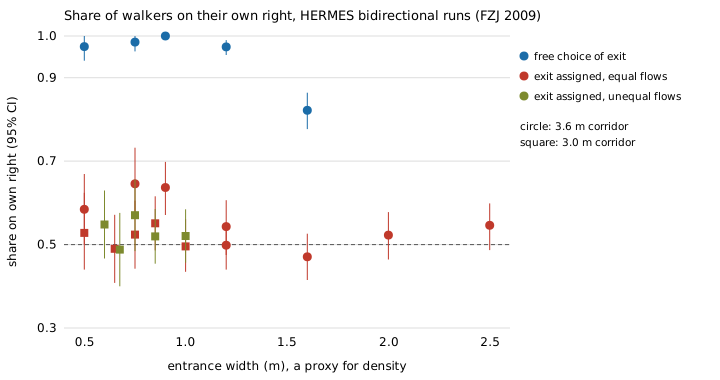
Milestone 1 measures the human baseline in the Forschungszentrum Jülich HERMES bidirectional corridor experiments (2009; 24 runs; 4,752 walkers tracked at 16 fps; DOIs 10.34735/ped.2009.10–12). With no instruction about the exit, 1,016 of 1,084 walkers (0.937, two-stage bootstrap 0.865 to 0.993) walked on their own right, both streams on the same relative side, and lane order was 0.91 to 1.00 against 0.25 to 0.52 for shuffled directions. When each walker was told to leave by the left or right exit, the share fell to 0.534 (0.503 to 0.568) over 13 symmetric runs and 0.526 over the asymmetric set, and lanes persisted at lower order (0.59 to 0.85, above the null in every run). Three of five registered predictions held; the share did fall at the highest density (0.82) and the free-speed run walked at 1.73 m/s, above the predicted range.
Milestone 2 replicates this on the independent BaSiGo corridor experiment (2013; 15 runs; 8,155 walkers; 4 m corridor; DOI 10.34735/ped.2013.5) with predictions registered first: with no exit instruction 0.924 (0.877 to 0.973) kept right, inside the HERMES interval; with exits assigned by wristband it fell to 0.689 (0.566 to 0.839; difference +0.235, 0.073 to 0.365), a smaller collapse than at HERMES, stepping down at the instruction rather than drifting with run order. In the last two runs, with the exit instruction kept and ‘screen information’ added (content not documented by the archive), 1,212 of 1,218 walkers (0.995) kept right. All six registered predictions held; lane order beat the null in all 15 runs.
Milestone 7 checks the convention outside the lab with a head-on encounter measure on the ETH/Hotel (Zurich) and UCY Zara (Nicosia) pavement recordings, after projecting every track back onto its video frames to fix each frame’s handedness: walkers kept right in 0.654 (0.592 to 0.741; 723 encounters) of Zurich passes and 0.680 (0.565 to 0.797; 491) of Nicosia passes, though Cyprus drives on the left; the same measure reproduces the lab’s 0.935 and 0.526. The street convention is real but far weaker than the corridor’s, and two scenes per city cannot separate a city norm from scene layout.
Show the rest of the summary (19 more paragraphs, 1,626 words)
Limits: ‘right’ assumes the archive frame is right-handed with z up; neither experiment randomised run order, so the instruction effect is descriptive, and what the BaSiGo screens showed is unknown; laboratory crowd of students; no robots yet.
Milestone 3 fits a social-force twin (JuPedSim 1.4.2, Helbing–Farkas–Vicsek parameters, plus one steering bias toward one’s own right when someone approaches head-on) on the nine free-choice runs. Without the bias it keeps 0.51 right; the fitted bias (β = 0.1) gives 0.89 to 0.97 and lane order within 0.10 in 7 of 9 runs, but only 3 of 9 runs fall inside their intervals and the twin cannot congest past about 1.5 walkers/m² (the densest real run reached 3.8).
On the 14 assigned-exit runs it never saw it keeps 0.78 on the right where people kept 0.54 (HERMES 3.6 m, pooled), overstating every run: the twin over-trusts the convention. Geometry (corridor length, exit positions) is assumed, as the archive was unreachable this session.
Milestone 4a tests that: moving the assigned walkers’ exits from a quarter width in to the walls lowers the held-out share to 0.68, still above people in 13 of 14 runs, and a second family, JuPedSim’s anticipation velocity model (Xu, Chraibi and Seyfried 2021, default parameters), fitted the same way (β = 0.35), forms near-perfect lanes, fails H3 (4 of 9 runs in interval, densities unreachable) and keeps 0.996 on the right under assigned exits. In both families a side bias fitted on free-choice runs survives the goals that made people drop it.
Milestone 4b tests the rule rather than the model: a bias that switches off for a walker whose exit lies on its left (walkers without a lateral goal, the only ones in the fitted runs, are unaffected, so nothing is refitted) cuts the mean held-out share error from 0.210 to 0.079 for social force, from 0.353 to 0.118 for a third family, JuPedSim’s collision-free speed model (Tordeux, Chraibi and Seyfried 2016; β = 0.2), and from 0.395 to 0.260 for the anticipation model.
Pooled HERMES held-out share: 0.610, 0.623 and 0.877 against people’s 0.541. The collision-free speed model with the yielding bias is the only pair that also gets the held-out lanes (12 of 14 within 0.10). The rule was chosen after the earlier failures were seen, and no rule reproduces the run-to-run spread.
Milestone 4c adds a fourth family from another code base, the anticipatory power law of Karamouzas, Skinner and Guy (2014), implemented in numpy with Inria UMANS’s closed-form force and parameters (k = 1.5, τ0 = 3 s; checked against a finite-difference gradient). Fitted the same way (β = 0.35) it keeps 0.971 on the right under assigned exits with the bias always on and 0.698 with the yielding bias (mean error 0.393 → 0.153). The over-trust replicates in all four families; the yielding fix brings the share within 0.10 in the two fitted with β ≤ 0.2, not in the two fitted with β = 0.35 (a pattern seen after the run).
The power law fails H3 too, so no family of four reproduces side, lanes and speed-density together, and H3 is refuted. A fifth family, ORCA (optimal reciprocal collision avoidance, ported from RVO2 with UMANS parameters), needs the strongest bias (β = 1.0) and fits the free runs worst, keeps 0.878 with the bias always on and 0.600 with the yielding bias (mean error 0.312 → 0.086, lanes within 0.10 in 11 of 14). So the over-trust replicates in all five families, the yielding fix works in three, and the registered test of the β-strength pattern refutes it. ORCA fails H3 as well.
Milestone 5a puts robots in the three JuPedSim crowds (free choice, two HERMES runs, 20 seeds per cell): robots of the people’s size capped at 1.2 m/s (the MiR250’s lower rated speed) replace 5, 10 or 20% of the agents, with four passing policies. A robot holding the side opposite the crowd’s convention is the worst policy on close passes (clearance under 0.5 m), delay per pass and lane order in all nine family-share cells; at 20% it costs people 3.98 s per 8 m transit in social force, 2.05 s and 0.45 s in the other two families, with 0.58, 0.16 and 0.63 of its passes close.
A robot holding the crowd’s side keeps close passes at 0.10 or below in every family and leaves the people’s side share within 0.03. The order of the three reasonable policies (crowd side, follow the local majority, a lateral exit goal) differs between families (Kendall τ 0.00 to 1.00), so the H5 preview fails: a policy tuned in one simulator need not rank the same in another. Five of eight registered predictions were refuted. Robots use the crowd’s own operational model, so people can push them.
Milestone 5b adds robots to ORCA (the robots run ORCA too) and the power law. The three families that passed the held-out share test (social force, collision-free speed, ORCA) rank the four policies identically by close passes at every share (crowd side < adapt < lateral goal < opposite; Kendall τ 1.00 in 9 of 9), with 0.02 to 0.08 of crowd-side passes and 0.58 to 0.74 of opposite-side passes under 0.5 m at 20% robots. By human delay per pass they disagree (τ 0.00 to 1.00), so H5 holds on one metric and fails on another.
Milestone 6a registers H5 on close passes as a confirmatory test: 20 fresh seeds per cell (3,120 runs), the three families at their fitted bias and at half of it. The ranking is identical in all 18 pair-share cells (τ 1.00; 95% bootstrap interval [1.00, 1.00] at the fitted bias), while by delay per pass it fails again (2 of 9 cells at τ ≥ 0.8). Halving the bias moved only the social-force crowd toward the street convention (0.95 → 0.80 on own right), so the weaker-convention check is strong for one family.
Milestone 6b trains a five-parameter lateral policy (not SARL) by the cross-entropy method in each of the three twins on equal budgets and evaluates all seven policies on fresh seeds: every learned policy holds the crowd's side harder than the hand-written lane, near the wall, and beats all four hand policies in all three twins, including the two it was not trained in (close passes at 10% robots, ORCA 0.019 → 0.006 to 0.009). The policy trained in social force was the weakest of the three even in social force, its noisiest training signal. Close-pass rankings of the seven policies agree across twins (τ 0.81 to 0.90); delay rankings do not (0.33 to 0.52). Walls cost little in the twins, so a real robot's wall clearance is not modelled.
Milestone 6c adds a density-matched control: an apparent speed-up from crowd-side robots in a weak-convention crowd was 88% lower density.
Milestone 6d registers the remaining lane-order gain with 40 fresh seeds and a same-bodies arm (robots with a lateral goal): in social force, crowd-side robots at 20 to 30% raise people’s lane order by 0.04 to 0.07 against no robots and by 0.12 to 0.21 against lateral-goal robots, which cost people 1.7 to 2.9 s per transit; in collision-free speed any robots slow people against the control (crowd-side by 0.5 to 0.9 s), though side-holding still beats the lateral goal.
Milestone 6e runs the same arms in ORCA and sweeps robot speed in collision-free speed (3,040 runs): in ORCA crowd-side robots beat lateral-goal ones by 1.1 to 4.1 s per transit and 0.04 to 0.15 lane order at every keep-right bias from street-like to fitted, so side-holding wins in all three twins; against no robots ORCA, like collision-free speed, has robots slow people (by up to 1 s) with no lane gain. Faster robots do not remove that slow-down (+0.5 s from 1.2 to 2.0 m/s), but they shrink the side’s advantage (0.70 s at 0.8 m/s to 0.12 s at 2.0 m/s).
Milestone 6f crosses the robot’s two differences from a person, its lane line and its 1.2 m/s cap, at a fixed agent count (1,920 runs): a crowd-side robot costs people less than the person it replaces in every twin (0.70 s per transit in social force, 0.42 s in collision-free speed, 0.78 s in street-like ORCA), the line carries all of it and the cap none, and the slow-down against the density-matched control is what any extra walker costs, which the twins put at 0.28 to 1.88 s.
Milestone 6g measures that cost on the HERMES runs: crossing 8 m takes 5.5 s at 0.35 persons/m² and 11.5 s at 1.85/m², and removing 20% of walkers saves people 0.30 to 0.76 s at the twins’ operating densities; collision-free speed (1.57 s) and street-like ORCA (1.31 s) over-price it 2 to 3×, fitted ORCA (0.08 s) under-prices it, and every twin but fitted ORCA is 2.3 to 3.9 s too slow at a given density, because walker count was calibrated on speed and the twins reach the real speed at about half the real density.
Milestone 6h fits each family’s one spacing parameter to that curve (2,400 runs, seven predictions registered first): collision-free speed at time gap 0.3 s and fitted ORCA at time horizon 2 s now match the real time to cross within about 0.5 s from 0.37 to 1.3 persons/m², on fresh seeds and on the eight assigned-exit runs the fit never saw, while social force (2.2 s off) and street-like ORCA (gridlock) cannot be fitted this way. Matching the level does not match the slope: at 0.83/m² the recalibrated twins put the saving from 20% fewer walkers at 0.19 and 0.01 s against a real 0.40 s, and no twin can reach the dense run’s 1.72/m², because its entrance rule caps inflow near 1.3/m².
2026-11-18 · Milestone 6h: recalibrate each twin on the measured transit-density curve, then test it on fresh seeds and held-out runs (predictions written before any number was read)
- Why this step: 6g measured what an extra walker costs on the HERMES 3.6 m runs and found every twin mis-prices it, because milestone 3 calibrated walker count on median speed: the twins reach the runs' speeds at about half the real density, and at a given density they are 1.5 to 3.7 s too slow per 8 m. Before 6f's robot factorial can be rerun in twins that price density right, each twin needs its density behaviour fitted to the real curve.
- The parameter: each family has one free parameter that sets how much room a walker keeps, and none was fitted so far: social force's interaction strength A (Helbing, Farkas and Vicsek 2000; JuPedSim 1.4.2 default 2000 N), collision-free speed's time gap T (Tordeux, Chraibi and Seyfried 2016; JuPedSim default 1.0 s) and ORCA's time horizon τ (van den Berg et al. 2011; RVO2's example value 5 s).
sftwin.simulate gains agent_scale and time_gap, orca.simulate gains tau; defaults unchanged (tested). - Tool:
experiments/m6h_recalibrate.py, reusing 6g's real-data code (m6g_density_cost) unchanged. - Part A (calibration, SEED0 20340000, 4 seeds): the four 6f settings (social force 0.75×, collision-free speed 0.5×, ORCA 0.02× and 1.0× their fitted biases), each parameter on a five-value grid that brackets the default on both sides (A 4000, 2000, 1000, 500, 250 N; T 1.5, 1.0, 0.7, 0.5, 0.3 s; τ 10, 5, 3, 2, 1 s), entrances 0.9 and 1.6 m, N in {20, 30, 40, 50, 60, 75, 90, 105, 120}; 120 s runs, first 40 s warm-up; 1,440 runs. Score of a value: RMS over cells whose mean transit density lies inside the real free-choice walkers' 5th to 95th density percentile (0.37 to 1.98/m²) of cell-mean transit minus 6g's free-choice curve at the cell's density; at least 4 cells needed. The chosen value is the grid minimum. Operating walker counts: for bo-360-090-090 (0.9 m) and bo-360-160-160 (1.6 m), the N at which the chosen twin's cell-mean transit density first reaches that run's own mean crossing density (6g: 0.830 and 1.721/m²), interpolated over the N grid.
- Part B (held out, SEED0 20341000, 12 fresh seeds): at the chosen value, the N grid again plus N<sub>op</sub> and N<sub>op</sub> − 20% at both entrances. (i) curve gap (RMS of fitted quadratics, 0.05/m² grid) against the free curve on fresh seeds; (ii) curve gap against the eight assigned-exit 3.6 m runs (doi:10.34735/ped.2009.11), which play no part in the fit, over the range both cover (their densities reach 2.8/m², past the fit's range); (iii) density cost at the operating points against the real curve at the twin's own densities; (iv) people's own-right share and lane order there.
- Disclosure: a 1-seed, 45 s smoke run checks the script end to end; only its exit status is read. Its timing (about 6 min for 378 runs of 45 s) put the registered 8 and 20 seeds at about 3.5 h, so before the full run the seeds were cut to 4 (Part A) and 12 (Part B); no number from the smoke run was read.
- Predictions: - R1: social force, collision-free speed and street-like ORCA each pick a value that gives walkers less room than the default (A below 2000, T below 1.0, τ below 5). Prior 75%. - R2: in every setting the chosen value's calibration score is at most half the default's. Prior 50%. - R3: on fresh seeds at least three of the four settings have a free-curve gap below 1.0 s. Prior 45%. - R4 (held-out runs): at least two settings have an assigned-exit curve gap below 1.0 s. Prior 35%. - R5: every chosen twin reaches the dense run's density (1.72/m²) at the 1.6 m entrance within N 120. Prior 55%. - R6: at the dense operating point at least two settings' twin density cost lies inside the real cost's interval. Prior 35%. - R7: at the dense operating point every chosen twin keeps people's own-right share above 0.6 (the recalibration does not dissolve the side convention the bias was fitted for). Prior 60%.
### Outcome of milestone 6h (experiments/m6h_recalibrate.py, experiments/m6h_recalibrate_results.txt, experiments/m6h_recalibrate_runs.csv, figure experiments/m6h_recalibrate.svg; 2,400 runs, about 14 min on 4 cores, 2 failed (social force, Part A); 7 new tests)
- The main result: one parameter fixes the curve's level in two families and fails in two. Calibration score (RMS of cell-mean transit against the real curve at the cell's own density), default → chosen: collision-free speed 8.87 → 0.55 s at time gap T = 0.3 s; fitted ORCA 5.40 → 0.78 s at τ = 2 s; social force 2.85 → 2.33 s at A = 1000 N; street-like ORCA 6.06 s, no grid value better than the default (gridlock: cells at N 90 and above often have no crossing). On 12 fresh seeds the two that fit hold up: curve gap against the free-choice curve 0.54 s [0.43, 0.78] (collision-free speed) and 0.58 s [0.41, 0.99] (ORCA), against social force 2.16 and street-like ORCA 7.59.
- R4 held, on runs the fit never saw. Against the eight assigned-exit 3.6 m runs the two recalibrated twins have curve gaps of 0.55 s [0.41, 0.75] and 0.50 s [0.34, 0.77] (social force 2.33, street-like ORCA 8.13).
- R1 refuted (by street-like ORCA only), R2, R3 refuted. Social force (1000 < 2000) and collision-free speed (0.3 < 1.0) did pick less room; street-like ORCA kept τ = 5. Only two settings halved their score, and only two (not three) have a fresh-seed gap below 1 s. Collision-free speed's choice sits at the grid's edge (0.3 s, the smallest value tried; score still falling from 0.5 s), so its best value may be lower; disclosed, not searched.
- R5 refuted, and it is the step's second finding: the twin corridor cannot hold the dense run's density. At the 1.6 m entrance no chosen twin reached bo-360-160-160's 1.72/m² by N 120. Cell density stops rising near N 75 to 90 and plateaus at 1.27 (collision-free speed), 1.12 (social force), 1.32 (fitted ORCA) and 0.89 (street-like ORCA, jammed); at the 0.9 m entrance, near 1.0. Extra walkers queue at the entrance (the 0.55 m clearance rule) instead of entering, so the real dense run is out of reach of milestone 3's geometry whatever the interaction parameter. R6 and R7 could not be tested (they were registered at the dense point, which no twin reached; the script prints them as refuted, which overstates it).
- Read after the run, not registered, at the 0.9 m point (bo-360-090-090, 0.83/m², reached at N 48 to 49 by three twins): matching the curve's level does not match its slope. Removing 20% of walkers saves +0.19 s [+0.09, +0.29] in recalibrated collision-free speed and +0.01 s [−0.08, +0.10] in recalibrated ORCA, against +0.40 s [+0.27, +0.56] and +0.40 [+0.28, +0.56] on the real curve at the same densities: both under-price the marginal walker, by about half and almost entirely. Their transit at that point is right (6.82 and 6.53 s against 6.49 and 6.53 s). People keep their convention there (own-right share 0.959 and 1.000, lane order 0.915 and 0.997). Social force's 0.9 m operating count (N 101 against 81) lies on the plateau where density falls with N, so its cost there (−0.91 s) means nothing.
- What it means for the programme: 6f's within-twin robot contrasts still stand, but no current twin is fit to price an extra body. Collision-free speed at T = 0.3 s and ORCA at τ = 2 s now get the time to cross right within about half a second across 0.37 to 1.3/m², on fresh seeds and on held-out runs, but are too flat at 0.7 to 0.8/m², and none can reach 1.7/m² because the entrance rule caps inflow. Next: replace the entrance admission rule (a periodic corridor at fixed N, or an entrance that admits at the real runs' measured inflow), fit level and slope together (score on the curve's derivative as well), then rerun 6f's factorial at the real runs' densities.
Show 17 earlier entries
2026-11-18 · Milestone 6g: what does an extra walker really cost? Each twin's density cost against the HERMES fundamental diagram (predictions written before any number was read)
- Why this step: 6f closed the robot question and left a calibration one. Every twin agrees on what a crowd-side robot does to people; they disagree by about 6× on what any extra body costs in the 3.6 m corridor (the control − none transit gap at 20% fewer walkers: +0.28 s in social force at 0.75×, +0.83 s in collision-free speed at 0.5×, +1.88 s in street-like ORCA). Whether adding robots on top of a crowd costs people time is decided by that number, and the HERMES runs span densities, so the real one can be measured.
- Tool:
experiments/m6g_density_cost.py. sftwin.measure gains one output, transit_density: for each walker who crosses the 8 m section, the mean section density over its own frames, averaged over those walkers (no earlier output changes; tested). - Real side (Part A): the five free-choice 3.6 m HERMES runs (doi:10.34735/ped.2009.12, the runs the twins were fitted on), milestone 1's walker filter, the twins' transit definition (a walker whose section samples span 7.5 m of the 8 m), and for each crossing walker the section density it saw (counted walkers in the section, averaged over its frames, over 8 m × 3.6 m). Fit transit T(ρ) = a + bρ + cρ² to the per-walker points. Interval: within each run, resample walkers in 10 s blocks of entry time (B = 2,000); this conditions on the five runs and is disclosed as such. Robustness: the seven symmetric 3.6 m runs (doi:10.34735/ped.2009.11, assigned exits) fitted the same way. Inputs seen beforehand: only milestone 1's per-run participant counts and median speeds (
m1_hermes_sides_runs.csv); no density, transit or per-walker value. - Twin side (Part B): people only, the four 6f settings (social force 0.75×, collision-free speed 0.5×, ORCA 0.02× and 1.0×), both entrance widths (0.9 and 1.6 m), N in {10, 16, 20, 24, 30, 40, 48, 60, 75, 90} (which holds 6f's none and control counts), 20 fresh seeds per cell (SEED0 20330000, disjoint from 5a to 6f), 120 s runs, first 40 s warm-up; 80 cells, 1,600 runs. Each run gives (transit_density, transit); the same quadratic is fitted per setting over both entrances (bootstrap over seeds within cells).
- Comparison: (i) the density cost at 6f's operating points: the twin's own cell-mean T(N) − T(N − k) at 6f's walker counts and entrances, against the real curve's T(ρ<sub>N</sub>) − T(ρ<sub>N−k</sub>) at the densities the twin produced in those two cells, counted only where both densities lie inside the real walkers' 5th to 95th percentile of density; (ii) the curve gap: root-mean-square difference between the twin's and the real fitted T(ρ) on a 0.05/m² grid over the density range both cover.
- Disclosure: a 1-seed, 45 s smoke run will check the script end to end; only its exit status is read.
- Predictions: - D1: real transit rises with density: the fitted slope dT/dρ at the real median density has an interval above 0. Prior 90%. - D2: the twins bracket reality: at the 60-walker operating point (bo-360-160), the real density cost lies between social force's and street-like ORCA's twin costs (point estimates). Prior 50%. - D3: collision-free speed has the smallest curve gap of the four settings. Prior 35%. - D4: social force under-prices an extra walker: at the 60-walker point its twin cost is below the real cost's interval. Prior 55%. - D5: street-like ORCA over-prices it: at the 60-walker point its twin cost is above the real cost's interval. Prior 50%. - D6: every setting's curve gap exceeds 0.5 s (no twin reproduces the real transit-density curve to half a second). Prior 60%. - D7: the symmetric (assigned-exit) runs give a real density cost at the 60-walker point within 30% of the free runs' cost. Prior 55%.
### Outcome of milestone 6g (experiments/m6g_density_cost.py, experiments/m6g_density_cost_results.txt, experiments/m6g_density_cost_runs.csv, experiments/m6g_density_cost_real.csv, figure experiments/m6g_density_cost.svg; 1,600 twin runs, about 6 min on 4 cores, none failed; 6 new tests)
- Deviation from the registration: the symmetric set has eight 3.6 m runs, not seven (bot-360-120-120v2 is a second run at 1.2 m entrances); all eight were used.
- D1 held: the real curve. 1,084 crossings in the five free-choice runs; transit T(0.35/m²) = 5.52 s [5.18, 5.84], T(0.85) = 6.58 [6.21, 7.06], T(1.35) = 8.57 [8.08, 9.22], T(1.85) = 11.48 [10.36, 12.71]; slope at the median density 1.12/m² +4.05 s per person/m² [+3.28, +4.88].
- D7 held: instruction does not change it. The eight assigned-exit runs (1,917 crossings) give a density cost within 5% of the free runs' at every operating point (e.g. +0.76 against +0.76 s, +0.45 against +0.43 s). The exit instruction breaks the side convention (milestone 1) but leaves the speed-density relation alone.
- D2, D4 refuted, D5 held: the twins mis-price an extra walker, in both directions. At 6f's 60-walker point (N 60 against 48), the real curve at the densities each twin produced gives +0.30 s [+0.21, +0.40] (social force's densities), +0.76 [+0.63, +0.92] (collision-free speed's), +0.43 [+0.34, +0.55] (street-like ORCA's) and +0.55 [+0.45, +0.68] (fitted ORCA's). The twins give +0.74 [−0.46, +1.98], +1.57 [+1.26, +1.94], +1.31 [−0.50, +3.12] and +0.08 [−0.01, +0.16]. Collision-free speed over-prices by 2× (intervals disjoint); street-like ORCA by 3× (point above the real interval, its own interval wide); fitted ORCA under-prices by about 7× (intervals disjoint); social force is too noisy to call. The real costs do not lie between social force's and street-like ORCA's (both are above reality), so D2 failed.
- D3, D6 refuted: fitted ORCA is the closest curve, and it is close (0.31 s RMS [0.23, 0.66]). Social force 2.18 s, collision-free speed 3.34 s and street-like ORCA 6.01 s are far off. But fitted ORCA's closeness is a flat curve meeting a gentle one: its transit stays at 6.4 to 6.7 s from 0.2 to 1.1/m² and then jams (7.8 to 8.0 s at N 90), which is why it under-prices the marginal walker.
- Read after the run, not registered: the twins are too slow at a given density, not too steep. At their 60-walker densities (0.82 to 1.09/m²) social force takes 8.83 s, collision-free speed 11.08 s and street-like ORCA 10.75 s to cross, against 6.50, 7.40 and 6.87 s on the real curve at the same densities. Milestone 3 set walker count so the twin's median speed matched the run's; the twins reach that speed at about half the real density (the real bo-360-160-160 run averaged 1.72/m²). On the real curve, thinning that crowd by 20% (1.72 to 1.38/m²) saves about 1.9 s per crossing (point from the fitted coefficients, no interval), so at the real density the cost is larger than any twin's 60-walker cost except collision-free speed's.
- What it means for the programme: 6f's robot results (crowd-side robots beat the person they replace; the line, not the cap) were within-twin contrasts and stand; its density costs (0.28 to 1.88 s) are not real-world numbers. The operator-facing number is now measured: in a 3.6 m corridor near 1 person/m², an extra 20% of walkers costs each person about 0.3 to 0.8 s per 8 m; near 1.7/m², about 2 s. Next: recalibrate each twin on the transit-density curve rather than on median speed, and rerun 6f's factorial in the recalibrated twins.
2026-11-17 · Milestone 6f: why do crowd-side robots slow people in two of three twins? A 2 × 2 factorial on the robot (predictions written before the full run)
- Why this step: 6d and 6e left one question open (README Next steps 6): robots that hold the crowd's side slow people against a density-matched control in collision-free speed and ORCA, yet speed them up in social force. 6e ruled out the speed cap as the whole story (the slow-down plateaus near 0.5 s from 1.2 to 2.0 m/s). A robot in these twins differs from a person in exactly two ways: its steering (a fixed line a quarter of the width from its right wall, where a person keeps its own line and veers right by β only when someone comes at it) and its speed (a 1.2 m/s cap, where a person draws Weidmann's 1.34 ± 0.26 m/s). Both can be switched, so the slow-down can be split between them.
- Tool:
experiments/m6f_factorial.py. Two switches added to the twins, defaults unchanged (tested): policy=robots.HUMAN keeps a robot on the people's steering rule, side bias included, and robot_speed=robots.PEOPLE_SPEED draws each robot entry's desired speed as a person's. A robot with both is a person the people-only measures leave out. - Design (fixed now): at a fixed total N, six arms: none (N people), control (N − k people), and k robots in a 2 × 2: hp (people's steering, people's speed: a labelled person), hc (people's steering, 1.2 m/s), lp (crowd-side line, people's speed), lc (line and cap: 6d/6e's crowd-side robot). Effects on people's measures: steer = ((lp − hp) + (lc − hc)) / 2, cap = ((hc − hp) + (lc − lp)) / 2, interaction, robot = lc − hp (what turning a person into this robot costs the others), seed = lc − control (6d/6e's effect), check = hp − none (should be zero). Settings: social force at 0.75× its fitted bias (6d's clearest speed-up), collision-free speed at 0.5× (6e Part B), ORCA at 0.02× (street-like, 6e's largest slow-down) and 1.0×; 20% robots; both HERMES 3.6 m runs with 6e's walker counts; 40 fresh seeds per cell (SEED0 20320000, disjoint from 5a to 6e); 120 s runs, first 40 s warm-up; 48 cells, 1,920 runs; percentile bootstrap over seeds within each cell (B = 2,000), runs pooled by the mean of their cell means.
- Disclosure: a 1-seed, 45 s smoke run checked the script end to end; only its exit status was read (its 5 s of measurement gives no numbers).
- Predictions: - V1 (the labelled person is a person): hp − none transit interval contains 0 in all four settings. Prior 80%. - V2 (6d/6e replicate on fresh seeds): lc − control transit interval above 0 in collision-free speed 0.5× and ORCA 0.02×, below 0 in social force 0.75×. Prior 55%. - V3: lc − hp transit interval above 0 in collision-free speed and ORCA 0.02× (a crowd-side robot costs the others more than the person it replaces). Prior 65%. - V4 (the line, not the cap): in those two settings the steering effect on transit has an interval above 0 and a larger point estimate than the cap effect. Prior 50%. - V5: in collision-free speed the cap effect on transit has an interval containing 0. Prior 45%. - V6: in social force 0.75× the steering effect on transit is below 0 (the line is what speeds people up there). Prior 50%. - V7: in social force 0.75× the steering effect on lane order is above 0. Prior 65%.
### Outcome of milestone 6f (experiments/m6f_factorial.py, experiments/m6f_factorial_results.txt, experiments/m6f_factorial_runs.csv, figure experiments/m6f_factorial.svg; 1,920 runs, about 9 min on 4 cores, no failed runs; 5 new tests)
- V1, V2 held: the setup is sound and 6d/6e replicate on fresh seeds. The labelled person (hp) is indistinguishable from a person in all four settings (hp − none transit +0.02, −0.04, −0.18, +0.05 s, every interval containing 0). Against the density-matched control, crowd-side robots again speed people up in social force (−0.42 s [−0.76, −0.09]) and slow them in collision-free speed (+0.41 s [+0.31, +0.52]) and street-like ORCA (+1.11 s [+0.40, +1.79]).
- V3 refuted, the main result: a crowd-side robot costs people less than the person it replaces, in every twin. lc − hp transit: −0.70 s [−1.03, −0.36] in social force, −0.42 s [−0.55, −0.29] in collision-free speed, −0.78 s [−1.79, +0.17] in street-like ORCA and −0.04 s [−0.09, +0.01] in fitted ORCA. The 6d/6e "slow-down" is the control having k fewer bodies: adding k labelled people to the control costs +0.83 s in collision-free speed and +1.88 s in street-like ORCA, but only +0.28 s in social force. So the three families agree on the robot; they disagree on how much any extra body costs in a 3.6 m corridor. 6e's "do not trust a twin's claim that robots speed people up" sharpens to: the answer depends on the counterfactual (robot added, or robot instead of a person), and the twins differ on the density cost, not on the robot.
- V4 refuted in direction, and V5, V6, V7 held: the gain is the steering; the cap does nothing measurable. The crowd-side line shortens people's transit against the people's own steering rule in all four settings (−0.56 [−0.82, −0.29], −0.33 [−0.43, −0.23], −0.95 [−1.95, −0.13] and −0.04 [−0.07, −0.01] s). The 1.2 m/s cap, against a person's speed draw, has no interval clear of zero on transit in any setting (−0.13, −0.09, +0.18, −0.00 s), and no interaction does either. In social force the line also lifts lane order (+0.047 [+0.026, +0.067]), and in every setting but fitted ORCA it raises people's own-right share (+0.03 to +0.09).
- Read after the run, not registered: the robots on the line move faster themselves than robots on the people's rule (social force 1.27 against 1.22 m/s with people's speed draws; collision-free speed 0.95 against 0.88; ORCA street-like 1.12 against 1.06). Holding a fixed lane near the wall keeps a robot out of the head-on exchanges a person on the people's rule gets into, which is plausibly the mechanism, untested.
- What it means for the programme: the open question of 6d/6e is closed. Side-holding is the whole of the robot's effect on people's time, its speed cap is not, and the twins' disagreement is a density effect that applies to any extra walker. For a fleet operator replacing human trips (a delivery a person would otherwise walk) with robot trips, a crowd-side robot is a net gain in all three twins; adding robots on top of the crowd costs what any extra walker costs, and the twins disagree by 6× on how much that is (0.28 to 1.88 s per person-transit at 20%), which is a calibration target for real data. Next: fit the density cost to the HERMES runs at several walker counts (they span densities), so the twins can be told apart on it.
2026-11-17 · Milestone 6e: does side-holding beat a lateral goal in ORCA too, and is robot speed why collision-free speed robots slow people? (predictions written before the full run)
- Why this step: 6d found, in social force, that crowd-side robots beat lateral-goal robots of the same bodies (+0.12 to +0.21 lane order, 1.8 to 3.6 s faster per person-transit), and that in collision-free speed any robots, even side-holding ones, slow people against a density-matched control. README Next steps 6 leaves two things open: the same arms in ORCA (the third family that passed the held-out test, and a planner real robots run) and whether the robots' 1.2 m/s cap is why collision-free speed robots slow people.
- Tool:
experiments/m6e_orca_speed.py reuses orca.simulate, sftwin.simulate, robots.py and m5_robots.py's constants unchanged. People-only measures. - Calibration before the design (disclosed): ORCA's crowd barely moves when its fitted bias is halved (6a: 0.998 on own right). A no-robot sweep on separate seeds (20319000 to 20319009, both runs, 120 s) gave own-right share 0.682, 0.874, 0.948, 0.971, 0.996, 0.997, 0.997 and lane order 0.785 to 0.989 at β 0.02, 0.05, 0.1, 0.15, 0.25, 0.5, 1.0. Those numbers were read and set the multipliers below. One timing probe (ORCA, 60 agents, 12 crowd-side robots, seed 1) was also seen: share 0.997, lanes 0.981, transit 6.5 s.
- Design (fixed now): Part A, ORCA at 0.02 (street-like 0.68), 0.05, 0.1 and 1.0 × the fitted bias 1.0; 6d's four arms (none, control = N − k people, crowd and goal = N − k people + k robots); shares 20% and 30%; robots 1.2 m/s; walker counts 30/60 (milestone 5b). Part B, collision-free speed at 0.5 × (β 0.1), 20%: crowd and goal robots at 0.8, 1.2, 1.6 and 2.0 m/s, with none and control shared across speeds; walker counts 20/60. Both HERMES 3.6 m runs, 40 fresh seeds per cell (SEED0 20310000, disjoint from 5a to 6d and the calibration), 120 s runs, first 40 s warm-up; 76 cells, 3,040 runs. Effects as 6d (seed = crowd − control, side = crowd − goal, body = goal − control, density = control − none); percentile bootstrap over seeds within each cell (B = 2,000), runs pooled by the mean of their cell means.
- Disclosure: a 1-seed, 45 s smoke run checked the script end to end; only its exit status and line counts were read, not its numbers.
- Predictions: - U1 (side beats bodies in ORCA): at 20%, crowd − goal lane order interval above 0 at all four multipliers. Prior 65% (at 1.0× ORCA lanes are near 0.99, so there is little room). - U2: at 20%, crowd − goal transit interval below 0 at all four multipliers. Prior 65%. - U3 (lane seeding in a street-like ORCA crowd): at 0.02× and 20%, crowd − control lane order interval above 0. Prior 50%. - U4: at 1.0×, crowd − control lane order interval contains 0 at both shares (ceiling). Prior 70%. - U5: at 1.0×, crowd − control transit interval above 0 at both shares (robots at 1.2 m/s slow a crowd that walks about as fast). Prior 45%. - U6 (speed): in collision-free speed at 0.5× and 20%, crowd − control transit falls with each step up in robot speed (point estimates, 0.8 → 2.0 m/s). Prior 45%. - U7 (the cap explains the slow-down): at 1.6 m/s, the crowd − control transit interval is no longer above 0. Prior 30% (people there already walk about 0.85 m/s, below the cap). - U8: collision-free speed crowd − goal transit interval below 0 at all four speeds (side-holding beats the lateral goal at any speed). Prior 75%.
### Outcome of milestone 6e (experiments/m6e_orca_speed.py, experiments/m6e_orca_speed_results.txt, experiments/m6e_orca_speed_runs.csv, figures experiments/m6e_orca_speed.svg and experiments/m6e_cfsm_speed.svg; 3,040 runs, about 12 min on 4 cores, no failed runs; 5 new tests)
- U1, U2 held, the main result: side beats bodies in ORCA too. Crowd-side minus lateral-goal robots, at 20%: lane order +0.070, +0.124, +0.111, +0.041 and transit −2.19, −4.07, −2.81, −1.13 s at 0.02, 0.05, 0.1 and 1.0× the fitted bias, every interval clear of zero; at 30% too (+0.069 to +0.150, −2.45 to −4.08 s). With 6d, the side effect is now clear of zero in all three families that passed the held-out test.
- U3 refuted: no lane seeding in a street-like ORCA crowd. At 0.02× (people keep 0.717 on their right with no robots) crowd-side robots at 20% lower people's lane order against the control by 0.029 [−0.058, −0.002]; at 30% −0.022 [−0.047, +0.002]. The small lane gain in social force (6d, +0.04 to +0.07) does not carry over.
- U4 refuted, trivially: at 1.0× the 20% interval is +0.004 [+0.001, +0.007], above zero but negligible against lane order 0.994.
- U5 refuted (one share of two), but the direction is the ORCA story: crowd-side robots slow people against the density-matched control in every ORCA cell (point +0.05 to +0.99 s), with intervals above zero in 5 of 8 (all four multipliers at 30%; at 20% only 0.02×). So ORCA sides with collision-free speed: any robot slows people against fewer people with no robot, and social force (where crowd-side robots shortened transits) is the odd one out.
- U6, U7 refuted: speed is not the reason collision-free speed robots slow people. Crowd − control transit is +1.08 s at 0.8 m/s, then +0.51, +0.57 and +0.52 s at 1.2, 1.6 and 2.0 m/s, every interval above zero. Raising robots above people's own free speed (1.34 m/s mean) leaves a plateau near half a second.
- U8 refuted, and it says when the side matters most. The side advantage (crowd − goal transit) shrinks as robots speed up: −0.70, −0.41, −0.30 and −0.12 s [−0.26, +0.02] at 0.8 to 2.0 m/s, because lateral-goal robots cost less when they are fast (body +1.77 → +0.64 s) while crowd-side ones level off. The side matters most for slow robots.
- Read after the run, not registered: in ORCA the lateral-goal robot's cost (body effect) is largest at the weakest conventions (+3.1 to +5.1 s at 0.02×, +1.2 to +2.5 s at the fitted bias), so the robot that ignores the crowd's side does most harm in the street-like crowd, the case 6a's weak level could not reach in ORCA.
- What it means for the programme: across the three families, the one result that holds everywhere is "hold the crowd's side rather than go straight to your lateral goal", worth 1.1 to 4.1 s per person-transit in ORCA, 1.8 to 3.6 s in social force and 0.1 to 0.7 s in collision-free speed. Whether a side-holding robot beats no robot depends on the twin (social force yes, ORCA and collision-free speed no), so a fleet operator should not read a twin's "robots speed people up" as transferable. Next: SARL proper and the wall-clearance cost (README Next steps 6), and the robots in the assigned-exit crowd (Next steps 7).
2026-11-17 · Milestone 6d: is 6c's lane-order gain real, and is it the robots' side or just their bodies? (predictions written before the full run)
- Why this step: 6c read, after its run and unregistered, that crowd-side robots at 20% raised people's lane order beyond a density-matched control in the social-force crowd at 0.25× (+0.080) and 0.75× (+0.055) the fitted bias. README Next steps 6 asks for a registered test. 6c's control (N − k people, no robots) also differs from the robot cells by k bodies, so a gain could come from any k extra walkers, not from holding a side. A fleet operator needs to know which: "hold the crowd's side" is a policy; "be there" is not.
- Tool:
experiments/m6d_lane_test.py reuses sftwin.simulate, robots.py and m5_robots.py's constants unchanged. People-only measures. - Design (fixed now): four arms per cell: none (N people), control (N − k people), crowd (N − k people + k crowd-side robots), goal (N − k people + k robots with a 50/50 lateral goal, robots.py "goal": same bodies and speed, no side-holding). Effects: seed = crowd − control (6c's), side = crowd − goal, body = goal − control, density = control − none. Social force (β 0.1) at 0.25, 0.5 and 0.75 × the fitted bias; collision-free speed (β 0.2) at 0.25 and 0.5 × (6c's left-over: does its crowd move at all). The two HERMES 3.6 m runs with
m5_robots.RUNS walker counts (social force 30/60, collision-free speed 20/60); shares 20% and 30%; robots 1.2 m/s; 40 fresh seeds per cell (SEED0 20300000, disjoint from 5a to 6c); 120 s runs, first 40 s warm-up. 70 cells, 2,800 runs. Percentile bootstrap over seeds within each cell (B = 2,000), runs pooled by the mean of their cell means. - Disclosure: a 1-seed, 45 s smoke run checked the script end to end; only its exit status and line count were read, not its numbers.
- Predictions: - T1 (the registered test of 6c's read): social force, 20%: crowd − control lane order, 95% interval above 0 at both 0.25× and 0.75×. Prior 55% (6c's intervals cleared 0 by 0.03 and 0.02; regression to the mean is likely). - T2: social force, 20%: crowd − goal lane order, interval above 0 at all three multipliers (the gain is side-holding, not bodies). Prior 60%. - T3: social force: the crowd − control lane gain is larger at 30% than at 20% at every multiplier (point estimates). Prior 55%. - T4: social force, 20%: no crowd − control transit interval lies wholly below 0 (6c's "no speed-up beyond density" replicates). Prior 70%. - T5: social force, 30%: crowd − control transit interval below 0 at one multiplier or more. Prior 25%. - T6: collision-free speed at 0.25× with no robots keeps above 0.85 on its own right (its convention barely moves even at a quarter of the bias). Prior 65%. - T7: collision-free speed: crowd − control lane order interval contains 0 in all four multiplier-share cells (lanes at the ceiling). Prior 60%.
### Outcome of milestone 6d (experiments/m6d_lane_test.py, experiments/m6d_lane_test_results.txt, experiments/m6d_lane_test_runs.csv, figure experiments/m6d_lane_test.svg; 2,800 runs, about 20 min on 4 cores; 4 new tests)
- T1 held: the lane-order gain is real. On fresh seeds, crowd-side robots at 20% raise people's lane order against the density-matched control at 0.25× (+0.038 [+0.004, +0.072]) and 0.75× (+0.052 [+0.028, +0.075]), and at 0.5× too (+0.050 [+0.018, +0.085]); at 30% all three intervals are also above zero (+0.045 to +0.068). Smaller than 6c's post-hoc read at 0.25× (+0.080), as expected of a number picked after a run.
- T2 held, the main result: it is the side, not the bodies. The same robots with a lateral goal instead of a side lower people's lane order against the control (body effect −0.077 to −0.146, all six cells below zero) and lengthen their transit by 1.72 to 2.93 s. Crowd-side minus lateral-goal robots: lane order +0.115 to +0.206 and transit −1.79 to −3.62 s in all six social-force cells, every interval clear of zero. Extra bodies hurt; holding the crowd's side more than pays for them.
- T3 refuted (narrowly): the gain is larger at 30% than at 20% at 0.25× and 0.5× but not at 0.75× (+0.052 → +0.045), where lanes are near the ceiling (0.945 with 20% robots).
- T4 refuted, T5 held: on 40 seeds there is a small speed-up beyond density. Crowd − control transit at 0.75× and 20% is −0.454 s [−0.733, −0.194] (6c's 20 seeds: −0.276 [−0.643, +0.074]); at 30% it is below zero at 0.5× (−0.685) and 0.75× (−0.328). Point estimates are negative in all six cells (−0.07 to −0.69 s). 6c's "no speed-up beyond density" was a power limit; the effect is real in social force, though smaller than the 0.4 to 1.9 s density effect except at 0.75× and 20%, where the two are about equal (−0.45 and −0.42 s).
- T6 refuted: collision-free speed at 0.25× with no robots keeps 0.768 [0.691, 0.838] on its right (0.937 at 0.5×), so a quarter of its bias does move it toward the street value, though not as far as social force (0.663).
- T7 held, and collision-free speed disagrees on transit. No lane gain from crowd-side robots there (all four intervals contain zero; lanes 0.94 to 0.97 already). But crowd-side robots slow people against the control by 0.50 to 0.88 s (every interval above zero), while lateral-goal robots slow them more (body +0.79 to +1.58 s; side −0.29 to −0.70 s). So the two families agree that side-holding beats the lateral goal and disagree on whether a side-holding robot is better than no robot: the 5b/6a split between close-pass rankings (which transfer) and delay (which does not) shows up again.
- Read after the run, not registered: in collision-free speed people's transit with no robots (9.4 to 9.7 s for 8 m, about 0.85 m/s) is already below the robots' 1.2 m/s cap, so the cap is not the obvious reason robots slow people there; robots are agents of the crowd model and cannot be squeezed past as easily as people (a guess, untested).
- What it means for the programme: the practical rule "hold the crowd's side" now has a reason beyond close passes. Against the robot people would otherwise get (one that goes where its job sends it, the lateral goal), side-holding is worth 1.8 to 3.6 s per person-transit and 0.12 to 0.21 lane order in social force, and 0.3 to 0.7 s in collision-free speed. Next: the same four arms in ORCA (the third family that passed the held-out test), and a robot speed sweep in collision-free speed.
2026-11-16 · Milestone 6c: do crowd-side robots seed lanes in a weak-convention crowd, or do they only thin it? (predictions written before any run)
- Why this step: 6a read, after its run and unregistered, that in the half-bias social-force crowd crowd-side robots at 20% cut people's transit by 1.59 s and raised people's lane order from 0.756 to 0.873. Robots there replace people at a fixed agent count, so those cells also hold fewer people; the lead cannot tell a lane seed from a thinner crowd. If the robots do seed lanes, a fleet operator has a reason to deploy crowd-side robots beyond "they collide less" (6a). This also starts README Next steps 2 (sweep the human side bias toward the street value 0.65). Milestone 6b (SARL in each twin) is a sibling's open PR #16714; this step does not touch it.
- Tool:
experiments/m6c_lane_seeds.py reuses sftwin.simulate and m5_robots.py's constants unchanged. People-only measures (robots are excluded by sftwin.measure). - Design (fixed now): social force only (JuPedSim 1.4.2, fitted β 0.1), the one family in which halving the bias moved the crowd toward the street convention (6a, R7); bias multipliers 0.25, 0.5, 0.75 and 1.0; the two HERMES 3.6 m runs with milestone 3's walker counts (N 30 and 60); four conditions: none (N people), control (N − k people, no robots), crowd (N − k people + k crowd-side robots), opposite (N − k people + k opposite-side robots), k = 10% and 20% of N as in 5a; robots 1.2 m/s; 20 fresh seeds per cell (SEED0 20280000); 120 s runs, first 40 s warm-up. 56 cells, 1,120 runs. Seeding effect = crowd − control; density effect = control − none. Cell values are seed means, pooled over the two runs by their mean; 95% percentile bootstrap over seeds within each cell (B = 2,000).
- Disclosure: a 1-seed, 45 s run checked the script end to end; its numbers were not read before these predictions were written.
- Predictions: - S1 (the registered test): at 0.5 × and 20%, crowd-side robots shorten people's transit against the density-matched control (95% interval of crowd − control below 0). Prior 40%. - S2: at 0.5 × and 20%, they raise people's lane order against the control (interval above 0). Prior 55%. - S3: at 0.5 × and 20%, the total change (crowd − none) is a cut and the density effect is less than half of it. Prior 35% (fewer people in a 3.6 m corridor is the simpler explanation). - S4: the transit seeding effect is more negative at 0.25 × and 0.5 × than at the fitted bias (both the minimum and the mean over shares). Prior 55%. - S5: opposite-side robots lengthen people's transit against the control in all 8 multiplier-share cells (interval above 0). Prior 75%. - S6: at 0.25 × with no robots, people's share on own right falls below 0.75. Prior 50%.
### Outcome of milestone 6c (experiments/m6c_lane_seeds.py, experiments/m6c_lane_seeds_results.txt, experiments/m6c_lane_seeds_runs.csv, figure experiments/m6c_lane_seeds.svg; 1,120 runs, about 10 min on 4 cores; 4 new tests)
- S1, S2, S3 refuted: the 6a lead was mostly density. At 0.5 × and 20% robots, people's transit fell by 0.911 s against the full crowd ([−1.582, −0.107]); the density-matched control alone gives −0.803 s ([−1.371, −0.257]), 88% of it. The robots' own seeding effect on transit is −0.108 s [−0.738, +0.659], and on lane order +0.044 [−0.003, +0.086] (just misses).
- S4 refuted: the transit seeding effect has no trend with bias (0.25 ×: +0.37, −0.65; 0.5 ×: +0.79, −0.11; 1.0 ×: +0.03, −0.04 s at 10% and 20%). No cell has an interval below zero.
- S5, S6 held: opposite-side robots lengthen people's transit against the control in 8 of 8 cells (+1.23 to +4.28 s, every interval above zero) and lower lane order in 8 of 8. At 0.25 × with no robots people keep 0.679 [0.628, 0.727] on their right, inside the street range 0.65 to 0.68 (milestone 7).
- Read after the run, not registered: at 20% robots crowd-side robots do raise people's lane order beyond the control at 0.25 × (+0.080 [0.031, 0.127]) and 0.75 × (+0.055 [0.024, 0.087]), and people's own-right share (0.25 ×: control 0.722, crowd 0.855). At 10% no lane effect shows. So a modest lane-tidying effect may exist at high robot shares; it does not turn into faster walking.
- The 6a figure of −1.59 s used 6a's seeds; this run's total at the same setting is −0.91 s, inside the interval width of a 20-seed cell (about ±0.7 s). A one-off post-hoc difference of that size was within noise.
- What it means: the fleet-operator case for crowd-side robots stays the 6a one (fewest close passes, ranked the same across three families), not "they speed people up". Next: the same control in collision-free speed and ORCA; a registered test of the lane-order gain at 20%; the close-pass ranking at 0.25 ×, the street-like crowd.
2026-11-16 · Milestone 6b: a robot policy learned inside each crowd twin, then evaluated in the other two (predictions written before the full run)
- Why this step: milestone 6 asks for a learned policy trained against each family on an equal budget, so the twin's effect on a learned policy can be read, not just on four hand-written ones. 6a found close-pass rankings of hand policies transfer between families and delay rankings do not; the sim-to-real question is whether a policy optimised in one twin keeps its advantage in another.
- This is not SARL. SARL (Chen et al. 2019) is a deep value network over a velocity action space; no neural-network library is installed in this container and the robots in 5a to 6a are agents of each crowd model, steered by a target. What is learned here is that target:
robots.LearnedLateral, five parameters, target offset 0.9 tanh(θ · [1, m_same, m_opp, f_opp, u]) in half-widths toward the robot's own right (m_same: mean offset of people walking its way within 4 m; m_opp: oncoming people ahead within 4 m, in the robot's frame; f_opp: their count / 4; u: its own offset). The family contains crowd exactly (a run with θ = crowd reproduces the string policy byte for byte in all three families, tested), opposite, and a smooth adapt. SARL proper stays open for milestone 6c. - Tool:
experiments/m6b_learned.py. Training per family by the cross-entropy method (Rubinstein 1999), 10 iterations × 12 candidates, elite 3, start at crowd's θ with sd 1.0, sd floor 0.05; each candidate on both HERMES 3.6 m runs × 3 seeds at 10% robots, common seeds within an iteration; 720 training runs per family (equal budgets). Objective fixed now: J = close-pass rate + 0.05 × human delay per transit (s). - Evaluation design (fixed now): the four hand policies and the three learned ones (each family's final CEM mean) in social force (β 0.1), collision-free speed (0.2) and ORCA (1.0), both runs, 10% robots, robots 1.2 m/s, 20 fresh seeds (SEED_EVAL 20290000, disjoint from training and from 5a to 6a), 120 s runs with 40 s warm-up, plus the 0% crowd for the delay baseline; 960 runs; percentile bootstrap over seeds (B = 1,000).
- Disclosure: a smoke run (2 iterations × 4 candidates, 1 seed, 2 eval seeds, 50 s) checked the script end to end, and its last lines were seen before these predictions: Kendall τ of the seven-policy ranking by J 0.71 to 1.00, by close passes 0.76 to 0.86, by delay 0.14 to 0.43. Too small to be this test.
- Predictions: - L1: in each family, its own learned policy has J no higher than crowd's on the fresh seeds (training finds at least the hand optimum). Prior 70%. - L2: in at least one family its own learned policy beats crowd with non-overlapping 95% intervals on J. Prior 30% (crowd is already near the floor on close passes in 6a). - L3: every learned policy keeps the crowd's side: target offset alone in its lane (m_same = u = 0.5, nobody oncoming) above 0. Prior 85%. - L4 (transfer): every learned policy, evaluated in each of the other two families, has J no worse than adapt there (a policy learned in the wrong twin still beats the second-best hand policy). Prior 55%. - L5 (transfer gap): in at least one family, a policy learned elsewhere is worse than that family's own learned policy with non-overlapping 95% intervals on J. Prior 35%. - L6 (H5 extended to learned policies): Kendall τ of the seven-policy ranking by close passes is at least 0.8 for all three family pairs. Prior 45% (three learned policies near crowd may tie up the order).
### Outcome of milestone 6b (experiments/m6b_learned.py, experiments/m6b_learned_results.txt, experiments/m6b_learned_eval.csv, experiments/m6b_learned_train.csv, figure experiments/m6b_learned.svg; 2,160 training and 960 evaluation runs, about 70 min on 4 cores; 4 new tests)
- All three trained policies moved further toward the robot's own right than the crowd lane: target offset alone in its lane +0.70 (social force), +0.88 (collision-free speed) and +0.80 (ORCA) half-widths against crowd's +0.50, i.e. within about 0.2 to 0.5 m of the right wall (the target is clipped at 0.30 m, body radius plus 5 cm). The two non-social-force policies also put a large negative weight on oncoming people's offset (−1.5, −1.9): when people coming the other way drift to the robot's right, it moves further right still.
- L1, L2, L3 held. Each family's own learned policy has lower J than crowd on fresh seeds (social force 0.078 against 0.089; collision-free speed −0.012 against 0.012; ORCA 0.011 against 0.022), with non-overlapping 95% intervals in collision-free speed and ORCA, overlapping in social force. Close passes at 10% robots: ORCA 0.019 (crowd) → 0.006 to 0.009 (learned); collision-free speed 0.022 → 0.000 to 0.001; social force 0.093 → 0.026 to 0.060.
- L4 held: transfer works. Every learned policy beats adapt in each other family, and every one also beats crowd in every family (9 of 9 cells).
- L5 refuted, the surprise: the policy trained in social force is the worst of the three learned policies in social force. On fresh social-force seeds, the policies trained in collision-free speed (J 0.017 [0.005, 0.029]) and ORCA (0.027 [0.007, 0.051]) beat social force's own (0.078 [0.039, 0.113]); the first pair of intervals does not overlap. In ORCA too, the native policy is the worst of the three (0.011 against 0.008), within intervals. Read after the run: social force's training scores were the noisiest (its 6-run delay term varies by over a second between seeds), and its CEM mean kept a large weight on the oncoming count (f_opp 1.31) that pulls the robot right only when people approach, which on fresh seeds cost people +0.35 s per transit. Six runs per candidate was too few for that twin. So "train in the twin you will deploy in" did not win here; training in a lower-noise twin and transferring did. This is one objective, one share and one budget, not a general law.
- L6 held: H5 extends to learned policies on close passes. Kendall τ-a of the seven-policy ranking by close passes is 0.90, 0.90 and 0.81 (social force with collision-free speed and ORCA, collision-free speed with ORCA; ties near zero among learned policies in collision-free speed lower it); by J 0.81 to 0.90; by delay 0.33 to 0.52, failing again, as in 5b and 6a.
- What it means for the programme: the practical rule from 5a to 6a was "hold the crowd's side". A five-parameter policy trained in any of the three twins says "hold it harder, near the wall, and move further over when oncoming people drift your way", and that advice transfers between twins. Caveats: robots here have a person's body and are pushed like one, and walls in the twins cost little, so a real robot's wall clearance (and the people walking by the wall) would limit how far right it can go; that limit is not modelled. The learned family is tiny next to SARL; SARL proper, with a velocity action space and a neural network, remains milestone 6c.
2026-11-16 · Milestone 6a: H5 registered on close passes, with fresh seeds, tau intervals and a weaker human convention (predictions written before the full run)
- Why this step: milestone 5b's preview found the three families that passed the held-out test (social force, collision-free speed, ORCA) rank the four robot policies identically by robot-person close passes (τ 1.00 in 9 of 9 cells) and not by human delay. That preview reused 5a and 5b's seeds, had no interval on τ, and ran only at each family's fitted side bias, which overstates the convention (lab 0.94 against 0.65 on the street, milestone 7). Milestone 6 asks for H5 per metric; this step registers it on close passes as a confirmatory test. SARL is the next step.
- Tool:
experiments/m6a_h5_closepass.py reuses m5_robots.py's measures and the simulators unchanged; a percentile bootstrap resamples seeds within each family-run-policy-share cell, re-pools the pass-weighted close-pass rate over the two runs and recomputes Kendall τ-a for each family pair (B = 1,000). - Design (fixed now): social force (β 0.1), collision-free speed (0.2) and ORCA (1.0), each at its fitted bias and at half of it ("weak", the registered robustness axis toward the street convention); the two HERMES 3.6 m runs with 5a/5b's calibrated walker counts; four policies at 5, 10 and 20%; robots 1.2 m/s; 20 fresh seeds per cell (SEED0 20270000, disjoint from 5a/5b); 120 s runs whose first 40 s are warm-up, as 5a and 5b. 3,120 runs. H5 on close passes holds at a level if τ ≥ 0.8 for every pair at every share (with four policies only an identical ranking passes).
- Disclosure: a smoke run of the full script at 2 seeds and 60 s (312 runs) checked it end to end, and its prediction lines were read before these predictions were written: at that size R1, R3, R4, R5 and R6 read as held and R2 and R7 as refuted (R2 minimum τ 0.67; R7's first share about 0.8). Two seeds of 20 s of measurement are not this test, but the priors below were set after seeing them. Also noted:
duration in all robot runs is the whole run, so 5a and 5b's "120 s after 40 s warm-up" means 80 s measured. - Predictions: - R1 (H5 on close passes, the confirmatory test): at the fitted bias, with fresh seeds, τ ≥ 0.8 for all three pairs at all three shares. Prior 60% (5b's margins between crowd and adapt at 5% were small: collision-free speed 0.018 against 0.038). - R2: the same holds at half the fitted bias. Prior 40%. - R3: at the fitted bias, the lower 95% bootstrap bound of τ is at least 0.33 in every pair-share cell (the ranking is not a seed accident). Prior 55%. - R4: opposite has the highest close-pass rate in all 18 level-family-share cells. Prior 85%. - R5: at half bias, crowd still has the lowest close-pass rate in at least 7 of 9 family-share cells (a weaker convention could favour adapt, which follows the local majority). Prior 55%. - R6: H5 on delay per robot pass fails again with fresh seeds at the fitted bias (some cell τ < 0.8). Prior 85%. - R7: at half bias the crowd with no robots keeps between 0.60 and 0.85 on its own right in every family (between the street's 0.65 and the lab's 0.94). Prior 35%.
### Outcome of milestone 6a (experiments/m6a_h5_closepass.py, experiments/m6a_h5_results.txt, experiments/m6a_h5_runs.csv, figure experiments/m6a_h5_closepass.svg; 3,120 runs, about 25 min on 4 cores; 4 new tests)
- R1, R2, R3 held, the main result: H5 on close passes survives a confirmatory test. With fresh seeds, social force, collision-free speed and ORCA rank the four policies identically by robot-person close passes in all 18 level-share-pair cells: crowd's side, then adapt, then lateral goal, then opposite (Kendall τ 1.00 everywhere). At the fitted bias the 95% bootstrap interval of τ is [1.00, 1.00] in all 9 cells, and 99 to 100% of resamples give τ = 1. At half the bias the lower bound drops to 0.67 in two cells (collision-free speed against social force and against ORCA, at 5% robots), with τ = 1 in 96% of resamples. At 20% robots and the fitted bias the close-pass rates are crowd 0.087/0.028/0.017, adapt 0.153/0.047/0.089, goal 0.365/0.193/0.461 and opposite 0.588/0.624/0.748 (social force/collision-free speed/ORCA), every adjacent pair separated by non-overlapping intervals.
- R4, R5 held: opposite has the most close passes in all 18 cells, and crowd the fewest in 9 of 9 at half bias.
- R6 held: H5 on human delay per robot pass fails again with fresh seeds (fitted bias: τ 0.00 to 1.00, 2 of 9 cells at 0.8 or above; collision-free speed puts goal first, the other two put adapt or crowd first). On lane order it fails too (3 of 9). At half bias delay agrees more (5 of 9, minimum 0.67) and lane order 7 of 9. So the 5b split replicates: the close-pass ranking carries over between simulators and the delay ranking does not.
- R7 refuted, and it limits R2: halving the fitted bias lowered the no-robot share on own right only in social force (0.951 → 0.802, lane order 0.93 → 0.76). Collision-free speed kept 0.947 and ORCA 0.998. So the "weak convention" axis really tested one family near the street value (0.65 to 0.68); in the other two it barely moved the crowd. The ranking held in all three anyway, including in the social-force crowd where people's own-right share fell by 0.15.
- Not registered, read after the run: in the half-bias social-force crowd, crowd-side robots at 20% speed people up by 1.59 s per transit (0.06 s at the fitted bias; no interval computed for delay in this step). Robots holding the right lane seem to act as lane seeds in a crowd whose own lanes are weaker (lane order 0.873 with them against 0.756 without). This is a lead, not a result: robots replace people at a fixed agent count, which also lowers density.
- What it means for the programme: H5 can be stated per metric. For the three families that pass the held-out share test, a robot policy ranked by close passes ranks the same in each, with intervals, on fresh seeds and in a crowd with a weaker convention. A ranking by delay does not transfer. Milestone 6 continues with SARL trained against each family, scored by close passes first. Caveats unchanged: none of the families passes H3, robots are agents of each crowd model (people push them), and the half-bias crowd reached the street convention only in social force.
2026-11-16 · Milestone 5b: robots in the ORCA and power-law crowds; does the 5a answer survive outside JuPedSim, and does H5 hold among the three families that passed the held-out test? (predictions written before the full run)
- Why this step: milestone 5a ran robots in the three JuPedSim families and named ORCA and the power law (own code) as the next step. ORCA matters most: it is one of the three families whose yielding bias passed the held-out share test (with social force and collision-free speed), so it completes the set H5 is defined over. It is also a planner real robots run, and here the robots are ORCA agents too.
- Tool:
orca.simulate and plaw.simulate gain milestone 5a's robots, policy, robot_speed and passes options, with robots.py's policies and pass tracker unchanged. With no robots both runs are unchanged, random draws included (byte comparison of one configuration each before and after the edit; tests/test_robots.py, 4 new tests). experiments/m5b_robots.py reuses m5_robots.py (now with its output names as module settings; 5a's outputs unchanged). - Design (fixed now): milestone 5a's protocol unchanged (two HERMES 3.6 m runs, shares 5/10/20%, the four policies, robots 1.2 m/s with 2.0 m/s at 10%, 20 seeds, 120 s after 40 s warm-up, same measures and bootstrap), with ORCA at β = 1.0 and the power law at β = 0.35, at their calibrated walker counts (bo-360-090-090: ORCA 30, power law 40; bo-360-160-160: 60 and 130). 1,360 runs. The H5 preview reads 5a's CSV for the three JuPedSim families.
- Disclosure: two probe runs before these predictions, to time the code (bo-360-160-160, crowd policy, 1.2 m/s): ORCA, 6 robots, close-pass rate 0.013 against 0.062 person-person, lanes 0.996; power law, 13 robots, 0.032 against 0.026, lanes 1.000. A smoke run of the full script at 2 seeds and 50 s checked it end to end; its output was not read. Also disclosed: this session first built its own version of milestone 5a in parallel with the one that landed (PR #16615, first version, closed into this step; independent policy code, robots at 0.9 m/s from Aethon's tug patent, US 7,894,939 B2). In the collision-free speed and social-force crowds it found the same main result: opposite-side robots at 20% cut the people's share on own right by 0.14 to 0.20 and lane order by 0.10 to 0.24, and crowd-side robots changed neither. It also found human delay per robot pass ranked differently by the two families (Kendall τ −0.67 to 0) while lane costs ranked alike (τ 0.67 to 1.0). Those numbers were seen before these predictions.
- Predictions: - B1: opposite has the highest robot-person close-pass rate in ORCA and the power law at every share (6 cells). Prior 65%. - B2: opposite gives the lowest human lane order in both families at every share (6 cells). Prior 50% (both form strong lanes on their own, and the anticipation model's lanes barely noticed a contraflow robot in 5a). - B3: ORCA, opposite at 20% lowers lane order by at least 0.10 below the 0% crowd. Prior 35%. - B4: under crowd the people's share on own right stays within 0.05 of the 0% crowd in both families, every share and run. Prior 70%. - B5: at 20% opposite delays people more per transit than crowd in both families. Prior 70%. - B6 (H5 on close passes): τ(ORCA, social force) and τ(ORCA, collision-free speed) ≥ 0.8 at every share. Prior 30%. - B7 (H5 on delay per pass): τ ≥ 0.8 for every pair of social force, collision-free speed and ORCA at every share. Prior 10%. - B8: in the power law, lateral-goal robots at 20% delay people within 0.5 s per transit of crowd robots (cheap, as in the collision-free speed and anticipation models, not as in social force). Prior 50%.
### Outcome of milestone 5b (experiments/m5b_robots.py, experiments/m5b_robots_results.txt, experiments/m5b_robots_runs.csv, experiments/m5b_h5_results.txt, figure experiments/m5b_robots.svg; 1,360 runs, about 12 min on 4 cores; 4 new tests)
- B6 held, the main result: on close passes, H5 holds among the three families that passed the held-out test. Social force, collision-free speed and ORCA rank the four policies identically at every share: crowd, then adapt, then lateral goal, then opposite (Kendall τ 1.00 in all 9 pair-share cells). At 20% robots the share of robot-person passes closer than 0.5 m is 0.03/0.08/0.02 (crowd), 0.05/0.16/0.09 (adapt), 0.22/0.37/0.46 (goal) and 0.63/0.58/0.74 (opposite) in collision-free speed/social force/ORCA. Over all five families, 18 of 30 pair-share cells reach τ ≥ 0.8 and the lowest is 0.33. The disagreements are with the anticipation model, whose three low-cost policies tie near 0.001.
- B7 refuted: on human delay per robot pass, H5 fails among the same three (τ 0.00 to 1.00, 1 of 9 cells at 0.8 or above; all five families: 10 of 30). On lane order it is in between (5 of 9 at 0.8 or above, minimum 0.67). This matches the independent 5a run disclosed above, where lane costs ranked alike and delay did not. Whether a robot policy chosen in one simulator carries over depends on which human cost is being minimised. The close-pass ranking carries over, and the delay ranking does not.
- B1, B4, B5 held: opposite has the highest close-pass rate in ORCA and the power law at every share. Crowd robots move the people's share on own right by at most +0.024. At 20%, opposite robots delay people 2.31 s (ORCA) and 2.21 s (power law) per 8 m transit, against 0.01 and 0.04 s for crowd robots.
- B2, B3 refuted: ORCA's lanes barely notice contraflow robots (lane order −0.063 at 20% opposite, from 0.994), as the anticipation model's did in 5a; strong lane formers absorb a few robots in the wrong lane. In the power law at 20%, lateral-goal and opposite robots tie for the lowest lane order (both −0.039).
- B8 refuted: in the power law, lateral-goal robots cost people 1.71 s per transit at 20% against 0.04 s for crowd robots. That is like social force (1.85 s) and unlike collision-free speed and the anticipation model (−0.32 and +0.07 s). So 5a's lead that the goal robot's cost is where families part holds with five families: two say it is expensive, two cheap, and ORCA sits between (0.89 s).
- Sensitivity (registered): at 2.0 m/s, ORCA's crowd robots come close to people more often (0.017 → 0.111, adapt 0.098 → 0.196), still below opposite (0.696); no policy changes rank on close passes in either family.
- What it means for the programme: the robust advice is the same in all five families: hold the crowd's side (or read it), never the opposite side, and expect a robot bound for a side door to cost something in between. A ranking by close passes is model-invariant across the three families that pass the held-out test, so H5 can be registered on that metric for milestone 6 with this as its preview. A ranking by delay is not, so any delay figure needs its family named. Caveats: none of the five families passes H3. The robots are agents of each crowd model, so people push them as they push each other, and the H5 preview reuses 5a's design rather than fresh seeds.
2026-11-16 · Milestone 5a: robots in the fitted crowds, four passing-side policies at three shares; what does each cost the people? (predictions written before the full run)
- Why this step: milestone 4 is complete, so the programme turns to its robot half. Milestone 5 asks for robots with four policies at robot shares of 5, 10 and 20%, with human costs per family; this step does it for the three JuPedSim families, whose robots and people share one simulator. ORCA and the power law (own code) are the next step.
- Tool:
robots.py (the four policies and a pass tracker) and a robots option in sftwin.simulate. A robot is an agent of the crowd's own operational model with the people's body radius (the proposal's choice) and no side bias, capped at 1.2 m/s, the lower of the two speed configurations the MiR250 manual rates ("Payload distribution": 1.2 and 2.0 m/s, no incline). Policies: crowd (hold a lane a quarter-width from the wall on its own right), opposite (the same on its left), adapt (aim at the mean lateral position of people walking its way within 4 m), goal (an exit a quarter-width from a wall at the far end, 50/50, as the assigned exits of milestone 4). With no robots the run is unchanged, random draws included: social force at N = 30, β = 0.1 on bo-360-090-090 reproduces milestone 3's 20-seed share, 0.9718. tests/test_robots.py (8 tests). - Measures (people only, middle 8 m): delay per transit against the 0% crowd of the same family and run; delay per robot pass (total human delay over robot-person passes); close-pass rate, the share of robot-person passes with clearance (centre distance less two radii) under 0.5 m, beside the person-person rate of the same run; lane order; share on own right.
- Disclosure: one probe run before these predictions, to time the code: social force, N = 30, 3 robots, crowd: 211 robot-person passes, close rate 0.23 (person-person 0.30), robot median speed 1.20 m/s.
- Design (fixed now;
experiments/m5_robots.py): families at their fitted β (social force 0.1, anticipation velocity 0.35, collision-free speed 0.2), free choice, on two HERMES 3.6 m runs with their calibrated walker counts: bo-360-090-090 (N = 30, 20, 20) and bo-360-160-160 (N = 60 for all). Robots replace max(1, round(share × N)) agents. 20 seeds per cell, 120 s after 40 s warm-up; the 0% baseline per family and run; robot speed 2.0 m/s at 10% as the registered sensitivity. H5's test as the proposal states it: Kendall tau of the four-policy ranking between each pair of families, at least 0.8 (with four policies, only an identical ranking passes). Strictly H5 is defined over families that pass H4, and none passed H3; this step reads it over the three JuPedSim families as a preview, and milestone 6 owns it. - Predictions: - Q1: opposite has the highest robot-person close-pass rate of the four policies in every family at every share (9 cells, pooled over the two runs). Prior 70%. - Q2: crowd has the lowest close-pass rate in at least 7 of the 9 cells. Prior 45%. - Q3: at 20%, opposite lowers human lane order by at least 0.10 below the 0% crowd in every family. Prior 50%. - Q4: under crowd, the people's share on own right stays within 0.05 of the 0% crowd in every family at every share. Prior 60%. - Q5: at 20%, human delay per transit under opposite exceeds that under crowd in every family. Prior 75%. - Q6: under crowd, the robot-person close-pass rate is below the person-person rate of the same runs in every family at 10%. Prior 40%. - Q7 (H5 on delay per pass): tau ≥ 0.8 for every pair of families at every share. Prior 25%. - Q8 (H5 on close-pass rate): tau ≥ 0.8 for every pair of families at every share. Prior 40%.
### Outcome of milestone 5a (experiments/m5_robots.py, experiments/m5_robots_results.txt, experiments/m5_robots_runs.csv, figure experiments/m5_robots.svg; 2,040 runs, about 25 min on 4 cores; 8 new tests)
- Q1 held, the main result: a robot that holds the opposite side has the highest close-pass rate in all 9 family-share cells (pooled, at 20%: social force 0.58, anticipation velocity 0.16, collision-free speed 0.63; the other three policies 0.00 to 0.37). It is also the worst policy on delay per robot pass in all 9 cells and on lane order in all 9. At 20% robots it costs people 3.98 s per 8 m transit in social force (5.61 s, 95% interval 4.87 to 6.46, in the denser run), 2.05 s in the anticipation model and 0.45 s in the collision-free speed model.
- Q4, Q5 held: under crowd the people's share on own right moves by at most +0.024 from the crowd with no robots; at 20% opposite delays people more than crowd in every family.
- Q2 refuted (6 of 9): crowd has the lowest close-pass rate in social force and collision-free speed at every share (0.07 to 0.10 and 0.02 to 0.03), but not in the anticipation model, where every policy except opposite gives 0.000 to 0.003 and the order is noise.
- Q3 refuted: at 20% opposite lowers lane order by 0.246 in social force but only 0.014 (anticipation) and 0.094 (collision-free speed); the anticipation model's lanes barely notice a contraflow robot (0.986).
- Q6 refuted: crowd robots pass people more widely than people pass each other in social force (0.100 against 0.14 to 0.15) and collision-free speed (0.023 against 0.03 to 0.06), but in the anticipation model both rates are about 0.001.
- Q7, Q8 refuted, so the H5 preview fails: the four-policy rankings agree only at the bottom. Kendall tau between families ranges 0.00 to 1.00 on delay per pass and 0.33 to 1.00 on close passes; social force and collision-free speed agree exactly on close passes at every share (tau 1.00) and the anticipation model disagrees with both. Which of crowd, adapt and goal is best depends on the model, and many of those differences sit inside the seed intervals.
- Not registered, read after the run: the lateral-goal robot is the policy whose cost depends most on the model. In social force it delays people 1.85 s per transit at 20% (0.93 and 2.77 s in the two runs, both intervals above zero) with 0.37 close passes; in the other two families it costs 0.07 s and −0.32 s. Social force was the family whose fitted people kept right too readily under assigned exits (milestone 3); how a robot with a side goal affects people is exactly where the families part.
- Sensitivity (registered): at 2.0 m/s instead of 1.2 m/s, at 10%, no policy changes rank on close passes in social force or collision-free speed (the anticipation model's three low rates are ties near 0.001); delays move by at most 0.38 s.
- Disclosures: robots replace people at a fixed agent count, so a robot share lowers the number of people; the small negative delays under crowd and adapt (−0.3 to +0.1 s) are within or near the seed intervals and partly that. Robots use the crowd's own operational model, so the people push them as they push each other; a real AMR does not yield to contact. The anticipation model almost never produces close passes (person-person rate 0.001), so its close-pass measure carries little information.
- What it means for the programme: the policy to avoid is model-invariant (hold the side opposite the crowd's convention), and holding the crowd's side is never worse than 0.10 close passes in any family. The choice among the reasonable policies is not model-invariant, so a policy tuned in one simulator should not be trusted in another (the H5 concern, previewed). Next: ORCA and the power law with robots (5b), then milestone 6, with SARL trained against each family.
2026-11-16 · Milestone 4d: does the over-trusted convention, and its yielding fix, carry over to ORCA, the velocity-obstacle family robots use? (predictions written before the full run)
- Why this step: ORCA is the last family milestone 4 names, and the one closest to the robot side of the programme (it is a standard multi-robot and crowd-simulation planner, and SARL-style crowd-navigation benchmarks simulate their crowds with it). It also tests 4c's unregistered lead on a fifth point: the yielding bias fixed the held-out share in the two families fitted with β ≤ 0.2 and not in the two fitted with β = 0.35.
- Tool:
orca.py is a numpy/numba port of RVO2's Agent.cpp (van den Berg, Guy, Lin and Manocha 2011; UNC, Apache-2.0) read in Inria UMANS's adaptation (src/3rd-party/ORCA/ORCASolver.cpp, CostFunctions/ORCA.{h,cpp}, examples/policies/ORCA.xml, MIT, same commit as 4c). Parameters are UMANS's (time horizon 5 s, range 5 m, relaxation 0, radius 0.24 m, acceleration cap 5, max speed 1.8/1.4 of desired, contact 5000/80) with two choices of this project, disclosed: at most 10 nearest neighbours (RVO2's example; UMANS takes all in range), and the walls as two hard obstacle half-planes with a 5 s horizon (UMANS's ORCA has none). One line follows RVO2 rather than UMANS (the colliding branch divides by |w|, not |w|²). tests/test_orca.py (6 tests) checks the answer lies in each half-plane, the pair's lateral changes are equal and opposite, a pair on a collision course passes without overlap, the wall bound and the infeasible fallback. - Disclosure: two probe runs before these predictions, to time the code: HERMES-like corridor, N = 60, β = 0.1: share 0.48, lane order 0.70, speed 1.02 m/s; BaSiGo-like, N = 130, β = 0: share 0.53, speed 0.10 m/s at 1.77/m² (near a jam). No held-out run was simulated.
- Design (fixed now;
experiments/m4d_orca.py): milestone 4c's protocol unchanged (walker-count grid {20, 30, 40, 60, 80, 100, 130, 160, 200} calibrated to speed at β = 0, 3 seeds; β fitted on {0, 0.05, 0.1, 0.2, 0.35, 0.5, 0.75, 1.0} over the nine free runs, 5 seeds; scored with 20; the 14 held-out runs under always, yield and scaled, exits at 0.25). Nothing refitted on held-out runs. - Predictions: - O1: at β = 0 the pooled free share lies in [0.40, 0.60]. Prior 65%. - O2 (H3, side): share inside the run's 95% interval in at least 6 of 9 free runs. Prior 25%. - O3 (H3, lanes): lane order within 0.10 in at least 6 of 9. Prior 30%. - O4 (H3, speed): b_03 and b_08 median speed within 0.15 m/s at the calibrated count. Prior 25% (ORCA slows sharply when dense, which may help here). - O5: with always, the pooled HERMES held-out share stays above 0.70 (the over-trust in a fifth family). Prior 70%. - O6: with yield, it lands within 0.10 of the observed 0.541. Prior 45%. - O7: yield lands closer than scaled. Prior 70%. - O8: the best fit loss is below social force's 43.2. Prior 25%. - O9 (4c's lead, now registered): yield lands within 0.10 of 0.541 if and only if ORCA's fitted β is ≤ 0.2. Prior 60%.
### Outcome of milestone 4d (experiments/m4d_orca.py, experiments/m4d_orca_results.txt, experiments/m4d_orca_runs.csv, experiments/m4d_orca_fit.csv, figure experiments/m4d_orca.svg; about 2,000 runs, about 30 min on 4 cores with numba; 6 new tests)
- O1 held: at β = 0 ORCA has no side (pooled free share 0.512, mean seed sd 0.180; lanes 0.80).
- The fit: loss falls from 4,264 at β = 0 to 244.4 at β = 1.0, the edge of the registered grid (O8 refuted; the worst of five families: social force 43.2, collision-free speed 53.9, power law 82.2, anticipation 106.8). ORCA needs the strongest bias of any family and still matches the free runs poorly. One grid point, β = 0.05, has no loss: in one free run (bo-360-120-120, N = 160) all five seeds had no frame the lane measure accepts. Many dense ORCA seeds gridlock (median speed 0.04 to 0.18 m/s with a few dozen walkers through the section), the known ORCA deadlock in dense counterflow; the script's "jammed" count (no walker crosses) does not catch them, so it reads 0.
- Unregistered sensitivity (after the run, because β = 1.0 is the grid's edge):
M4D_EXTEND=1 adds β = 1.5 and 2.0 (experiments/m4d_orca_extended_results.txt, _fit.csv). Their losses are 437.8 and 265.6, so β = 1.0 stays the minimum and every held-out number is unchanged. - O2, O3, O4 refuted, H3 fails for a fifth family: 2 of 9 free runs in their intervals (0.95 to 1.00 in most; 0.700 in bo-360-120-120 where people kept 0.974), lanes within 0.10 in 5 of 9 (BaSiGo 0.94 to 1.00 against 0.77 to 0.84), and b_08 reaches 1.41/m² at 1.11 m/s against 3.79/m² at 0.24 m/s.
- O5 held: with the bias always on, ORCA keeps 0.878 of HERMES walkers on their right under assigned exits (people 0.541). The over-trusted convention replicates in all five families.
- O6, O7 held: with yield it gives 0.600 (scaled 0.779); mean share error over the 14 held-out runs 0.312 → 0.086 (second only to social force's 0.079), lanes within 0.10 in 11 of 14 (from 1). The yielding rule now puts three of five families within 0.10 of people: social force, collision-free speed and ORCA.
- O9 refuted, so 4c's lead is dead: ORCA was fitted with the strongest bias of all (β = 1.0) and the yielding rule still works. The strength of the fitted bias does not predict which families the fix works in. Nor does each family's own lane order at β = 0, read from the committed fit CSVs after the run (social force 0.62, collision-free speed 0.82 and ORCA 0.80 pass; power law 0.83 and anticipation 0.93 fail). Why the anticipation model and the power law keep carrying unbiased walkers along is open.
- What it means for the programme: milestone 4 is complete. Five families from three code bases (JuPedSim, numpy ports of UMANS's power law and of RVO2) all over-trust the keep-right convention when it is added as an always-on bias (0.78 to 0.996 against 0.541), none passes H3, and the yielding bias fixes the held-out share in three. ORCA with the yielding bias is a third candidate crowd for milestone 5, and since ORCA is also a standard robot planner, robot and crowd can share one code path there. Its poor free-run fit (loss 244) and dense-crowd gridlock make it a cross-check rather than the primary crowd.
- Not done: the walls are this project's two hard half-planes (UMANS's ORCA has none), and the 10-neighbour cap is RVO2's example value, not swept. Calibrating the walker count at the fitted β, the H3 fix 4c named, is still open for all five families.
2026-11-15 · Milestone 4c: does the over-trusted convention, and its yielding fix, carry over to the anticipatory power law? (predictions written before the full run)
- Why this step: milestone 4 asks for the power law and ORCA beside social force. Three families are in (social force, the anticipation velocity model, the collision-free speed model), all from JuPedSim. The power law of Karamouzas, Skinner and Guy (2014, Phys. Rev. Lett. 113, 238701) is the one model in the proposal built from measured pedestrian data on anticipation rather than distance, and it comes from a different code base, so it tests whether milestone 4b's result is a JuPedSim habit.
- Tool: no maintained wheel ships it, and this session could not build Inria's UMANS bindings (installing an unreviewed third-party build was refused by the session's sandbox, reasonably). So
plaw.py implements it in numpy, with UMANS's closed-form force (PowerLaw.cpp, MIT, which follows the paper's supplement) and every parameter from UMANS's defaults: k = 1.5, tau0 = 3 s, relaxation 0.5 s, range 5 m, radius 0.24 m, acceleration cap 5 m/s², contact scale 5000/80. tests/test_plaw.py checks the force against a finite-difference gradient of the energy (agreement to 1e-5) and Newton's third law. The arXiv, APS and UMN hosts are refused by this session's proxy, so the paper's own text was not read; the parameter values are UMANS's, which UMANS states reproduce the original algorithm. - Disclosure: two probe runs before these predictions, to time the code: HERMES-like corridor, N = 60, beta = 0.1, share 0.95, lane order 0.90, speed 1.28 m/s; BaSiGo-like, N = 130, beta = 0, share 0.64, lane 0.65, speed 0.78 m/s at 1.56/m². No held-out run was simulated.
- Design (fixed now;
experiments/m4c_powerlaw.py): milestone 4b's Part B protocol unchanged, with the walker-count grid extended to {20, 30, 40, 60, 80, 100, 130, 160, 200} because the power law's soft contact lets the crowd pack. Calibrate N to speed at beta = 0 (3 seeds), fit beta on {0, 0.05, 0.1, 0.2, 0.35, 0.5, 0.75, 1.0} over the nine free runs (5 seeds), score with 20, then the 14 held-out runs (b_03 and b_08 calibrated to measured density) under the rules always, yield and scaled, exits at 0.25. Nothing refitted on held-out runs. - Predictions: - P1: at beta = 0 the pooled free share lies in [0.40, 0.60]. Prior 60%. - P2 (H3, side): share inside the run's 95% interval in at least 6 of 9 free runs. Prior 30%. - P3 (H3, lanes): lane order within 0.10 in at least 6 of 9. Prior 40%. - P4 (H3, speed): b_03 and b_08 median speed within 0.15 m/s at the calibrated count. Prior 25%. - P5: with always, the pooled HERMES held-out share stays above 0.70 (the over-trust replicates in a fourth family, outside JuPedSim). Prior 75%. - P6: with yield, it lands within 0.10 of the observed 0.541. Prior 50%. - P7: yield lands closer than scaled. Prior 70%. - P8: the best fit loss is below social force's 43.2. Prior 30%.
### Outcome of milestone 4c (experiments/m4c_powerlaw.py, experiments/m4c_powerlaw_results.txt, experiments/m4c_powerlaw_runs.csv, experiments/m4c_powerlaw_fit.csv, figure experiments/m4c_powerlaw.svg; about 50 min on 4 cores, about 2,000 runs, numpy only; 6 new tests)
- P1 held: at β = 0 the power law has no side (pooled free share 0.559, mean seed sd 0.260; lanes still form, 0.83).
- The fit: loss falls from 2,912 at β = 0 to 82.2 at β = 0.35, then rises as the share saturates (P8 refuted: social force 43.2, collision-free speed 53.9, anticipation 106.8). Like the anticipation model, it needs a strong bias, because its own anticipation forms lanes that a weak bias cannot orient.
- P2, P3, P4 refuted, so H3 fails for the power law, and for the programme: 3 of 9 free runs in their intervals (0.93 to 1.00 everywhere; 0.981 where people kept 0.822), lanes within 0.10 in 5 of 9 (BaSiGo lanes 0.77 to 0.84 against 0.98), and b_08 reaches 1.24/m² at 1.12 m/s against 3.79/m² at 0.24 m/s. H3 needed two of three families to pass; none of four does.
- P5 held, the main result: with the bias always on, the power law keeps 0.971 of HERMES walkers on their right under assigned exits (people 0.541; b_03 0.995 against 0.754). The over-trusted convention replicates in a fourth family, from a different code base and a different interaction principle (time to collision rather than distance or velocity obstacles).
- P6 refuted, P7 held: the yielding bias brings it to 0.698 (scaled 0.745); mean share error 0.393 → 0.153, lanes within 0.10 in 9 of 14 held-out runs (from 1). Still above people in 11 of 14; the two low-density HERMES runs fall below (0.51 against 0.59 and 0.65).
- Not registered, noticed after the run: the yielding rule fixes the held-out share (within 0.10) in the two families fitted with β ≤ 0.2 (social force 0.1, collision-free speed 0.2) and not in the two fitted with β = 0.35 (anticipation velocity 0.877, power law 0.698). A family that forms strong lanes on its own needs a strong bias to orient them, and walkers who keep their bias then carry the yielding walkers along. Four points; a lead to test, not a finding.
- Calibration artefact, now seen in all four families: the walker count is calibrated at β = 0, where counterflow is slow, and at the fitted β lanes let the crowd walk near free speed (1.2 to 1.3 m/s against 0.3 to 0.9 observed). Calibrating at the fitted β is the next fix for H3.
- Not done: ORCA (no maintained RVO2 wheel for this interpreter; building Inria's UMANS bindings from a third-party fork was refused by the session sandbox). The paper's own text was not read (arXiv, APS and UMN hosts refused); parameters are UMANS's.
2026-11-15 · Milestone 4b: does a side bias that yields to a lateral goal fix the over-trusted convention, in three families? And a third family, JuPedSim's collision-free speed model (predictions written before the full run)
- Why this step: milestones 3 and 4a found that two families with no side of their own, given the keep-right convention as a steering bias fitted on free-choice runs, keep it under assigned exits where people dropped it (social force 0.78, AVM 0.996, people 0.54 pooled over the eight HERMES runs). Milestone 4a's log pointed at the bias rule rather than the operational model. This step tests that directly, and adds a third operational family that this session can run with industrial-grade open code: JuPedSim 1.4.2's CollisionFreeSpeedModel (CFSM; Tordeux, Chraibi and Seyfried 2016, arXiv:1512.05597). ORCA and the power law stay open (no maintained RVO2 wheel for this interpreter; the power law needs its own integrator).
- The rules (
sftwin.bias_weight, no new parameter): always (milestones 3 and 4a); yield, the bias is off for a walker whose lateral goal lies on its left half; scaled, the bias is weighted by (1 + r) / 2, r the goal's offset toward the walker's right in half-widths (0.75 or 0.25 at exits 0.25 of the width from a wall). A walker without a lateral goal gets the full bias under every rule, so the free-choice runs, and the fitted beta, are untouched: social force keeps beta = 0.1 and the AVM 0.35, and nothing is refitted on the held-out runs. - Disclosure: the rule is chosen after seeing the held-out failures of the "always" rule, so the held-out runs are not unseen for the choice of rule, only for its parameter (there is none to fit). Before writing these predictions three probe simulations ran once each (one HERMES-like corridor, N = 40, beta = 0.1, rule yield, one per family; shares 0.72 SF, 0.78 AVM, 0.60 CFSM) to check the code runs.
- Design (fixed now): Part A, social force (beta 0.1) and AVM (beta 0.35) at their earlier walker counts on the 14 held-out runs, exits at 0.25, rules yield and scaled, 20 seeds; their "always" numbers are read from the milestone 3 and 4a CSVs, not rerun. Part B, CFSM under milestone 3's protocol (N grid {20, 30, 40, 60, 80, 100, 130} calibrated to speed at beta = 0, 3 seeds; beta in {0, 0.05, 0.1, 0.2, 0.35, 0.5, 0.75, 1.0} fitted with 5 seeds; scored with 20), then the 14 held-out runs under all three rules.
- Predictions: - Y1: social force with yield puts the pooled bot-360 held-out share within 0.10 of the observed 0.541. Prior 55%. - Y2: the same for the AVM. Prior 30% (its lanes, once formed, hold). - Y3: yield lands closer to the observed pooled share than scaled in all three families. Prior 70%. - Y4: social force with yield puts b_03 (0.754) and b_08 (0.505) both within 0.10. Prior 25%. - Y5: social force with yield is below the observed share in at least 5 of the 14 runs (the error is no longer one-sided). Prior 50%. - C1: CFSM at beta = 0 gives a pooled free share in [0.40, 0.60]. Prior 70%. - C2 (H3, side): CFSM at its fitted beta puts the share inside the run's 95% interval in at least 6 of 9 free runs. Prior 35%. - C3 (H3, lanes): lane order within 0.10 in at least 6 of 9. Prior 35%. - C4 (H3, speed): b_03 and b_08 median speed within 0.15 m/s at the calibrated count. Prior 10%. - C5: CFSM with the "always" rule keeps the pooled bot-360 held-out share above 0.70 (the over-trust replicates in a third family). Prior 75%. - C6: CFSM with yield puts it within 0.10 of 0.541. Prior 50%. - Headline: yield within 0.10 in all three families. Prior 20%.
### Outcome of milestone 4b (experiments/m4b_yield_cfsm.py, experiments/m4b_yield_cfsm_results.txt, experiments/m4b_yield_cfsm_runs.csv, experiments/m4b_cfsm_fit.csv, figure experiments/m4b_yield_cfsm.svg; about 45 min on 4 cores, about 2,900 JuPedSim runs; 3 new tests)
- Y1 held, Y3 held: with the bias switched off for walkers whose exit is on their left, social force keeps 0.610 of HERMES walkers on their right in the held-out runs (people 0.541; always 0.781; scaled 0.640). Mean share error over the 14 held-out runs falls from 0.210 to 0.079. The on/off rule beats the scaled one in all three families.
- Y2 refuted: the AVM only falls to 0.877 (scaled 0.926). Its lanes, once the unbiased walkers join them, hold; the error falls from 0.395 to 0.260.
- Y4, Y5 refuted: the rule flattens the run-to-run spread. Social force gives b_03 0.615 and b_08 0.576 against 0.754 and 0.505, and is still above people in 10 of 14 runs (below in 4).
- Part B, the collision-free speed model: C1 held (pooled free share 0.566 at β = 0, each run locking into a side, seed sd 0.302). Fit: β = 0.2, loss 53.9 (between social force's 43.2 and the AVM's 106.8). C2 refuted (4 of 9 free runs in their intervals: it is near-unanimous everywhere), C3 held (6 of 9 lanes within 0.10), C4 refuted (b_08 reaches 1.96/m² against 3.79). C5 held: with always it keeps 0.931 under assigned exits, so the over-trust replicates in a third family. C6 held: with yield it gives 0.623.
- Lanes, not registered but reported: the rule costs social force its held-out lane match (within 0.10 in 11 of 14 runs with always, 5 with yield; its lanes become too weak). The collision-free speed model goes the other way (2 of 14 to 12 of 14). It is the only family-and-rule pair that gets the held-out share roughly right (error 0.118) and the lanes right.
- Headline refuted (the AVM misses), and the rule was chosen after milestone 3 and 4a had shown the always failures; nothing was refitted on the held-out runs, but this is a candidate mechanism, not a blind confirmation.
- What it means for the programme: the over-trust of milestones 3 and 4a is mostly in how the convention was added, not in the operational model, for two of three families. Milestone 5 (robots) can use the collision-free speed model with the yielding bias as its primary crowd and social force with it as the cross-check. ORCA and the power law (4c) and a test on assigned-exit data the rule was not designed on remain.
2026-11-15 · Milestone 4a: is the over-trusted convention a social-force artefact? The exit-position check, and a second family, JuPedSim's anticipation velocity model (predictions written before the full run)
- Why this step: milestone 3 found the social-force twin keeps 0.78 of walkers on their right under assigned exits where people kept 0.54, and named the exit position as the assumption most likely to move that. Milestone 4 adds model families; the first one added here is the one this session can run with industrial-grade open code: JuPedSim 1.4.2's AnticipationVelocityModel (AVM; Xu, Chraibi and Seyfried 2021, Transportation Research Part C 133, 103464), a velocity-based model built to reproduce bidirectional flow. ORCA and the power law (Karamouzas et al. 2014) stay for milestone 4b.
- Source read before predicting (JuPedSim v1.4.2,
libsimulator/src/AnticipationVelocityModel.cpp): the AVM's lateral influence points away from each neighbour's predicted position, with a random left/right only at an exact tie, so it has no side preference of its own. The same steering bias β as milestone 3 is added through the same direct-steering stage. AVM parameters are JuPedSim's defaults (radius 0.2 m, time gap 1.06 s, anticipation 1.0 s, reaction 0.3 s, neighbour repulsion 8.0 over 0.1 m); desired speeds as milestone 3. - Disclosure: before writing these predictions a probe ran 16 AVM simulations (β 0 to 0.2, N 20 to 80, HERMES 3.6 m and BaSiGo 4.0 m geometry, one to three seeds). Seen: at β = 0 lanes form almost perfectly (lane order 0.94 to 1.00 below about 0.7 walkers/m²) and each run locks into one side as a whole (share 0.0 or 1.0 in the 3.6 m runs); in the 4.0 m corridor N = 100 deadlocks (median speed 0.002 m/s). Two code fixes followed, neither changing the social-force runs: an AVM entry refused for contact waits for room (a walker marked for removal is still present for one step), and a refused initial placement enters later.
- Design (fixed now): Part A, social force at the fitted β = 0.1 and the walker counts milestone 3 calibrated (
m3_sf_twin_runs.csv), the 14 held-out runs with the exit goal at 0.10 (at the wall, after clipping to the body), 0.25 (milestone 3, rerun) and 0.40 of the width from a wall, 20 seeds. Part B, the AVM under milestone 3's protocol unchanged except the walker-count grid, made finer because the AVM jams: N in {20, 30, 40, 60, 80, 100, 130}; β in {0, 0.05, 0.1, 0.2, 0.35, 0.5, 0.75, 1.0}; calibration 3 seeds, fit 5, score 20; held out at all three exit positions and without goals. A run in which no walker crosses the measured section is counted as jammed and reported, not averaged. - Predictions, Part A: - E1: the rerun at 0.25 reproduces milestone 3's 14 held-out shares within 0.005. Prior 85%. - E2: shares fall as the exit moves to the wall: pooled bot-360 share at 0.10 < 0.25 < 0.40. Prior 80%. - E3: milestone 3's F5 conclusion survives the wall exits: at 0.10 the twin's share is above the observed in at least 12 of the 14 held-out runs. Prior 60%.
- Predictions, Part B (AVM): - A1: at β = 0 the pooled free share lies in [0.40, 0.60] and the mean per-run seed sd of share exceeds 0.30 (a convention forms in each run, its side at random). Prior 75%. - A2 (H3, side): at the fitted β, share inside the run's 95% interval in at least 6 of 9 free runs. Prior 30%. - A3 (H3, lanes): lane order within 0.10 in at least 6 of 9. Prior 40%. - A4 (H3, speed): b_03 and b_08 median speed within 0.15 m/s with N calibrated to the measured density. Prior 15%. - A5 (H4, held out): share within 0.10 of the observed for b_03, b_08 and pooled bot-360, exits at 0.25. Prior 20%. - A6: the AVM's pooled bot-360 held-out share is closer to the observed 0.54 than the social-force twin's 0.78. Prior 40%. - A7: the AVM's best fit loss is below the social-force twin's 43.2. Prior 35%.
- H3 for the AVM family passes if A2, A3 and A4 hold.
### Outcome of milestone 4a (experiments/m4_avm_exits.py, experiments/m4_avm_exits_results.txt, experiments/m4_avm_exits_runs.csv, experiments/m4_avm_fit.csv, figure experiments/m4_avm_exits.svg; about 35 min on 4 cores, about 3,000 JuPedSim runs; 3 new tests)
- E1 held: the social-force rerun at exits 0.25 reproduces milestone 3's 14 held-out shares exactly (largest difference 0.0000), so the code changes for the AVM left social force untouched and JuPedSim's social force is deterministic given the seed.
- E2 held, E3 held (13 of 14): moving the exits to the walls lowers the pooled HERMES held-out share from 0.781 to 0.678 (0.818 near the centre), b_03 from 0.825 to 0.764, b_08 from 0.717 to 0.600. People: 0.541, 0.754, 0.505. Only bot-360-075 falls just under (0.643 against 0.646). The exit position moves the result by about 0.10, a third of the gap; milestone 3's conclusion stands.
- A1 held, on the line: at β = 0 the AVM's pooled free share is 0.585 and the mean seed sd 0.3003 (bar 0.30). Each run forms lanes almost perfectly (mean lane order 0.93) and the whole run picks a side at random. A self-organised convention without a direction, as the probe showed.
- The fit: loss fell from 2,776 at β = 0 to 106.8 at β = 0.35, then rose to 122 as the share went to 1.000. It needs a larger β than social force (0.1), because its own lane formation fights a weak bias; with 5 seeds, β = 0.2 (144) and 0.35 sit close.
- A2 refuted (4 of 9), A3 refuted (5 of 9): at β = 0.35 the share is 0.95 to 1.00 in every free run and lanes 0.94 to 1.00. It matches the near-unanimous HERMES runs and misses the BaSiGo runs, whose lanes (0.77 to 0.84) were less ordered than any the model makes.
- A4 refuted: like social force, it cannot reach the BaSiGo densities. It deadlocks rather than packing: b_08's calibrated crowd gives 0.79/m² at 0.41 m/s against 3.79/m² at 0.24 m/s measured (2 of 20 seeds jammed outright).
- A5, A6, A7 refuted, and the main result: with lateral exit goals the AVM kept 0.996 of HERMES walkers on their right (people 0.541), b_03 0.970 (0.754), b_08 0.767 (0.505). The exit goal barely moves it (no goal: 0.998 to 1.000 in the HERMES runs). The over-trust of the convention found in milestone 3 is not a social-force artefact: in two families with no built-in side, adding the convention as a steering bias fitted on free-choice runs gives crowds that keep it when people would not. The AVM is the worse of the two because its lanes, once formed, hold.
- Calibration caveat: at low density the AVM's walkers are slower than the HERMES walkers (0.95 to 1.05 m/s at N = 20, the smallest tried, against 1.25 to 1.48 m/s observed): its speed is capped by spacing over a 1.06 s time gap. The AVM keeps JuPedSim's default parameters; only β and the walker count are fitted.
- Next: milestone 4b, ORCA and the power law under the same protocol. The finding here points at the bias rule rather than the operational model, so 4b should also test a bias that yields to a lateral goal (scaled by how far the goal is from the walker's own side), fitted on the free runs and judged on the held-out ones.
2026-11-15 · Milestone 3: does a social-force twin, fitted on the free-choice runs, reproduce the keep-right convention, the lanes and the speed, and does it predict the assigned-exit collapse it never saw? (predictions written before any simulation ran)
- Data situation this session: the FZJ archive (ped.fz-juelich.de) refused the egress proxy (HTTP 403 on CONNECT), as did arxiv.org and crossref. Two things are reachable. (1) The per-run summaries milestones 1 and 2 committed (
experiments/m1_hermes_sides_runs.csv, experiments/m2_basigo_sides_runs.csv): share on own right with its 95% interval, lane order and median speed for every run. H3 is scored on exactly these. (2) PedPy (github.com/PedestrianDynamics/PedPy, MIT; its notebooks/demo-data/bi-directional/) redistributes two raw BaSiGo runs, bi_corr_400_b_03 and bi_corr_400_b_08, from the same archive (CC BY 4.0). They give a real inflow, density and speed for two runs, both assigned-exit (variant B), so they serve the speed check and the held-out test, not the fit. - Model: the social-force model as implemented in JuPedSim 1.4.2 (PyPI; Forschungszentrum Jülich's open simulator), with its defaults, which are the parameters of Helbing, Farkas and Vicsek (2000): A = 2000 N, B = 0.08 m, body force 1.2e5 kg/s², friction 2.4e5 kg/(m s), reaction time 0.5 s, mass 80 kg, radius 0.3 m. JuPedSim's social force has no side preference, so the one added parameter is a steering bias β: every 0.1 s, a walker with an oncoming walker within 3 m ahead (heading within 45 degrees of opposite, lateral gap under 1 m) aims its desired direction at lateral slope β toward its own right; otherwise it aims straight ahead along the corridor. β = 0 is plain JuPedSim social force. Desired speed ~ N(1.34, 0.26) m/s clipped to [0.6, 2.0] (Weidmann 1993, as used by Helbing et al. 2000).
- Geometry: an open straight corridor of the run's width (3.6 m HERMES free choice, 4.0 m BaSiGo) and length (16 m for HERMES, assumed, since the archive geometry is out of reach; BaSiGo's
length_m), entries at both ends across the run's entrance width centred on the axis (centring assumed), measured in the middle 8 m with the same statistics as milestones 1 and 2 (lanes.py: per-walker mean offset toward own right, lane order in 30 cm bins on frames with at least 4 walkers each way, median speed). - Inflow: unknown for the nine free-choice runs (their durations are not in the committed summaries), so it is calibrated per run so that the simulated median speed matches the observed one (done at β = 0). Speed is then a calibration target in those runs, not a test. The speed test uses b_03 and b_08, whose real inflow is measured from the PedPy files.
- Fit set (fixed before running): the nine free-choice runs, HERMES
bo-360-* (5) and BaSiGo a_02 to a_05 (4, the unguided ones, as milestone 2's primary). β on a grid {0, 0.1, 0.2, 0.35, 0.5, 0.75, 1.0}, 5 seeds per run per β; loss = sum over runs of the squared share miss divided by the run's interval half-width (floor 0.02), plus the squared lane-order miss over 0.05. Scored at the fitted β with 20 seeds per run. - Held out (never used to fit): every assigned-exit run. Walkers get a lateral goal: the far end at a quarter of the width from the left or the right wall, 50/50 (exit positions assumed), with the fitted β unchanged.
- Predictions: - F1: with β = 0, the pooled simulated free-choice share lies in [0.40, 0.60]: plain social force carries no convention. Prior 90%. - F2 (H3, side): at the fitted β, the simulated share (mean over seeds) lies inside the run's 95% interval in at least 6 of the 9 free-choice runs. Prior 40%. - F3 (H3, lanes): simulated lane order lies within 0.10 of the observed in at least 6 of 9. Prior 50%. - F4 (H3, speed): with the inflow measured from the PedPy files, the simulated median speed of b_03 and b_08 lies within 0.15 m/s of the measured, in both runs. Prior 45%. - F5 (H4, held out): with lateral exit goals and the fitted β, the simulated share lies within 0.10 of the observed for b_03, b_08 (real inflow) and the pooled HERMES symmetric 3.6 m runs (
bot-360-*, 0.5 to 0.65 measured). Prior 35%. - F6: across the nine matched free-choice runs the simulated share falls as calibrated inflow rises (Spearman negative), as the data did (milestone 1, L4). Prior 45%. - F7 (data check): the PedPy copies of b_03 and b_08 reproduce milestone 2's walker counts and shares for those runs exactly. Prior 95%. - H3 for the social-force family passes if F2, F3 and F4 all hold.
- Design change, made after the F7 data check and before any simulation ran: the PedPy files show b_08 at 3.8 walkers/m² and 0.24 m/s with a lower inflow (1.64/s per direction) than b_03 (2.0/s, 1.0 walkers/m², 1.02 m/s). The congestion comes from the loop the participants walked and the exit geometry, not from the inflow, so an inflow-driven open corridor cannot reach it. The twin therefore holds the number of walkers fixed, as the experiment's loop did: a walker who leaves at the far end re-enters at its own entrance as soon as there is room. That number, not an inflow, is calibrated to the observed speed in the free runs. For F4 it is set from the measured mean section density (b_03 1.01/m², b_08 3.79/m²). The predictions above are unchanged.
### Outcome of milestone 3 (sftwin.py, experiments/m3_sf_twin.py, experiments/m3_sf_twin_results.txt, experiments/m3_sf_twin_runs.csv, experiments/m3_sf_twin_fit.csv, figure experiments/m3_sf_twin.svg; about 35 min on 4 cores, about 1,400 JuPedSim runs; 7 new tests)
- F7 held: the PedPy copies of b_03 and b_08 match milestone 2 exactly (480 and 701 walkers, shares 0.7542 and 0.5050), so the redistributed files are the archive's.
- F1 held: plain JuPedSim social force (β = 0) gives a pooled free-choice share of 0.510, with lanes on either side at random (mean lane order 0.62). The model carries no convention of its own.
- The fit: loss fell from 3,915 at β = 0 to 43 at β = 0.1, then rose (89 at 0.2, 121 to 123 from 0.35 up, where the share is 0.999 to 1.000 and lanes are perfect). A small bias is enough: a lateral slope of 0.1 when someone is coming the other way within 3 m.
- F2 refuted (3 of 9): at β = 0.1 the twin's share sits at 0.89 to 0.97 in every free run, but the real runs spread from 0.82 to 1.00 and their intervals are narrow. The twin is too uniform: it misses the near-unanimity of the low-density HERMES runs (0.97 against 1.000 [1.000, 1.000] in bo-360-090) and the weakening at the widest entrance (0.95 against 0.82 in bo-360-160).
- F3 held (7 of 9): lane order within 0.10 in seven runs; it missed bo-360-120 (0.83 against 0.96) and a_04 (0.92 against 0.77).
- F4 refuted: the twin cannot reach the measured densities. With a fixed walker count it congests only to about 0.8 to 1.5 walkers/m² before walkers are forced through a wall (a JuPedSim error, counted and dropped: 0 to 8 of 20 seeds in the densest cells). b_03: sim 1.09 m/s at 0.65/m² against 1.02 m/s at 1.01/m². b_08: sim 0.74 m/s at 1.19/m² against 0.24 m/s at 3.79/m². The same gap shows in the calibration: the four BaSiGo free runs walked at 0.28 to 0.33 m/s, and the nearest the twin got was 0.52 to 0.71 m/s (misses 0.19 to 0.41 m/s), so in those runs the "matched" crowd is a lighter one.
- H3 fails for the social-force family (F2 and F4 refuted). The proposal named this outcome in advance: the family does not reproduce the free-choice runs within their intervals.
- F5 refuted, and this is the result for the robot programme: given lateral exit goals and the fitted β, the twin still kept 0.78 of walkers on their right in the pooled HERMES 3.6 m assigned runs, where people kept 0.54; b_03 0.83 against 0.75, b_08 0.72 against 0.51, and every one of the 14 held-out runs sat above the observed share (by 0.07 in b_03 and 0.10 to 0.30 in the other 13). Without goals the same crowds kept 0.85 to 0.97, so the goal costs the convention 0.06 to 0.22 in the twin, against 0.23 (BaSiGo) and 0.40 (HERMES) in people. The twin over-trusts the convention. A robot-policy study run in it would understate how easily a goal-driven agent, human or robot, breaks the lanes.
- F6 held: across the nine free runs the simulated share fell with the calibrated walker count (Spearman -0.92), the direction of milestone 1's L4. The size did not match (bo-360-160 above).
- Assumptions that drive these numbers and are not from a source: the HERMES corridor length (16 m), centred entrances, the exits' lateral positions (a quarter width from each wall) for assigned walkers, and the steering rule's look-ahead (3 m), lateral gap (1 m) and 0.1 s update. Body radius 0.25 m is the lower end of Helbing et al. (2000)'s range, chosen because JuPedSim's 0.3 m default cannot pack to the measured densities. The exit position is the assumption most likely to move F5: exits at the walls would pull walkers harder than the quarter-width points used here. That sensitivity was not run in this step and is the first check of the next one.
- Next: milestone 4 adds ORCA and the anticipatory power law (Karamouzas et al. 2014) under the same fit and held-out test. Before that, three checks on this result: the exit-position sensitivity above; rerun the social-force fit with the real geometry once the FZJ archive answers (the WKT polygons fix the length, entrances and exits), and try JuPedSim's own anticipation model (AnticipationVelocityModel, in 1.4.2) as a fourth family.
2026-11-14 · Milestone 2: does the BaSiGo 2013 corridor replicate the keep-right convention, and its collapse under assigned exits? (predictions written before any BaSiGo trajectory was analysed)
- Data: BaSiGo bidirectional corridor (Düsseldorf, 2013; FZJ archive, doi:10.34735/ped.2013.5), 15 runs, 25 fps, a 4.0 m wide corridor along x between walls at y = 0 and 4 m. Variant A (5 runs, 12:41 to 12:56): no instruction about the lateral exits. Variant B (10 runs, 13:03 to 13:51): "choose your exit based on your wristband colour (red/yellow)"; b_09 and b_10 also had screen information. In four runs (a_01, b_01 to b_03) the metadata note "guide splitting pedestrian stream upon entering corridor". The archive answered this session (HTTPS; the plain-HTTP links 301 to it).
- The run-order confound is not broken by this design either: every variant A run came before every variant B run, as at HERMES. What the data can still say: whether the share steps down at the A/B boundary or drifts down with time inside each variant.
- Frame: the same handedness assumption as milestone 1 (PeTrack output, z is head height and positive, right-handed). Corridor coordinates are rotated by +90 degrees (a rotation, so handedness is kept): along-corridor = x, lateral = 400 cm - y, so a walker heading +x has their right at small y. The measured section is the middle 8 m (x = -4 to 4 m), as at HERMES.
- Primary analysis (fixed before running): runs without the guide note, A = a_02 to a_05 and B = b_04 to b_10. The guide physically split the incoming stream, which can sort people laterally for reasons other than convention; the guided runs are reported separately as a sensitivity. Same measures and code as milestone 1 (
lanes.py): per-walker share on own right, two-stage bootstrap over runs and walkers, lane order against 100 within-frame label shuffles, median speed. - Predictions: - B1: variant A (primary) pooled share on own right exceeds 0.5 with the 95% interval excluding 0.5. Prior 75%. - B2 (H2 replication): variant B (primary) is lower than variant A by at least 0.10, with the difference's 95% interval (bootstrap over runs and walkers in each variant) excluding 0. Prior 60%. - B3: lane order exceeds the shuffled-label p97.5 in every measurable run. Prior 85%. - B4 (step, not drift): within variant B (all 10 runs) the share does not fall with start time (Spearman not negative). Prior 55%. - B5: the variant A share lies inside HERMES free-choice's interval [0.865, 0.993]. Prior 45% (the corridor is wider, 4.0 against 3.6 m, and milestone 1 found the convention weakest at the widest entrance). - B6 (units and frame rate): median walker speed in the lowest-density run (b_01, entrance 0.6 m) lies within 1.0 to 1.6 m/s at 25 fps. Prior 70%.
### Outcome of milestone 2 (experiments/m2_basigo_sides.py, experiments/m2_basigo_sides_results.txt, experiments/m2_basigo_sides_runs.csv, figure experiments/m2_basigo_sides.svg; 44 s, stdlib; two new helpers in lanes.py, 2 new tests)
- 15 runs, 8,155 walkers who crossed at least 2 m of the middle 8 m section. Archive hash in the results file.
- B1 held: variant A (no exit instruction, 4 unguided runs) kept right in 2,001 of 2,165 walkers, 0.924 [0.877, 0.973]; both directions sat on their own right in every run (mean offsets +0.31 to +0.47 half-widths).
- B2 held (H2 replicated): variant B (exit by wristband, 7 unguided runs) fell to 0.689 [0.566, 0.839]; A minus B +0.235 [+0.073, +0.365]. With all 15 runs: 0.924 against 0.691, difference +0.232 [+0.099, +0.343]. The drop is smaller than at HERMES (0.94 to 0.53), and the B runs spread widely (0.505 to 0.687 without screens).
- B3 held: lane order beat the shuffled-label p97.5 in all 15 runs (0.63 to 0.98 against nulls 0.15 to 0.63).
- B4 held, but read it with the next bullet: within variant B the share did not fall with start time (Spearman +0.18, n = 10). Within variant A (not registered) it did fall (-0.70, n = 5), from 0.98 and 0.97 in the 22 m runs to 0.88 in the 17 m and 12 m runs, so inside A run order is confounded with corridor length.
- Not registered, and the largest effect in the data: the last two runs, b_09 and b_10 (13:48 and 13:51, starting 19 minutes after b_08), kept the wristband exit instruction and added "screen information: given". In them 1,212 of 1,218 walkers (0.995) kept right and lane order was 0.94 to 0.98, higher than in any instruction-free run. The archive metadata do not say what the screens showed. The same session's crossing experiment (archive page
crossing_90) used the monitors to display a traffic sign, so a displayed sign is likely, but this is not documented for the corridor. The overview video (2013bidirectional_videos.zip, b_09, read by HTTP range request) shows monitors on the end trusses, but their content cannot be read from the overhead camera. So: something shown on screens restored and exceeded the convention while every walker still had a lateral goal. Until the screen content is known this is a lead, not a mechanism. - This undercuts a pure run-order reading of H2: the share fell at the A/B boundary, did not keep drifting through B, and returned to 0.99 in the last runs of the day. It does not prove the instruction caused the fall, because nothing in this design randomises the order.
- B5 held: 0.924 lies inside HERMES free choice's [0.865, 0.993]. Two experiments four years apart, with different corridors (3.6 against 4.0 m) and participants, give the same free-choice share within 0.013.
- B6 held: median speed 1.36 m/s in the 141-walker b_01 run at 25 fps; the units and frame rate read correctly. Dense runs walked at 0.24 to 0.68 m/s.
- Guided runs (a guide split the incoming stream; a_01 and b_01 to b_03): pooled 0.767 [0.626, 0.885]. a_01 (A) 0.920, b_01 to b_03 (B) 0.58 to 0.75, so the guide did not erase the A/B gap either.
- Frame: as at HERMES, "right" assumes a right-handed frame. The z column is a constant 176 cm in this archive (PeTrack with a fixed head height), so it carries no orientation information. The conclusion that both streams chose the same relative side, and that the share changes between variants, does not depend on the frame.
- Reading for the robot programme: the human baseline now replicates (0.92 to 0.94 with no instruction, two experiments), the lateral-goal collapse replicates in direction but not size (to 0.53 or 0.69), and a crowd twin has a third condition to pass: a signal on screens that brings lateral-goal walkers back to 0.99. For robots this is the interesting one. If a displayed instruction can override lateral goals, a fleet operator's lever may be signage rather than robot behaviour.
- Next: milestone 3 (fit the social-force family on the free-choice runs of both experiments, hold out the assigned-exit runs). Open item: find what the b_09 and b_10 screens displayed (the PhD thesis by S. Holl, FZJ IAS Series vol. 32, which the archive cites, juser.fz-juelich.de/record/825757; its host served a bot challenge to this session).
2026-11-13 · Milestone 7 (taken early): do pedestrians keep right outside the lab, and does the side follow the local road rule? (predictions written before any in-the-wild trajectory was analysed)
- Why now: milestone 2 needs BaSiGo 2013 from ped.fz-juelich.de, which the cloud session's egress proxy refused (HTTP 403 on CONNECT, also doi.org). The OpenTraj collection (Amirian et al. 2020, github.com/crowdbotp/OpenTraj, commit 97ec1d5e) is reachable and mirrors the ETH/Hotel (Zurich, 2009) and UCY Zara (Nicosia) trajectories, which is milestone 7's data. Taken out of order; milestone 2 stays next once the archive answers.
- The contrast the proposal did not plan: Switzerland drives on the right and Cyprus on the left (Kincaid 1986, The Rule of the Road). If the corridor convention of milestone 1 is a local norm rather than a human universal, it should differ between the two cities.
- Measure (fixed before running): head-on encounters. Two pedestrians, not listed in the same group in
groups.txt, both moving faster than 0.3 m/s, headings more than 135 degrees apart, approaching, with closest approach under 2.0 m inside their shared time window. At closest approach each walker sees the other on their left (the pair kept right), on their right (kept left), or the two disagree (dropped, counted). Share kept right per scene, 95% interval by a block bootstrap over 60 s time blocks. Sensitivity: closest approach 1.5 and 3.0 m, heading gap 150 degrees. - Orientation: passing side depends on the handedness of the world frame. Each scene's
H.txt maps image pixels to world metres; the image (u right, v down) is an unmirrored view of the ground from above, so the world frame is right-handed seen from above if and only if the image-to-world Jacobian has negative determinant. The projection is checked by drawing the world tracks back onto each scene's reference frame before any side is counted. - Method check on lab data: the same encounter code on the HERMES 2D runs (OpenTraj mirror of the milestone 1 files).
- Predictions: - W0 (method check): encounter keep-right share in the five HERMES free-choice runs is at least 0.85, and in the assigned-exit runs within 0.40 to 0.65. Prior 75%. - W1: in Zurich (ETH and Hotel pooled) the keep-right share exceeds 0.5 with the 95% interval excluding 0.5. Prior 60%. - W2: in Nicosia (Zara01 and Zara02 pooled) the keep-right share is lower than in Zurich, with the difference's 95% interval excluding 0. Prior 45%. - W3: in Nicosia the keep-right share is below 0.5 with the interval excluding 0.5 (a keep-left norm). Prior 25%. - W4: the Zurich in-the-wild share is lower than the HERMES free-choice encounter share (open pavement against a closed corridor). Prior 75%.
### Outcome of milestone 7 (experiments/m7_wild_sides.py, experiments/m7_wild_sides_results.txt, figure experiments/m7_wild_sides.svg; 21 s, stdlib; encounters.py, 5 tests)
- Frame check, done before any side was counted: every scene's world tracks were drawn back onto its video frames with ffmpeg. All four
H.txt files take (row, col), not (col, row); with (col, row) the ETH tracks fall on the snow. Zara02's obsmat.txt matches H-old.txt, not its H.txt (which puts every track off the image). The projected positions sit on the people in frames with an asymmetric layout, which rules out a mirror. From the Jacobian of each homography the ETH and Hotel world frames are right-handed seen from above and both Zara frames are left-handed; the code flips the latter. - W0 held (method check): on the HERMES corridor runs the encounter measure gives 0.935 [0.870, 1.000] kept right in free choice (10,331 of 11,046 pair encounters) and 0.526 [0.497, 0.560] with exits assigned, matching milestone 1's walker-level 0.937 and 0.53 by an independent route. (Pair encounters in a dense run are many and strongly dependent; the interval clusters by run.)
- W1 held: Zurich (ETH + Hotel), 473 of 723 head-on encounters kept right, 0.654 [0.592, 0.741] (block bootstrap over 60 s blocks). ETH 0.596, Hotel 0.750.
- W2 refuted: Nicosia was not lower. Zara01 + Zara02 kept right in 334 of 491 encounters, 0.680 [0.565, 0.797]; Zurich minus Nicosia -0.026 [-0.160, +0.119].
- W3 refuted: no keep-left norm on a Nicosia pavement, though Cyprus drives on the left. The interval excludes 0.5 on the right side.
- W4 held: in the wild the convention is far weaker than in the closed corridor (0.65 to 0.68 against 0.94): about two encounters in three, not nineteen in twenty.
- Sensitivity: closest approach under 1.5 or 3.0 m and a heading gap over 150 degrees move the pooled shares by at most 0.03 (Zurich 0.628 to 0.668, Nicosia 0.661 to 0.704); no conclusion changes.
- "Views disagree" was 0 in every scene. For exactly antiparallel walkers the two views have the same sign by construction, and at a heading gap over 135 degrees they almost always do, so this is not an independent check and nothing here relies on it.
- Caveats: each city is two camera views of one or two pavements recorded for papers published in 2009 (Zurich) and 2007 (Nicosia), 6 to 13 time blocks per scene, so the intervals are wide and the scenes' geometry (shop doors, a side street, a tram stop) can push walkers to one side for reasons other than a norm, exactly the lateral-goal effect milestone 1 found. Two scenes per city cannot separate a city norm from scene layout. The Nicosia finding says only that these Zara pavements did not show a keep-left norm.
- Reading for the robot programme: outside the lab a keep-right bias exists but is weak (0.65 to 0.68), between the lab's no-instruction 0.94 and its lateral-goal 0.53. A crowd twin calibrated only on HERMES free-choice runs would overstate the convention a street robot meets. The robot experiments (milestone 5) should sweep the human side bias over at least 0.53 to 0.94, with 0.65 as the in-the-wild reference.
- Next: milestone 2 (BaSiGo, when ped.fz-juelich.de answers) or milestone 3 (fit the social-force family on HERMES, now readable from the OpenTraj mirror without the Jülich host).
2026-11-13 · Milestone 1: do people in a real bidirectional corridor keep to their right, and how lane-ordered is the flow? (predictions written before any trajectory was analysed)
- Why: every
society-* result on robots and passing side so far (society-robotnorms, society-plaza, society-twinfidelity, society-sidefit) rests on a side bias that was assumed or read off a figure (17.5% left, Moussaïd et al. 2009, Fig. 4). Before any robot is added, the programme needs the human baseline measured from real trajectories: how strongly people hold their right, and how much lane order forms, in the setting the robot simulations will later be calibrated against. - Data: the HERMES bidirectional corridor experiments (Düsseldorf, 2009; Forschungszentrum Jülich pedestrian data archive, DOIs 10.34735/ped.2009.12 free choice, .11 symmetric, .10 asymmetric), 24 runs, 50 to 309 participants, trajectories at 16 fps from overhead stereo cameras. The corridor runs along y (walls at x = 0 and x = 3.0 or 3.6 m, measured section y = -4 to 4 m). Data are fetched by script and not redistributed; only derived statistics are committed.
- Coordinates: x, y, z in cm, z is head height (positive, so z points up). Assuming the right-handed frame this implies, a walker heading +y has their right at +x and one heading -y at -x. If the frame were mirrored every side result below would flip sign; this is stated as an assumption and checked against nothing else in this step.
- Primary analysis (fixed before running): the five free-choice runs (
bo-360-*, no exit assigned). Ordered runs (bot-*, boa-*) are secondary because participants were told to use the left or right exit, which can sort them laterally for reasons other than convention. - Measures: per walker, direction from the sign of net displacement in y inside the section; mean signed lateral offset toward the walker's own right, as a fraction of the half-width; "on own right" if that mean is positive. Per run and pooled: share on own right with a 95% bootstrap interval resampling walkers (pooled: resampling runs, then walkers). Lane order: per frame, 30 cm lateral bins; per bin ((N+ - N-)/(N+ + N-))^2 weighted by occupancy, averaged over frames with at least 4 walkers of each direction in the section; compared with the same statistic after shuffling direction labels within each frame (200 shuffles), reported as excess over the shuffled mean.
- Predictions: - L1: pooled over the five free-choice runs, more than 50% of walkers are on their own right, and the 95% interval excludes 50%. Prior 70%. - L2: in the free-choice runs the pooled share on own right is at least 0.65. Prior 35%. - L3: lane order exceeds the shuffled-label null in every one of the 24 runs that has enough frames to measure it. Prior 85%. - L4: in the free-choice runs the share on own right does not fall as entrance width (and so density) rises: Spearman over the five runs is not negative. Prior 50%. - L5: free walking speed (median speed in
boa-300-frei, 50 participants) lies between 1.1 and 1.5 m/s, as a sanity check on units and frame rate. Prior 85%.
### Outcome of milestone 1 (experiments/m1_hermes_sides.py, experiments/m1_hermes_sides_results.txt, experiments/m1_hermes_sides_runs.csv, figure experiments/m1_hermes_sides.svg; 12 s, stdlib; lanes.py, 5 tests)
- 24 runs, 4,752 walkers who crossed at least 2 m of the section. Archive hashes are recorded in the results file.
- L1 held: in the five free-choice runs, 1,016 of 1,084 walkers (0.937, two-stage bootstrap over runs and walkers [0.865, 0.993]) walked on their own right half. The mean signed offset was +0.32 to +0.50 half-widths in both directions in every run, so both streams picked the same relative side: a shared convention, not a geometric artefact of one entrance.
- L2 held: 0.937 is far above 0.65.
- L3 held: lane order beat the 97.5th percentile of the shuffled-label null in all 23 measurable runs (the 50-person free-speed run has too few frames with 4 walkers each way). Free-choice runs: 0.91 to 1.00 against null 0.25 to 0.52. Assigned-exit runs: 0.59 to 0.85 against null 0.20 to 0.58.
- L4 refuted: the right share fell at the widest entrance (0.822 [0.777, 0.864] at 1.6 m against 0.97 to 1.00 at 0.5 to 1.2 m; Spearman -0.60 over the five runs). At the highest density the convention weakened but held.
- L5 refuted: median walker speed in
boa-300-frei was 1.73 m/s, above the 1.1 to 1.5 m/s range written from everyday walking speeds. Speeds in the other low-density runs were 1.42 to 1.51 m/s. Either the participants walked briskly in a hall experiment or the frame rate is not 16 fps for that run. The archive states 16 fps and nothing here can check it, so absolute speeds from this step are not used later until the fundamental diagram is compared with Zhang et al. (2012). - Not registered, seen in the data and labelled so: in the 18 assigned-exit runs (each walker told to leave by the left or the right exit; Zhang et al. 2012 describe all 3.0 m symmetric runs as assigned, though their metadata leave the instruction blank), the right share collapses to 0.534 [0.503, 0.568] (13 symmetric runs) and 0.526 [0.487, 0.564] (5 asymmetric runs plus the 50-person free-speed run
boa-300-frei, 0.50, pooled with them as the archive files it), while lanes persist at lower order. This matches the qualitative description in Zhang et al. (2012): stable separated lanes without instructions, dynamic multi-lanes with them. This step adds per-walker side shares and a permutation null to that description. Exit assignment is confounded with run order and corridor width (all 3.0 m runs had assigned exits), so this is descriptive until BaSiGo 2013 variants A and B (milestone 2). - Caveat: "right" assumes the archive's frame is right-handed with z up. If it were mirrored, the people kept left. The finding that both streams chose the same relative side does not depend on the frame.
- Reading for the robot programme: people in an uninstructed corridor hold a near-unanimous side convention, and giving each person a lateral goal is enough to erase it. A robot fleet heading for side doors resembles the second condition more than the first, which is the held-out test any crowd twin will now have to pass (PROPOSAL.md, H4).
- Next: milestone 2, the BaSiGo 2013 bidirectional corridor (DOI 10.34735/ped.2013.5, variants A and B), with the same script.
Produced with AI assistance (Claude). Results are from the code in this repository and are simulated or stylised unless the abstract says otherwise; nothing here implies affiliation with or endorsement by any lab, researcher or company cited. MIT licensed.