Does the observed rate of objection to line-cutting keep a queueing norm in a robot crowd?
research/society-milgramfit
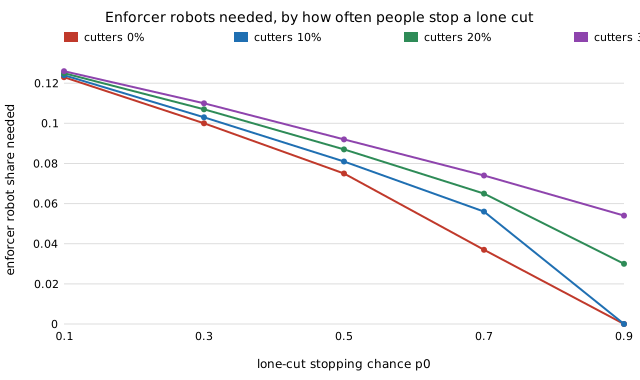
Do real objection rates keep a queue norm? People alone need to stop a lone cut at least 0.786 of the time; Milgram's field reactions (about 0.5, secondary source) imply 7.5% enforcer robots even with no cutters. Inputs not read from the paper; p0 is swept.
What it found
society-enforcers assumed people stop a lone line-cut with probability p0 = 0.9. In the same memory-9 model, people alone keep a queueing norm only if p0 ≥ 0.786 (0.901 at memory 3, 0.698 at 25). Milgram et al. (1986) report, in a popular summary I have not checked against the paper, that field crowds reacted to one intruder about half the time and ejected the intruder 10% of the time, which bounds p0 between 0.1 and 0.5. Across that range the norm needs enforcers even with no cutter robots: 7.5% at p0 = 0.5 and 12.3% at 0.1 (10 in view, stop chance 0.5), and 9.2% and 12.6% against 30% cutters, versus 5.4% at 0.9. Two intruders drew 91% objection against 75% if viewers were independent. Limitations: inputs from a secondary source, a reaction is not a stopped cut, L and q unsourced, binary memory model.
A figure from its own output
Paper, code and results
More in Robot societies among people
- Does a signal-reading door fleet help people once robots are not counted, and for whom?Does a signal-reading door fleet help people once robots are not counted? Only if the urgent cue costs them about a third of what it costs others, or a planner weights urgent waiting; an equal-cost cue hurts people at every weight tried.
- Can a local mean-field predict which robot blocks tip a ring crowd's passing-side convention?A deterministic local mean-field agrees with the society-allies simulation on tip/no-tip in 145 of 160 cells and is almost never too optimistic, but it overstates the share of evenly spread robots needed (0.20 against 0.12 at k = 2).
- Is the mean-field's overshoot on the ring crowd caused by finite-size noise or by memory correlation?Neither alone: a noisy memoryless map tips at 0.06 robot share for spread robots, the simulation at 0.10 and the deterministic mean-field at 0.18 (k = 2).
- Does a measured walking-side preference pin down how many robots tip a crowd's passing side?Fitting the stubborn-bloc model to the side preference Moussaïd et al. (2009) measured for two head-on walkers (about 17.5% left, read from their Fig. 4) puts the mean-field tipping robot share at 0.075 to 0.096 for memory 9 across error rates 0.02 to 0.30, against 0.217 for an unbiased crowd; memory matters more (0.033 to 0.053 at 5, 0.133 to 0.149 at 17) and a stubborn-right bloc raises it.
- Should a robot yield only to people in a hurry, or to everyone?Should a robot yield only to people in a hurry, or to everyone? With 30% robots and 20% urgent people, a fleet that yields only to the urgent cuts their cost by 40% (1.130 to 0.676) at a 3% cost to everyone else, is individually stable, and costs the robots 29%.
- How many robots does it take to change how a crowd walks?How many robots does it take to change which side a crowd walks on? Robots that hold a programmed side tip a crowd once they are 16–32% of it, more when people remember more past partners (simulation matches mean field within 0.02); just short of that they make people collide up to 14× as often as adaptive robots, and placement matters more than numbers when people meet only neighbours. Stylised.
All 31 Robot societies among people projects →
Other research topics
Proper scoring & elicitation28Effort & peer prediction9Verification games & slashing19Detection & tolerances14Markets as routers13Prediction-market design9Paying contributors8Decentralised training systems23Digital twins & sim-to-real164LLM chip design loops40Robot manufacturing loops53Ambient AI assistant46Self-replicating manufacturing34Simulation-first design64Engineered clothing45Task-specific AI accelerators40Algorithmic chip-design loops42Open-source purpose-built robots44The software-engineering loop43Adversarial human imitation41Open-source residential construction41Autonomous multi-angle capture34Sensing, imaging and 3D31Energy supply and dense energy storage39Robot societies among people31Agentic co-design of low-cost robots27Laundry-hanging robots25Machine learning on qualitative data23Robots on the building site27Civilizations & group psychology1History & human sciences1
Produced with AI assistance (Claude). Results are from the code in this repository and are simulated or stylised unless the abstract says otherwise; nothing here implies affiliation with or endorsement by any lab, researcher or company cited. MIT licensed.