Does a signal-reading door fleet help people once robots are not counted, and for whom?
research/society-peoplecost
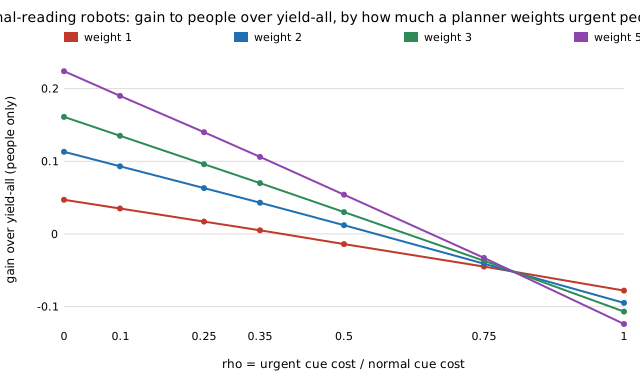
Does a signal-reading door fleet help people once robots are not counted? Only if the urgent cue costs them about a third of what it costs others, or a planner weights urgent waiting; an equal-cost cue hurts people at every weight tried.
What it found
society-cheapcue found the crowd average, robots included, is worse under a reading fleet than under yield-all in all 35 cells, because robots that go against non-signallers collide. Here robots are dropped from the score and a planner weights urgent people's cost by λ (1 = plain average). With 30% robots, 20% urgent people, normal cue cost 0.6, collision cost 3 and dithering cost 1, the fleet helps people at λ = 1 only if the urgent cue costs them ≤ about 0.35 of what it costs normal people (gain +0.005 at ρ = 0.35, +0.017 at 0.25, +0.047 at 0); at ρ = 1 it hurts people at every λ tried (−0.078 at λ = 1, −0.124 at 5). At ρ = 0.25 a planner needs λ ≥ 0.71 to prefer it. A 10% misreading rate cuts the usable ρ at λ = 1 to 0.175 and 20% to 0; with 70% robots people lose even at ρ = 0.25 (−0.109). Mean field from society-fakeurgency, which was checked by simulation. Assumed, not sourced: ρ, cue costs and λ (swept), round-figure door costs, logit sharpness, no robot learning, random pairing.
A figure from its own output
Paper, code and results
More in Robot societies among people
- Can a local mean-field predict which robot blocks tip a ring crowd's passing-side convention?A deterministic local mean-field agrees with the society-allies simulation on tip/no-tip in 145 of 160 cells and is almost never too optimistic, but it overstates the share of evenly spread robots needed (0.20 against 0.12 at k = 2).
- Is the mean-field's overshoot on the ring crowd caused by finite-size noise or by memory correlation?Neither alone: a noisy memoryless map tips at 0.06 robot share for spread robots, the simulation at 0.10 and the deterministic mean-field at 0.18 (k = 2).
- Does a measured walking-side preference pin down how many robots tip a crowd's passing side?Fitting the stubborn-bloc model to the side preference Moussaïd et al. (2009) measured for two head-on walkers (about 17.5% left, read from their Fig. 4) puts the mean-field tipping robot share at 0.075 to 0.096 for memory 9 across error rates 0.02 to 0.30, against 0.217 for an unbiased crowd; memory matters more (0.033 to 0.053 at 5, 0.133 to 0.149 at 17) and a stubborn-right bloc raises it.
- Should a robot yield only to people in a hurry, or to everyone?Should a robot yield only to people in a hurry, or to everyone? With 30% robots and 20% urgent people, a fleet that yields only to the urgent cuts their cost by 40% (1.130 to 0.676) at a 3% cost to everyone else, is individually stable, and costs the robots 29%.
- How many robots does it take to change how a crowd walks?How many robots does it take to change which side a crowd walks on? Robots that hold a programmed side tip a crowd once they are 16–32% of it, more when people remember more past partners (simulation matches mean field within 0.02); just short of that they make people collide up to 14× as often as adaptive robots, and placement matters more than numbers when people meet only neighbours. Stylised.
- Do robots that keep to one side make people walk on it, or jam the corridor?Do robots that keep to one side make people walk on it, or jam the corridor? In a social-force corridor, robots that adapt change nothing, but robots that hold the left cut people's speed from 0.91 to 0.39 of desired by 30% of the crowd and halve lane separation, while people move to their side only gradually (no sharp tipping, unlike the 1D model). Stylised.
All 31 Robot societies among people projects →
Other research topics
Proper scoring & elicitation28Effort & peer prediction9Verification games & slashing19Detection & tolerances14Markets as routers13Prediction-market design9Paying contributors8Decentralised training systems23Digital twins & sim-to-real164LLM chip design loops40Robot manufacturing loops53Ambient AI assistant46Self-replicating manufacturing34Simulation-first design64Engineered clothing45Task-specific AI accelerators40Algorithmic chip-design loops42Open-source purpose-built robots44The software-engineering loop43Adversarial human imitation41Open-source residential construction41Autonomous multi-angle capture34Sensing, imaging and 3D31Energy supply and dense energy storage39Robot societies among people31Agentic co-design of low-cost robots27Laundry-hanging robots25Machine learning on qualitative data23Robots on the building site27Civilizations & group psychology1History & human sciences1
Produced with AI assistance (Claude). Results are from the code in this repository and are simulated or stylised unless the abstract says otherwise; nothing here implies affiliation with or endorsement by any lab, researcher or company cited. MIT licensed.