Does a measured walking-side preference pin down how many robots tip a crowd's passing side?
research/society-sidefit
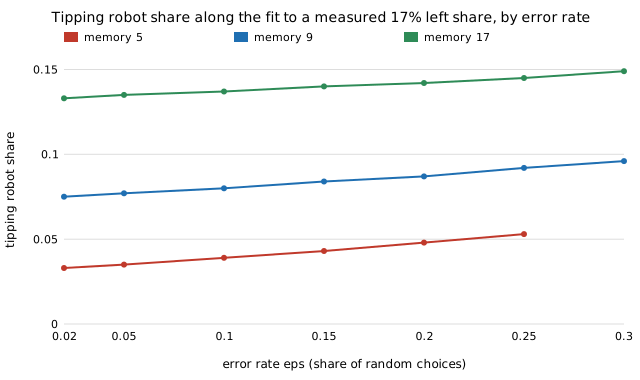
Fitting the stubborn-bloc model to the side preference Moussaïd et al. (2009) measured for two head-on walkers (about 17.5% left, read from their Fig. 4) puts the mean-field tipping robot share at 0.075 to 0.096 for memory 9 across error rates 0.02 to 0.30, against 0.217 for an unbiased crowd; memory matters more (0.033 to 0.053 at 5, 0.133 to 0.149 at 17) and a stubborn-right bloc raises it.
What it found
society-blocs swept the share of always-left people by hand. Here the share is fitted instead: the status-quo crowd must show the left share Moussaïd et al. (2009, Proc. R. Soc. B 276) measured when two walkers meet head on, which I read from their Fig. 4 bars as 0.175 (static obstacle: 0.40; the paper prints no numbers, reading error about 0.01). Always-left share and error rate trade off along the fit (at memory 9: 0.155 at ε = 0.02 down to 0.019 at 0.30), yet the tipping robot share barely moves along it: 0.075 to 0.096, against 0.217 with no bias. Memory length and a stubborn-right bloc move it more (memory 5: 0.033–0.053; 17: 0.133–0.149; with 30% always-right, 0.135–0.151 at memory 9). Simulation (200 people, 12 seeds) reproduces the left share (0.170–0.171) and tips 0 of 12 crowds 0.04 below and 12 of 12 0.04 above the mean-field value. Limits: one binary game in a well-mixed crowd, two walkers in a corridor are not a crowd, the bar heights are read from a figure, and the measured pairs may be partly stubborn and partly noisy in ways this cannot tell apart.
A figure from its own output
Paper, code and results
More in Robot societies among people
- Should a robot yield only to people in a hurry, or to everyone?Should a robot yield only to people in a hurry, or to everyone? With 30% robots and 20% urgent people, a fleet that yields only to the urgent cuts their cost by 40% (1.130 to 0.676) at a 3% cost to everyone else, is individually stable, and costs the robots 29%.
- How many robots does it take to change how a crowd walks?How many robots does it take to change which side a crowd walks on? Robots that hold a programmed side tip a crowd once they are 16–32% of it, more when people remember more past partners (simulation matches mean field within 0.02); just short of that they make people collide up to 14× as often as adaptive robots, and placement matters more than numbers when people meet only neighbours. Stylised.
- Do robots that keep to one side make people walk on it, or jam the corridor?Do robots that keep to one side make people walk on it, or jam the corridor? In a social-force corridor, robots that adapt change nothing, but robots that hold the left cut people's speed from 0.91 to 0.39 of desired by 30% of the crowd and halve lane separation, while people move to their side only gradually (no sharp tipping, unlike the 1D model). Stylised.
- Can a robot fleet's reputation survive one bad incident?Can a robot fleet's reputation survive one bad incident? In a model where trust spreads by experience and gossip, a dent always recovers because people keep meeting robots; reputation is lost only through avoidance (at a 0.30 avoid-below threshold, 20/20, 18/20 and 0/20 crowds recover under neutral, 2× and 4× negativity in gossip), and robots that explain failures recovered every time. Stylised.
- What does it cost robots to let people go first at a shared lift or narrow pavement?What does it cost robots to let people go first at a shared lift or narrow pavement? At load 0.9, deference cuts people's wait 6.5× (4.60 to 0.71) and raises robots' by 2.6 units; total waiting cost is conserved, so it pays only if a person's wait costs more than a robot's, and a lone defector waits far less (2.08 vs 7.65). Queueing model within 2.7% of closed forms.
- Do robot agents keep the norms they state?Do robot agents keep the norms they state? A pluggable town harness with a deterministic stub (no language model run): a robot stating "always yield" keeps it in 1 − 0.4×pressure of meetings (1.00 to 0.60), and people's cost per meeting rises from 0.20 to 1.08. Stylised.
All 31 Robot societies among people projects →
Other research topics
Proper scoring & elicitation28Effort & peer prediction9Verification games & slashing19Detection & tolerances14Markets as routers13Prediction-market design9Paying contributors8Decentralised training systems23Digital twins & sim-to-real164LLM chip design loops40Robot manufacturing loops53Ambient AI assistant46Self-replicating manufacturing34Simulation-first design64Engineered clothing45Task-specific AI accelerators40Algorithmic chip-design loops42Open-source purpose-built robots44The software-engineering loop43Adversarial human imitation41Open-source residential construction41Autonomous multi-angle capture34Sensing, imaging and 3D31Energy supply and dense energy storage39Robot societies among people31Agentic co-design of low-cost robots27Laundry-hanging robots25Machine learning on qualitative data23Robots on the building site27Civilizations & group psychology1History & human sciences1
Produced with AI assistance (Claude). Results are from the code in this repository and are simulated or stylised unless the abstract says otherwise; nothing here implies affiliation with or endorsement by any lab, researcher or company cited. MIT licensed.