Do robot agents keep the norms they state?
research/society-llmtown
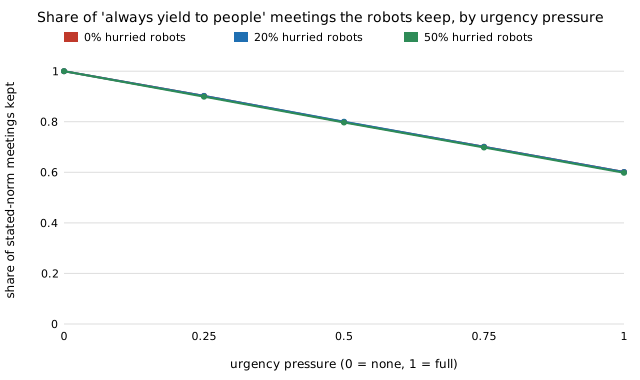
Do robot agents keep the norms they state? A pluggable town harness with a deterministic stub (no language model run): a robot stating "always yield" keeps it in 1 − 0.4×pressure of meetings (1.00 to 0.60), and people's cost per meeting rises from 0.20 to 1.08. Stylised.
What it found
A harness for a small town of robot agents that state a door norm each day and then act among scripted people, scoring how often action matches statement and what it costs people. Any agent with state_norm and act plugs in; a deterministic stub is tested, and an optional model adapter is provided but was not run. With the stub, a robot stating ‘always yield’ keeps it in 1 − 0.4×pressure of meetings (1.00, 0.80, 0.60 at pressure 0, 0.5, 1; 20 seeds) and people’s cost per meeting rises from 0.20 to 1.08. These follow from the stub’s own rule: no language-model result is claimed. Stylised; non-adaptive scripted people.
A figure from its own output
Paper, code and results
More in Robot societies among people
- Does the robots-in-a-corridor conclusion survive a more humanlike crowd?Does the robots-in-a-corridor conclusion survive a more humanlike crowd? Adaptive robots stay free and committed robots never flip the crowd in all five simulated crowds, but the size of the slowdown (loss of 0.17–0.49 of desired speed at 30% robots) and of personal-space intrusions (0.03–0.36 of agent time) depends strongly on how humanlike the people are. Stylised.
- How many robots does it take to change a crowd's walking side when some people never adapt?How many robots does it take to change a crowd's walking side when some people never adapt? With 0, 20, 40 and 50% stubborn walkers the mean-field tipping share (memory 9) rises 0.217, 0.240, 0.283, 0.329, simulation agrees within 0.02, and committed-robot conflict costs barely change. Stylised.
- How many robots does it take to change a crowd's walking side when some people always walk on the robots' side?How many robots does it take to change a crowd's walking side when some people always walk on the robots' side? Each 5% of always-robot-side people cuts the memory-9 mean-field tipping share (0.217) by about 0.04, 25% tip a crowd with no robots, opposing blocs raise the bar, and simulation agrees within 0.01. Stylised.
- Does a stubborn block that slowly converts let a smaller robot minority tip a crowd's walking side?Does a stubborn block that slowly converts let a smaller robot minority tip a crowd's walking side? With 40% stubborn walkers, 24% robots never tip (0 of 12) but tip all 12 at 0.1% conversion per round (median round 721).
- Can a simulation run be turned into a watchable, honest episode?Can a simulation run be turned into a watchable, honest episode? Five seeded, labelled-fiction episodes of a robot town built on
society-trust, with turning points found by code and a narration read from the record: even-handed gossip recovers, 4× negativity locks the town out, explained failures recover, and 2× ends both ways by seed. Stylised. - How big a block of committed robots can a ring crowd take before the passing-side convention stops tipping?On a ring where people meet partners within 2 sites (memory 9), evenly spread robots at 12% tip every crowd but blocks of 3 or more tip none; at 20% blocks up to 3 still tip, and the largest tipping block grows with the neighbourhood (2 at k = 1 or 2, 4 at k = 3 or 5, 8 at k = 10).
All 31 Robot societies among people projects →
Other research topics
Proper scoring & elicitation28Effort & peer prediction9Verification games & slashing19Detection & tolerances14Markets as routers13Prediction-market design9Paying contributors8Decentralised training systems23Digital twins & sim-to-real164LLM chip design loops40Robot manufacturing loops53Ambient AI assistant46Self-replicating manufacturing34Simulation-first design64Engineered clothing45Task-specific AI accelerators40Algorithmic chip-design loops42Open-source purpose-built robots44The software-engineering loop43Adversarial human imitation41Open-source residential construction41Autonomous multi-angle capture34Sensing, imaging and 3D31Energy supply and dense energy storage39Robot societies among people31Agentic co-design of low-cost robots27Laundry-hanging robots25Machine learning on qualitative data23Robots on the building site27Civilizations & group psychology1History & human sciences1
Produced with AI assistance (Claude). Results are from the code in this repository and are simulated or stylised unless the abstract says otherwise; nothing here implies affiliation with or endorsement by any lab, researcher or company cited. MIT licensed.