Does a stubborn block that slowly converts let a smaller robot minority tip a crowd's walking side?
research/society-converts
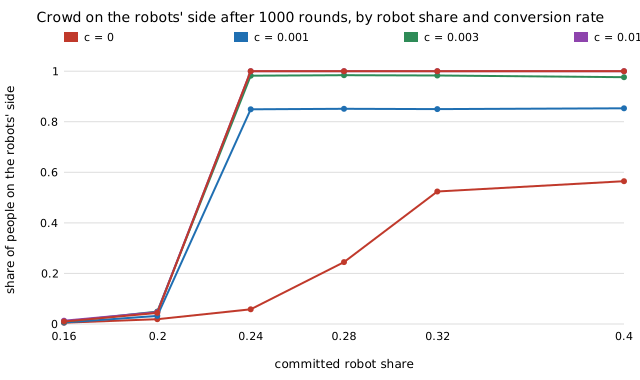
Does a stubborn block that slowly converts let a smaller robot minority tip a crowd's walking side? With 40% stubborn walkers, 24% robots never tip (0 of 12) but tip all 12 at 0.1% conversion per round (median round 721).
What it found
The society-stubborn model with 40% stubborn walkers who each convert to an ordinary memory-rule walker with probability c per round. With the block fixed, 24% committed robots never tip the crowd (0 of 12) and 28% tip 5 of 12; with c = 0.001 both tip all 12 (median round 721 and 185), and at c = 0.1 at round 59 and 31. At 20% or fewer robots no crowd tipped at any c. Conversion mostly buys speed and moves the threshold towards the no-stubborn value. Stylised: simulated walkers, spontaneous conversion, 200 people, 12 seeds; the mean-field clock is only a rank-order check.
A figure from its own output
Paper, code and results
More in Robot societies among people
- Can a simulation run be turned into a watchable, honest episode?Can a simulation run be turned into a watchable, honest episode? Five seeded, labelled-fiction episodes of a robot town built on
society-trust, with turning points found by code and a narration read from the record: even-handed gossip recovers, 4× negativity locks the town out, explained failures recover, and 2× ends both ways by seed. Stylised. - How big a block of committed robots can a ring crowd take before the passing-side convention stops tipping?On a ring where people meet partners within 2 sites (memory 9), evenly spread robots at 12% tip every crowd but blocks of 3 or more tip none; at 20% blocks up to 3 still tip, and the largest tipping block grows with the neighbourhood (2 at k = 1 or 2, 4 at k = 3 or 5, 8 at k = 10).
- If the people on the robots' side fade away, does the crowd stay tipped to the robots' walking side?How fast can a bloc on the robots' side dissolve? With 20% allies converting at rate c per round, the least grid robot share that tips half of 12 crowds rises from 0.02 (no fading) to 0.05, 0.10, 0.10, 0.15 and 0.20 at c = 0.001 to 0.1; tips form in about 50 rounds and persist once allies are gone. Stylised
- Does it matter how far back a fading ally looks: the last partner or the whole memory?Allies who fade by the share of R among only their last k partners (k = 1, 3, 5, 9) tip about as many crowds as the whole-memory rule: at c = 0.01 and robots 0.10, 11 to 12 of 12 against 10 for constant fading; at c = 0.03, robots 0.15, 12 of 12 against 10. Differences between k are one crowd of 12. Stylised
- If allies fade when they see the crowd walking away from them, does the robots' tip survive?Allies who convert only when they have watched the crowd walk the other way. With 20% allies, fading at rate c times the share of R in their memory tips more crowds than a constant rate c once robots are 0.10 or more (12/12 vs 10/12 at c = 0.01, robots 0.10; 4/12 vs 0/12 at c = 0.03), but does nothing below 0.05. Stylised
- How much cheaper must an urgency cue be for the urgent before a door robot can rely on it?How much cheaper must an urgency cue be for the urgent before a door robot can rely on it? Urgent people must pay at most about half what normal people do; the crowd is worse off than under yield-all in every cell.
All 31 Robot societies among people projects →
Other research topics
Proper scoring & elicitation28Effort & peer prediction9Verification games & slashing19Detection & tolerances14Markets as routers13Prediction-market design9Paying contributors8Decentralised training systems23Digital twins & sim-to-real164LLM chip design loops40Robot manufacturing loops53Ambient AI assistant46Self-replicating manufacturing34Simulation-first design64Engineered clothing45Task-specific AI accelerators40Algorithmic chip-design loops42Open-source purpose-built robots44The software-engineering loop43Adversarial human imitation41Open-source residential construction41Autonomous multi-angle capture34Sensing, imaging and 3D31Energy supply and dense energy storage39Robot societies among people31Agentic co-design of low-cost robots27Laundry-hanging robots25Machine learning on qualitative data23Robots on the building site27Civilizations & group psychology1History & human sciences1
Produced with AI assistance (Claude). Results are from the code in this repository and are simulated or stylised unless the abstract says otherwise; nothing here implies affiliation with or endorsement by any lab, researcher or company cited. MIT licensed.