If allies fade when they see the crowd walking away from them, does the robots' tip survive?
research/society-allywatch
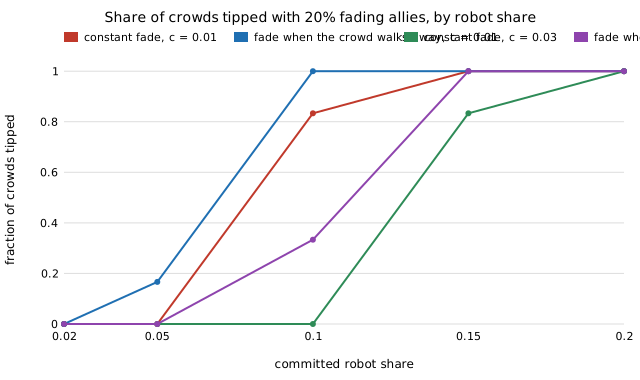
Allies who convert only when they have watched the crowd walk the other way. With 20% allies, fading at rate c times the share of R in their memory tips more crowds than a constant rate c once robots are 0.10 or more (12/12 vs 10/12 at c = 0.01, robots 0.10; 4/12 vs 0/12 at c = 0.03), but does nothing below 0.05. Stylised
What it found
The society-allyfade crowd (200 people, memory 9, error 0.02, 12 seeds, 1500 rounds) with 20% allies who walk the robots' side, comparing a constant fade rate c with a rate c×f, where f is the share of the ally's own memory on the other side. At c = 0.01 and robot share 0.10 all 12 crowds tip with watching allies (about 26 of 40 allies still there) against 10 with constant fading; at c = 0.03 it is 4 against 0 at 0.10 and 12 against 10 at 0.15; at 0.05 robots only 2 of 12 tip at c = 0.01 against 0. The first rounds are the same in both rules (memories start all R, so f = 1), so the gain comes only after the tip begins: allies who watch it stay. Below 0.05 robots, or at c ≥ 0.1, neither rule tips. Stylised: the discouragement rule and its rates are assumed, not measured; simulated walkers only.
A figure from its own output
Paper, code and results
More in Robot societies among people
- How much cheaper must an urgency cue be for the urgent before a door robot can rely on it?How much cheaper must an urgency cue be for the urgent before a door robot can rely on it? Urgent people must pay at most about half what normal people do; the crowd is worse off than under yield-all in every cell.
- At what collision cost does a door stop tempting robots to go first?At what collision cost does a door stop tempting robots to go first? With 30% robots and dithering cost 1, always-yielding robots are individually stable only above a collision cost of 2.80 (waiting cost 1); below it a single robot gains by going though yielding is best for the crowd. The threshold rises with dithering cost and robot share.
- When robots always yield at a door, do people learn to walk through first, and who pays?When robots always yield at a door, do people learn to walk through first, and who pays? Always-yielding robots raise the share of people who go from 0.388 to 0.595 at 50% robots and cut the crowd's cost (1.064 to 0.968); always-going robots raise it to 1.373. Mean field and simulation agree within 0.003.
- Can a few queue-enforcing robots hold a queueing norm against line-cutting robots?How many enforcer robots hold a queue against line-cutting robots? About 5% of the crowd holds the norm against 30% cutters (memory 9, 10 people in view of each cut, stop chance 0.5), simulation agrees. Stylised: view size and stop chance are swept, not sourced.
- Do stubborn walkers who convert after meeting robots let a smaller robot minority tip a crowd's walking side?Do stubborn walkers who convert after meeting robots let a smaller robot minority tip a crowd's walking side? At 24% robots every crowd tips for k = 30 meetings (median round 171) though the fixed block stops it; at 16-20% none tip.
- Can a robot that yields to people in a hurry survive people faking a hurry?Can a robot that yields to people in a hurry survive people faking a hurry? With 30% robots, no signal cost on a 0 to 1.2 grid lets a signal-reading fleet beat yield-all for the crowd, and urgent people keep about 6% of the gain they get from perfect reading.
All 31 Robot societies among people projects →
Other research topics
Proper scoring & elicitation28Effort & peer prediction9Verification games & slashing19Detection & tolerances14Markets as routers13Prediction-market design9Paying contributors8Decentralised training systems23Digital twins & sim-to-real164LLM chip design loops40Robot manufacturing loops53Ambient AI assistant46Self-replicating manufacturing34Simulation-first design64Engineered clothing45Task-specific AI accelerators40Algorithmic chip-design loops42Open-source purpose-built robots44The software-engineering loop43Adversarial human imitation41Open-source residential construction41Autonomous multi-angle capture34Sensing, imaging and 3D31Energy supply and dense energy storage39Robot societies among people31Agentic co-design of low-cost robots27Laundry-hanging robots25Machine learning on qualitative data23Robots on the building site27Civilizations & group psychology1History & human sciences1
Produced with AI assistance (Claude). Results are from the code in this repository and are simulated or stylised unless the abstract says otherwise; nothing here implies affiliation with or endorsement by any lab, researcher or company cited. MIT licensed.