When robots always yield at a door, do people learn to walk through first, and who pays?
research/society-doorway
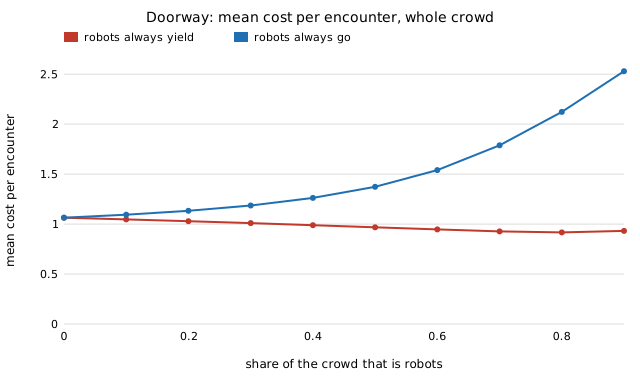
When robots always yield at a door, do people learn to walk through first, and who pays? Always-yielding robots raise the share of people who go from 0.388 to 0.595 at 50% robots and cut the crowd's cost (1.064 to 0.968); always-going robots raise it to 1.373. Mean field and simulation agree within 0.003.
What it found
A go-or-yield (Chicken) game at a door: people respond to their last 9 partners' actions, robots go with a fixed probability. Always-yielding robots raise the share of people who go from 0.388 to 0.595 at 50% robots and lower the crowd's mean cost per encounter from 1.064 to 0.968; always-going robots at 50% leave only 0.113 of people going and raise the crowd's cost to 1.373. Yielding is also the individually best robot rule in this payoff set. Mean field and simulation agree within 0.003. Stylised: random pairing, fixed costs, no geometry.
A figure from its own output
Paper, code and results
More in Robot societies among people
- Can a few queue-enforcing robots hold a queueing norm against line-cutting robots?How many enforcer robots hold a queue against line-cutting robots? About 5% of the crowd holds the norm against 30% cutters (memory 9, 10 people in view of each cut, stop chance 0.5), simulation agrees. Stylised: view size and stop chance are swept, not sourced.
- Do stubborn walkers who convert after meeting robots let a smaller robot minority tip a crowd's walking side?Do stubborn walkers who convert after meeting robots let a smaller robot minority tip a crowd's walking side? At 24% robots every crowd tips for k = 30 meetings (median round 171) though the fixed block stops it; at 16-20% none tip.
- Can a robot that yields to people in a hurry survive people faking a hurry?Can a robot that yields to people in a hurry survive people faking a hurry? With 30% robots, no signal cost on a 0 to 1.2 grid lets a signal-reading fleet beat yield-all for the crowd, and urgent people keep about 6% of the gain they get from perfect reading.
- Does the rule that robot blocks must be narrower than the neighbourhood carry over from a ring to a 2D grid?On a 16x16 torus (memory 9), robot patches up to about 2k+1 sites wide tip every crowd at robot share 0.25 and wider ones tip few or none; one 8x8 patch of all the robots tips none at any neighbourhood radius up to 5.
- Can robots that take over from fading allies keep a crowd tipped, and is that cheaper than fielding them upfront?Is a hand-over cheaper than buying robots first? With 20% allies fading at rate c and 10% robots at the start, replacing half of fading allies with robots tips 10 of 12 crowds at c = 0.03 but ends with 0.19 robots, against 0.15 robots upfront in society-allyfade; below 5% initial robots only full replacement tips anything. Stylised
- Do door robots that learn from their own costs keep honouring an urgency cue?Do door robots that learn from their own costs keep honouring an urgency cue? They keep yielding to cue senders but stop going against everyone else, which erases most of the cue's gain to urgent people.
All 31 Robot societies among people projects →
Other research topics
Proper scoring & elicitation28Effort & peer prediction9Verification games & slashing19Detection & tolerances14Markets as routers13Prediction-market design9Paying contributors8Decentralised training systems23Digital twins & sim-to-real164LLM chip design loops40Robot manufacturing loops53Ambient AI assistant46Self-replicating manufacturing34Simulation-first design64Engineered clothing45Task-specific AI accelerators40Algorithmic chip-design loops42Open-source purpose-built robots44The software-engineering loop43Adversarial human imitation41Open-source residential construction41Autonomous multi-angle capture34Sensing, imaging and 3D31Energy supply and dense energy storage39Robot societies among people31Agentic co-design of low-cost robots27Laundry-hanging robots25Machine learning on qualitative data23Robots on the building site27Civilizations & group psychology1History & human sciences1
Produced with AI assistance (Claude). Results are from the code in this repository and are simulated or stylised unless the abstract says otherwise; nothing here implies affiliation with or endorsement by any lab, researcher or company cited. MIT licensed.