Can a flow-equivalent-server decomposition predict a robot-printer cell's throughput without enumerating its states?
research/robofab-cell-fesc
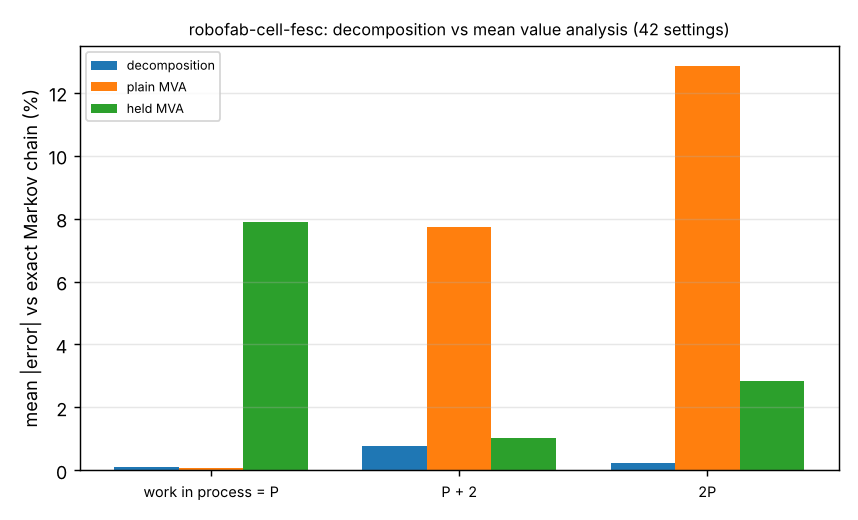
Can a flow-equivalent-server decomposition predict a robot-printer cell without enumerating its states? Mean error 0.3% (max 1.6%) against the exact Markov chain in 42 settings, where plain MVA is off by up to 20%. Stylised.
What it found
A follow-up to the exact Markov-chain project: Norton’s theorem applied to the same stylised cell (one arm, 2–6 printers held through load and unload, one inspector; Erlang print time; illustrative times). The arm-and-printers subsystem is solved exactly at each population and replaced by one load-dependent server. Over the same 42 settings the mean absolute error against the exact chain is 0.32% (maximum 1.57%), against 6.8% (up to 20.3%) for plain mean value analysis and 4.3% for the held-printer variant; in five cells of 8–12 printers it is 0.09–0.31%. It underestimates in 38 of 42 settings because the cell is not product form. The subsystem chain is about a tenth the size of the full chain, but both solve in under a second here, so no speed claim. Stylised: one job class, exponential load, unload and inspect times.
A figure from its own output
Paper, code and results
More in Robot manufacturing loops
- Is the error of queueing analysis of a robot-printer cell from print-time variability or from the cell's structure?Is the error of queueing analysis of a robot-printer cell from print-time variability or from structure? An exact Markov chain says structure: cv 1 to 0.33 moves throughput by at most 0.71%, while plain MVA overshoots up to 20% beyond the printer count.
- Does holding the printer through load and unload fix queueing analysis of a robot-printer cell?Does adding load and unload time to the printer's demand fix MVA of the robot-printer cell? Mixed: it cuts the error at saturation (2.9% against 8.2%) but raises it elsewhere (7.3% against 3.6%), so overall plain MVA is better (4.7% against 6.2%). Stylised.
- Does an arm-wait-aware printer demand fix queueing analysis of a robot-printer cell?Does adding the arm's queueing delay (a fixed point, no fitted parameter) to the held printer's demand fix MVA of the robot-printer cell? No: it underpredicts in all 32 settings and is worse overall (7.9% mean error against 6.2% for held-demand and 4.7% for plain MVA). Negative result. Stylised.
- Can a blocking-aware correction to queueing analysis predict a robot-printer cell across loads?Can a blocking-aware correction to MVA predict the held-printer robot cell across loads? A fitted stall helps only at saturation (1.4% error) and worsens other loads (8.5%); keeping latency apart from capacity gives 3.6% against plain MVA's 4.7% on the design grid, but only ties plain MVA (3.4% against 3.5%) on a held-out job mix. Stylised.
- Can a parallel-jaw arm assemble its own gripper?Can a parallel-jaw arm assemble its own toy gripper? A complete order exists only once the jaw opens to the widest part (30 mm); a top-down-only arm accepts 120 of 720 orderings against 384 with sideways moves; pad thickness changes nothing (negative). Stylised boxes.
- Can a printed gripper assemble its own next generation?Can a printed gripper assemble its own next generation? With fixed-size jaw pads a gripper builds a copy only at scale ≥ pad thickness in mm (4 mm pads: scale 4); a stroke cap of S mm needs 30·pad ≤ S; seeds of 130 and 140 mm sustain a chain, 60 and 100 mm decay. Largely algebraic given an assumed opening; stylised.
All 53 Robot manufacturing loops projects →
Other research topics
Proper scoring & elicitation28Effort & peer prediction9Verification games & slashing19Detection & tolerances14Markets as routers13Prediction-market design9Paying contributors8Decentralised training systems23Digital twins & sim-to-real164LLM chip design loops40Robot manufacturing loops53Ambient AI assistant46Self-replicating manufacturing34Simulation-first design64Engineered clothing45Task-specific AI accelerators40Algorithmic chip-design loops42Open-source purpose-built robots44The software-engineering loop43Adversarial human imitation41Open-source residential construction41Autonomous multi-angle capture34Sensing, imaging and 3D31Energy supply and dense energy storage39Robot societies among people31Agentic co-design of low-cost robots27Laundry-hanging robots25Machine learning on qualitative data23Robots on the building site27Civilizations & group psychology1History & human sciences1
Produced with AI assistance (Claude). Results are from the code in this repository and are simulated or stylised unless the abstract says otherwise; nothing here implies affiliation with or endorsement by any lab, researcher or company cited. MIT licensed.