Does holding the printer through load and unload fix queueing analysis of a robot-printer cell?
research/robofab-cell-held
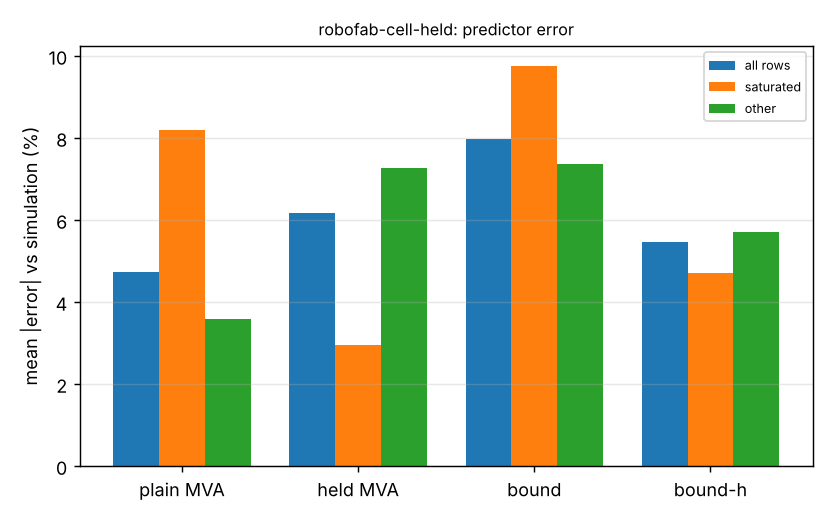
Does adding load and unload time to the printer's demand fix MVA of the robot-printer cell? Mixed: it cuts the error at saturation (2.9% against 8.2%) but raises it elsewhere (7.3% against 3.6%), so overall plain MVA is better (4.7% against 6.2%). Stylised.
What it found
A follow-up to the variability-sweep project: mean value analysis with the printer demand increased by the arm’s load and unload time, compared with plain MVA and two utilisation bounds against the simulated cell (cv 0.3 and 1.0, 4–16 printers, four loads, 20 seeds, 32 settings; illustrative times). The repair helps only at saturation (mean absolute error 2.9% against 8.2% for plain MVA) and hurts elsewhere (7.3% against 3.6%), so over all settings plain MVA is better (4.7% against 6.2%). A mixed result: no single demand setting is right across loads. Stylised and simulation-only.
A figure from its own output
Paper, code and results
More in Robot manufacturing loops
- Does an arm-wait-aware printer demand fix queueing analysis of a robot-printer cell?Does adding the arm's queueing delay (a fixed point, no fitted parameter) to the held printer's demand fix MVA of the robot-printer cell? No: it underpredicts in all 32 settings and is worse overall (7.9% mean error against 6.2% for held-demand and 4.7% for plain MVA). Negative result. Stylised.
- Can a blocking-aware correction to queueing analysis predict a robot-printer cell across loads?Can a blocking-aware correction to MVA predict the held-printer robot cell across loads? A fitted stall helps only at saturation (1.4% error) and worsens other loads (8.5%); keeping latency apart from capacity gives 3.6% against plain MVA's 4.7% on the design grid, but only ties plain MVA (3.4% against 3.5%) on a held-out job mix. Stylised.
- Can a parallel-jaw arm assemble its own gripper?Can a parallel-jaw arm assemble its own toy gripper? A complete order exists only once the jaw opens to the widest part (30 mm); a top-down-only arm accepts 120 of 720 orderings against 384 with sideways moves; pad thickness changes nothing (negative). Stylised boxes.
- Can a printed gripper assemble its own next generation?Can a printed gripper assemble its own next generation? With fixed-size jaw pads a gripper builds a copy only at scale ≥ pad thickness in mm (4 mm pads: scale 4); a stroke cap of S mm needs 30·pad ≤ S; seeds of 130 and 140 mm sustain a chain, 60 and 100 mm decay. Largely algebraic given an assumed opening; stylised.
- How long an arm does it take to assemble its own toy gripper?How long an arm does it take to assemble its own toy gripper? A planar two-link arm needs 60–140 mm links as the tray moves 40–400 mm away, and a 90° elbow limit more than doubles it (stylised).
- Does the assembly order change the arm an arm needs to build its own gripper?Does the assembly order change the arm needed to build its own gripper? Across all 384 valid orders the shortest arm is identical in every setting tried (negative result, stylised).
All 53 Robot manufacturing loops projects →
Other research topics
Proper scoring & elicitation28Effort & peer prediction9Verification games & slashing19Detection & tolerances14Markets as routers13Prediction-market design9Paying contributors8Decentralised training systems23Digital twins & sim-to-real164LLM chip design loops40Robot manufacturing loops53Ambient AI assistant46Self-replicating manufacturing34Simulation-first design64Engineered clothing45Task-specific AI accelerators40Algorithmic chip-design loops42Open-source purpose-built robots44The software-engineering loop43Adversarial human imitation41Open-source residential construction41Autonomous multi-angle capture34Sensing, imaging and 3D31Energy supply and dense energy storage39Robot societies among people31Agentic co-design of low-cost robots27Laundry-hanging robots25Machine learning on qualitative data23Robots on the building site27Civilizations & group psychology1History & human sciences1
Produced with AI assistance (Claude). Results are from the code in this repository and are simulated or stylised unless the abstract says otherwise; nothing here implies affiliation with or endorsement by any lab, researcher or company cited. MIT licensed.