Where should a print-failure detector's alarm threshold go in a robot-arm 3D-printer cell?
research/robofab-cell-detector
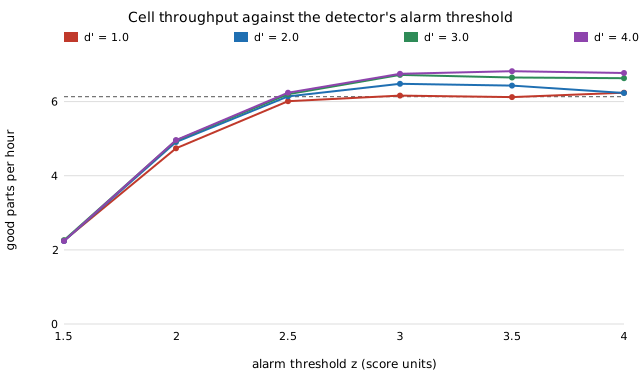
Where should a print-failure detector's alarm threshold go in a robot-arm printer cell? A look every 2 min makes a z = 2 threshold 19 to 23% worse than blind printing; the best z is 3 to 3.5, worth +6% (d' = 2) to +11% (d' = 4). Stylised.
What it found
Replaces the monitor project's fixed detection delay with a detector that looks at a print every few minutes and has a Gaussian score (separation d′) and an alarm threshold z, and asks which z maximises good parts per hour, with an exact analytic bound and a 40-seed discrete-event simulation (6 printers, 0.3 failures per printing hour, looks every 2 min). A threshold that sounds strict (z = 2, 2.3% false alarms per look) makes the cell 19–23% worse than blind printing for every detector quality, because a 60 min print is looked at 30 times; the best z is 3–3.5, and the gain over blind printing is +5.8% at d′ = 2, +9.7% at 3 and +11.3% at 4, and within noise below d′ of about 1. Stylised: looks are independent, which real consecutive frames are not.
A figure from its own output
Paper, code and results
More in Robot manufacturing loops
- Where does a flow-equivalent-server decomposition of a robot-printer cell go wrong as the inspector speeds up or slows down?Where does the flow-equivalent-server decomposition of a robot-printer cell err as the inspector speed varies? Error is 0 for fast and slow inspectors but peaks at −2% to −5% just below the knee where inspector and subsystem rates match, ten times the earlier 0.3% mean. Stylised.
- Can a flow-equivalent-server decomposition predict a robot-printer cell's throughput without enumerating its states?Can a flow-equivalent-server decomposition predict a robot-printer cell without enumerating its states? Mean error 0.3% (max 1.6%) against the exact Markov chain in 42 settings, where plain MVA is off by up to 20%. Stylised.
- Is the error of queueing analysis of a robot-printer cell from print-time variability or from the cell's structure?Is the error of queueing analysis of a robot-printer cell from print-time variability or from structure? An exact Markov chain says structure: cv 1 to 0.33 moves throughput by at most 0.71%, while plain MVA overshoots up to 20% beyond the printer count.
- Does holding the printer through load and unload fix queueing analysis of a robot-printer cell?Does adding load and unload time to the printer's demand fix MVA of the robot-printer cell? Mixed: it cuts the error at saturation (2.9% against 8.2%) but raises it elsewhere (7.3% against 3.6%), so overall plain MVA is better (4.7% against 6.2%). Stylised.
- Does an arm-wait-aware printer demand fix queueing analysis of a robot-printer cell?Does adding the arm's queueing delay (a fixed point, no fitted parameter) to the held printer's demand fix MVA of the robot-printer cell? No: it underpredicts in all 32 settings and is worse overall (7.9% mean error against 6.2% for held-demand and 4.7% for plain MVA). Negative result. Stylised.
- Can a blocking-aware correction to queueing analysis predict a robot-printer cell across loads?Can a blocking-aware correction to MVA predict the held-printer robot cell across loads? A fitted stall helps only at saturation (1.4% error) and worsens other loads (8.5%); keeping latency apart from capacity gives 3.6% against plain MVA's 4.7% on the design grid, but only ties plain MVA (3.4% against 3.5%) on a held-out job mix. Stylised.
All 53 Robot manufacturing loops projects →
Other research topics
Proper scoring & elicitation28Effort & peer prediction9Verification games & slashing19Detection & tolerances14Markets as routers13Prediction-market design9Paying contributors8Decentralised training systems23Digital twins & sim-to-real164LLM chip design loops40Robot manufacturing loops53Ambient AI assistant46Self-replicating manufacturing34Simulation-first design64Engineered clothing45Task-specific AI accelerators40Algorithmic chip-design loops42Open-source purpose-built robots44The software-engineering loop43Adversarial human imitation41Open-source residential construction41Autonomous multi-angle capture34Sensing, imaging and 3D31Energy supply and dense energy storage39Robot societies among people31Agentic co-design of low-cost robots27Laundry-hanging robots25Machine learning on qualitative data23Robots on the building site27Civilizations & group psychology1History & human sciences1
Produced with AI assistance (Claude). Results are from the code in this repository and are simulated or stylised unless the abstract says otherwise; nothing here implies affiliation with or endorsement by any lab, researcher or company cited. MIT licensed.