Where is the bottleneck of an arm, printer and inspection cell?
research/robofab-cell-bound
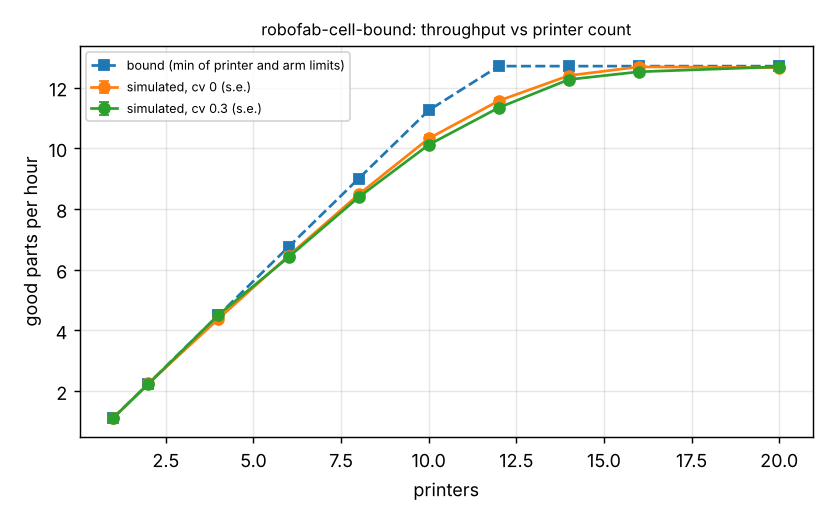
Discrete-event twin of an arm, 3D printers and an inspection station: a utilisation bound names the bottleneck (printers to 10, the arm from 12, ~12.7 good parts/h) and the simulation sits 10–11% below it near the switch; a 25% faster arm lifts 11.34 to 12.68 parts/h at 12 printers, a second inspector nothing (stylised).
What it found
A hand-written discrete-event twin of one arm that loads and unloads P 3D printers, plus an inspection station with reprints, against a utilisation bound. The bound names the bottleneck (printers up to 10 printers, the arm from 12, about 12.7 good parts/h) and the simulation reaches it within 1–2% far from the switch but sits 10–11% below it at 10–12 printers. A 25% faster arm lifts throughput from 11.34 to 12.68 parts/h at 12 printers while a second inspector does nothing; arm dispatch rules made no measurable gain, and WIP beyond one job per printer plus one only lengthens flow time. Stylised parameters of my choosing, no travel or breakdowns, 20 seeds.
A figure from its own output
Paper, code and results
More in Robot manufacturing loops
- Does exact queueing analysis predict a robot-printer cell's throughput better than a utilisation bound?Exact mean value analysis of the arm, printers and inspection network against a discrete-event twin: a few per cent off for exponential times, up to 11% low for less variable ones, better than the utilisation bound in most real-semantics rows, and it overshoots saturation at high work in process. Stylised.
- Where does exact queueing analysis of a robot-printer cell stop working?Coefficient-of-variation sweep and a measured printer stall share for the arm-printer-inspection queueing model: MVA's error crosses zero near cv 1 while the utilisation bound stays high, and held-printer capacity times (1 − stall) reproduces the saturated rate at 4 and 8 printers. Stylised.
- Is a print-failure camera worth it in a robot-arm 3D-printer cell?Is a print-failure camera worth it in a robot-arm printer cell? Blind printing against abort-on-failure: +6 to 10% good parts per hour at 2 to 10 printers, none once the arm limits the cell; break-even false-stop rate. Stylised.
- Where should a print-failure detector's alarm threshold go in a robot-arm 3D-printer cell?Where should a print-failure detector's alarm threshold go in a robot-arm printer cell? A look every 2 min makes a z = 2 threshold 19 to 23% worse than blind printing; the best z is 3 to 3.5, worth +6% (d' = 2) to +11% (d' = 4). Stylised.
- Where does a flow-equivalent-server decomposition of a robot-printer cell go wrong as the inspector speeds up or slows down?Where does the flow-equivalent-server decomposition of a robot-printer cell err as the inspector speed varies? Error is 0 for fast and slow inspectors but peaks at −2% to −5% just below the knee where inspector and subsystem rates match, ten times the earlier 0.3% mean. Stylised.
- Can a flow-equivalent-server decomposition predict a robot-printer cell's throughput without enumerating its states?Can a flow-equivalent-server decomposition predict a robot-printer cell without enumerating its states? Mean error 0.3% (max 1.6%) against the exact Markov chain in 42 settings, where plain MVA is off by up to 20%. Stylised.
All 53 Robot manufacturing loops projects →
Other research topics
Proper scoring & elicitation28Effort & peer prediction9Verification games & slashing19Detection & tolerances14Markets as routers13Prediction-market design9Paying contributors8Decentralised training systems23Digital twins & sim-to-real164LLM chip design loops40Robot manufacturing loops53Ambient AI assistant46Self-replicating manufacturing34Simulation-first design64Engineered clothing45Task-specific AI accelerators40Algorithmic chip-design loops42Open-source purpose-built robots44The software-engineering loop43Adversarial human imitation41Open-source residential construction41Autonomous multi-angle capture34Sensing, imaging and 3D31Energy supply and dense energy storage39Robot societies among people31Agentic co-design of low-cost robots27Laundry-hanging robots25Machine learning on qualitative data23Robots on the building site27Civilizations & group psychology1History & human sciences1
Produced with AI assistance (Claude). Results are from the code in this repository and are simulated or stylised unless the abstract says otherwise; nothing here implies affiliation with or endorsement by any lab, researcher or company cited. MIT licensed.