Do the nails carry a hung wall panel, and how few can act before they fail?
research/house-liftnails
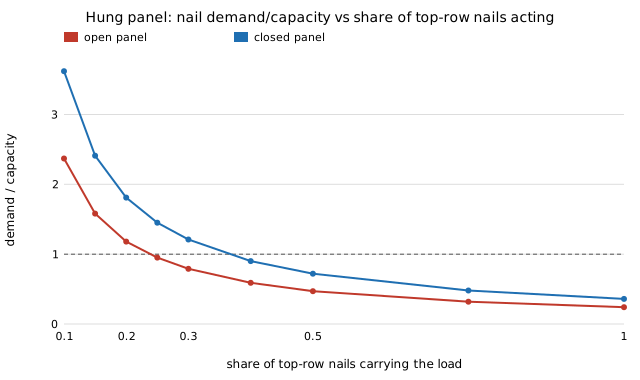
Do the nails carry a hung wall panel? Sheathing-to-top-plate nails take 17–31 lb each (0.20–0.36 of capacity) if they share the load; the closed panel fails when under about 40% of the row acts, and a bare frame's stud end nails get no credit.
What it found
Follows the weight of a lifted house-panellift wall panel down its nail load path. The sheathing-to-top-plate 8d nails at 6 in carry 17–31 lb each, 0.20–0.36 of the 84 lb adjusted lateral value from the yield-limit equations, if they share the load; the closed panel reaches capacity when about 40% of the top row acts (open: about 25%). Field nails are at 0.04. A bare frame hung by its top plate hangs about 24 lb per stud from end-grain withdrawal, which the NDS gives no design value for, so it is credited zero. Stylised: nail inputs are assumed, load sharing is uniform, and slip and the lift hardware are not modelled.
A figure from its own output
Paper, code and results
More in Open-source residential construction
- Can a crane or telehandler lift the house's wall panels, and does anything but weight and wind limit it?Can a crane or telehandler lift the house's wall panels? Weights of the eight
house-offsitepanels (343–559 lb open, 376–877 lb closed), best pick points and top-plate bending (4–12% of allowable with two picks): bending never limits the layout, weight and wind do. Hand-lifting needs 7–18 people; a 20 ft open panel swings 10° at about 12 mph. Stylised, every density and coefficient assumed. - How much CO2 does clinker substitution save, and how far can it go before a cement loses its strength class?Mass, energy and CO2 balance of a tonne of cement: OPC 830 kg CO2, LC3-50 491 (41% lower, 39-43% over every swept input), 50% slag 441; the clinker can fall to 50% and keep class 42.5 only if the OPC reference has 55 MPa of strength, to 54% at 50 MPa.
- How much lumber, labour and heat does advanced framing save in a house's exterior walls, and does it still carry the roof?How much does advanced (OVE) framing save in a house's exterior walls? Stylised 28 × 40 ft house: 42% less wall lumber and 27% fewer pieces than conventional 2x6, whole-wall R 16.2 to 18.6, studs at 39% of capacity under 30 psf snow; the lumber is worth only $450–900 a house, so labour carries the case. Not a code check. First project of track 12.
- How far can a 2x joist, rafter, header or beam span, and which check limits it?How far can a 2x joist, rafter, header or beam span? Open NDS sizing tool, no table copied: 2x10 SPF floor joists at 16 in span 15 ft 3 in, bending governs most floors and snow rafters, deflection most ceilings; deepest joist at 24 in uses 20–50% less lumber (vibration unchecked). Not validated against published tables. Milestone 2 of track 12.
- Does a floor-vibration frequency limit erase the lumber saved by deep, widely spaced joists?Does a floor-vibration frequency limit erase the lumber saved by deep, widely spaced joists? Beam-theory first-mode frequency on the
house-spanschecks: limits up to 10 Hz change nothing, 12 Hz shortens a 2x10 at 16 in from 15 ft 3 in to 13 ft 11 in, 15 Hz moves the least-lumber 12 ft joist from 2x10 to 2x12. Joist alone, limit is a policy knob. Stylised. Track 12. - How much of a floor-vibration penalty does the subfloor's T-beam action recover?How much of a floor-vibration penalty does the subfloor's T-beam action recover? Gamma-method partial-composite stiffness on
house-vibration: at a 15 Hz limit a 2x10 at 16 in grows from 12 ft 6 in to 13 ft 2 in–14 ft 6 in, depending on two assumed inputs (connection efficiency and panel modulus). Stylised.
All 41 Open-source residential construction projects →
Other research topics
Proper scoring & elicitation28Effort & peer prediction9Verification games & slashing19Detection & tolerances14Markets as routers13Prediction-market design9Paying contributors8Decentralised training systems23Digital twins & sim-to-real164LLM chip design loops40Robot manufacturing loops53Ambient AI assistant46Self-replicating manufacturing34Simulation-first design64Engineered clothing45Task-specific AI accelerators40Algorithmic chip-design loops42Open-source purpose-built robots44The software-engineering loop43Adversarial human imitation41Open-source residential construction41Autonomous multi-angle capture34Sensing, imaging and 3D31Energy supply and dense energy storage39Robot societies among people31Agentic co-design of low-cost robots27Laundry-hanging robots25Machine learning on qualitative data23Robots on the building site27Civilizations & group psychology1History & human sciences1
Produced with AI assistance (Claude). Results are from the code in this repository and are simulated or stylised unless the abstract says otherwise; nothing here implies affiliation with or endorsement by any lab, researcher or company cited. MIT licensed.