How much of a floor-vibration penalty does the subfloor's T-beam action recover?
research/house-composite
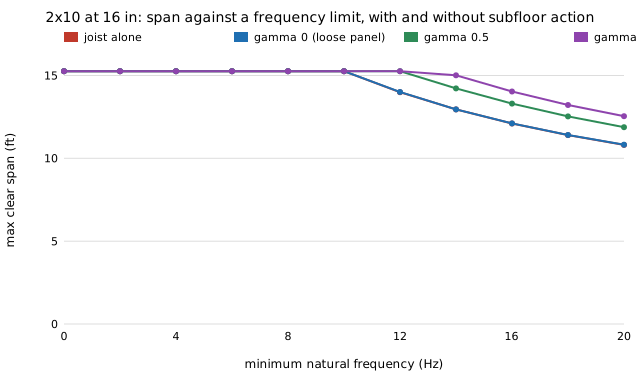
How much of a floor-vibration penalty does the subfloor's T-beam action recover? Gamma-method partial-composite stiffness on house-vibration: at a 15 Hz limit a 2x10 at 16 in grows from 12 ft 6 in to 13 ft 2 in–14 ft 6 in, depending on two assumed inputs (connection efficiency and panel modulus). Stylised.
What it found
The subfloor modelled as a partial flange of a T-beam by the gamma method (rederived from the parallel-axis theorem and tested against an independent transformed-section calculation), added to the frequency check of house-vibration for a 2x10 SPF No. 2 joist at 16 in. The result depends on two assumed, unsourced inputs, the connection efficiency γ and the panel modulus. At a panel modulus of 0.5 million psi the 15 ft first-mode frequency rises from 10.5 Hz to 12.6 Hz at γ 0.5 and 14.0 Hz at γ 1, and under a 15 Hz limit the span grows from 12 ft 6 in to 13 ft 2 in–14 ft 6 in. Strength checks stay joist-alone; live-load mass is left out, so gains are optimistic. Stylised, not validated against a measured floor, not a design.
A figure from its own output
Paper, code and results
More in Open-source residential construction
- Does a joist lapped over a middle support span farther than a simple-span joist?Does a joist lapped over a middle support span farther than a simple span? FE beam with pattern loading and NDS checks: two-span peak moment equals a simple span's, so bending-governed floors and snow rafters gain nothing; deflection-governed ceiling joists gain up to 18.5%; 1.5 in bearing on the middle support cuts a 2x10 floor joist to 11 ft 4 in. Not validated against published tables. Follow-up to
house-spans. - How far can the beam under a two-span joist sit from the middle of the house?How far can the beam under a two-span joist sit from the middle of the house? Bending-governed floor joists lose 0.4% of total width at a short/long span ratio of 0.9 and 13% at 0.5 (the short span relieves the long one); deflection-governed ceiling joists lose about 5% per 0.1 of ratio. A 2x10 floor can have its beam 3.5 ft off the middle of a 28 ft house. Stylised; not a design.
- Can a house plan be data, and which plan needs the least framing lumber per square foot?Can a house plan be data, and which plan needs the least lumber per sq ft? Parametric one-storey plan to framing takeoff, bill of materials, room-rule checks and IFC4; best plans use 4.8 to 5.2 bf/sq ft at 640 to 1,024 sq ft with none feasible by stick framing at 1,400; local search hits the exhaustive optimum in 36 of 40 runs where random search hits none. Stylised, not a design.
- Where does a new home's price go, and which levers move it most?Where does a new home's price go, and which levers move it most? Share-anchored model (NAHB 2024): size moves the price most (87.8 to 112.0 for 1,600 to 2,400 sq ft), then storeys, finish level and lot; a 14% framing-lumber cut is worth 0.85% of price (2.4% with labour). Index not dollars, assumed driver splits. Milestone 4 of track 12.
- Does the house-cost lever ranking survive its assumed driver splits?Does the house-cost lever ranking survive its assumed driver splits? Monte Carlo over the splits: floor area stays the largest lever in 96–100% of draws; storeys is the soft claim (swing 9.0–19.9 vs 14.0 baseline); the lumber result does not move. Index not dollars.
- Which uncertain input of the house-cost model drives the uncertainty in a house's price?Which uncertain input of the house-cost model drives a house's price uncertainty? Sobol indices over every lever range, the framing share and the driver splits at once: floor area 53% of variance, storeys 19%, all framing inputs together under 1%. Index not dollars.
All 41 Open-source residential construction projects →
Other research topics
Proper scoring & elicitation28Effort & peer prediction9Verification games & slashing19Detection & tolerances14Markets as routers13Prediction-market design9Paying contributors8Decentralised training systems23Digital twins & sim-to-real164LLM chip design loops40Robot manufacturing loops53Ambient AI assistant46Self-replicating manufacturing34Simulation-first design64Engineered clothing45Task-specific AI accelerators40Algorithmic chip-design loops42Open-source purpose-built robots44The software-engineering loop43Adversarial human imitation41Open-source residential construction41Autonomous multi-angle capture34Sensing, imaging and 3D31Energy supply and dense energy storage39Robot societies among people31Agentic co-design of low-cost robots27Laundry-hanging robots25Machine learning on qualitative data23Robots on the building site27Civilizations & group psychology1History & human sciences1
Produced with AI assistance (Claude). Results are from the code in this repository and are simulated or stylised unless the abstract says otherwise; nothing here implies affiliation with or endorsement by any lab, researcher or company cited. MIT licensed.