Which uncertain input of the house-cost model drives the uncertainty in a house's price?
research/house-sobol
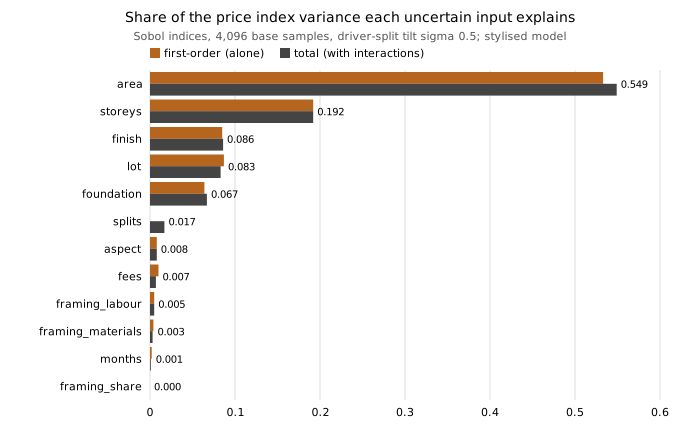
Which uncertain input of the house-cost model drives a house's price uncertainty? Sobol indices over every lever range, the framing share and the driver splits at once: floor area 53% of variance, storeys 19%, all framing inputs together under 1%. Index not dollars.
What it found
A variance-based (Sobol) global sensitivity analysis of house-cost, treating the ten lever ranges, the framing materials share and the assumed driver splits as random at once (4,096 base samples, bootstrap intervals). Floor area explains 53% of the price-index variance and storeys 19%; finish level, lot price and foundation type 6–9% each. The three framing inputs together explain under 1%, so the lumber saving optimised in house-plan barely moves the price of a whole house, and the assumed splits explain none alone and 1.7% through interactions. Per square foot, storeys matters more (25–27%). Stylised: the answer is relative to the assumed uniform ranges and ignores correlations.
A figure from its own output
Paper, code and results
More in Open-source residential construction
- Which envelope upgrades pay for themselves over 30 years, by climate, and does advanced framing belong in the answer?Which envelope upgrades pay back over 30 years, by climate? A degree-day net-present-cost search of 640 packages in eight climates: advanced 2x6 framing is in every optimum (13–15% lower cost than a 2x4 baseline); better windows and R-49 attics do not pay at assumed prices. Stylised, assumed prices, not EnergyPlus.
- Does any alternative to a wood-framed wall beat it on cost, carbon or heat loss for a small house?Does any alternative to a wood-framed wall beat it on cost, carbon or heat loss for a small house? In a stylised model wood 2x6 is cheapest in 97% of random draws and lowest-carbon in 100%; SIP, CLT and printed walls win only on labour. Inputs are ranges from memory.
- Does a small wood-frame house have enough shear wall for wind and earthquakes once the windows and doors are cut out?Does a small wood-frame house have enough shear wall for wind and earthquakes once the openings are cut out? At 115 mph and SDS 0.50 the 28 x 40 ft house uses 19% of a gable-wall line's capacity at 6 in nailing; the openings, not the load, are what shrink it. Stylised, capacities from memory.
- How much does accidental torsion add to the garage-front wall's demand in a rigid-diaphragm wind split?How much does accidental torsion add to the garage-front wall's demand in a rigid-diaphragm wind split? Offsetting the load up to 15% of the length in
house-nailedwall's split raises a 22 ft-door wall from 0.36–0.59 to 0.44–0.71 demand over capacity, still under the flexible 1.05. Stylised. - Does the rigid-diaphragm relief for a garage-front wall survive a nailed-wall stiffness model?Does the rigid-diaphragm relief for a garage-front wall survive a nailed-wall stiffness model? Four-term pier deflection (bending, shear, nail slip, hold-down) in
house-diaphragm's rigid split: yes; a centred 22 ft door falls from 1.05 (flexible) to 0.36–0.59 demand over capacity. Stylised. - Does the half-and-half load split understate the demand on a garage-front wall?Does the half-and-half load split understate the demand on a garage-front wall? In a toy stiffness model a rigid roof diaphragm gives the garage line less than half, so the flexible split governs; stylised, torsion not modelled.
All 41 Open-source residential construction projects →
Other research topics
Proper scoring & elicitation28Effort & peer prediction9Verification games & slashing19Detection & tolerances14Markets as routers13Prediction-market design9Paying contributors8Decentralised training systems23Digital twins & sim-to-real164LLM chip design loops40Robot manufacturing loops53Ambient AI assistant46Self-replicating manufacturing34Simulation-first design64Engineered clothing45Task-specific AI accelerators40Algorithmic chip-design loops42Open-source purpose-built robots44The software-engineering loop43Adversarial human imitation41Open-source residential construction41Autonomous multi-angle capture34Sensing, imaging and 3D31Energy supply and dense energy storage39Robot societies among people31Agentic co-design of low-cost robots27Laundry-hanging robots25Machine learning on qualitative data23Robots on the building site27Civilizations & group psychology1History & human sciences1
Produced with AI assistance (Claude). Results are from the code in this repository and are simulated or stylised unless the abstract says otherwise; nothing here implies affiliation with or endorsement by any lab, researcher or company cited. MIT licensed.