Does a floor-vibration frequency limit erase the lumber saved by deep, widely spaced joists?
research/house-vibration
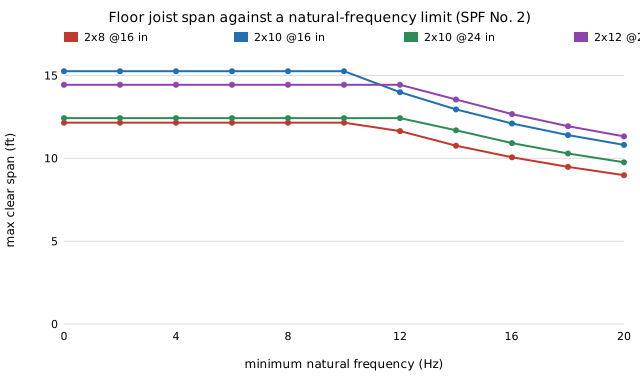
Does a floor-vibration frequency limit erase the lumber saved by deep, widely spaced joists? Beam-theory first-mode frequency on the house-spans checks: limits up to 10 Hz change nothing, 12 Hz shortens a 2x10 at 16 in from 15 ft 3 in to 13 ft 11 in, 15 Hz moves the least-lumber 12 ft joist from 2x10 to 2x12. Joist alone, limit is a policy knob. Stylised. Track 12.
What it found
A first-mode natural-frequency check (f1 = (π/2L2)√(EIg/w), derived and tested against the static-deflection form) added to the NDS strength and deflection checks of house-spans, for SPF No. 2 floor joists under 10 + 40 psf. The joist alone is modelled, with no subfloor composite action. Any limit up to 10 Hz changes nothing: the longest strength-passing 2x10 at 16 in (15 ft 3 in) already vibrates at 10.1 Hz. At 12 Hz it shortens to 13 ft 11 in, and at 15 Hz the least-lumber joist at a 12 ft span moves from 2x10 at 24 in (0.83 board feet per sq ft) to 2x12 at 24 in (1.00), while at 14 ft the 2x12 at 24 in no longer passes and 2x12 at 16 in (1.50) is needed. The limit in Hz is a policy choice swept here, not a code-book criterion, and the model is conservative by ignoring the subfloor and optimistic by ignoring live-load mass. Stylised.
A figure from its own output
Paper, code and results
More in Open-source residential construction
- How much of a floor-vibration penalty does the subfloor's T-beam action recover?How much of a floor-vibration penalty does the subfloor's T-beam action recover? Gamma-method partial-composite stiffness on
house-vibration: at a 15 Hz limit a 2x10 at 16 in grows from 12 ft 6 in to 13 ft 2 in–14 ft 6 in, depending on two assumed inputs (connection efficiency and panel modulus). Stylised. - Does a joist lapped over a middle support span farther than a simple-span joist?Does a joist lapped over a middle support span farther than a simple span? FE beam with pattern loading and NDS checks: two-span peak moment equals a simple span's, so bending-governed floors and snow rafters gain nothing; deflection-governed ceiling joists gain up to 18.5%; 1.5 in bearing on the middle support cuts a 2x10 floor joist to 11 ft 4 in. Not validated against published tables. Follow-up to
house-spans. - How far can the beam under a two-span joist sit from the middle of the house?How far can the beam under a two-span joist sit from the middle of the house? Bending-governed floor joists lose 0.4% of total width at a short/long span ratio of 0.9 and 13% at 0.5 (the short span relieves the long one); deflection-governed ceiling joists lose about 5% per 0.1 of ratio. A 2x10 floor can have its beam 3.5 ft off the middle of a 28 ft house. Stylised; not a design.
- Can a house plan be data, and which plan needs the least framing lumber per square foot?Can a house plan be data, and which plan needs the least lumber per sq ft? Parametric one-storey plan to framing takeoff, bill of materials, room-rule checks and IFC4; best plans use 4.8 to 5.2 bf/sq ft at 640 to 1,024 sq ft with none feasible by stick framing at 1,400; local search hits the exhaustive optimum in 36 of 40 runs where random search hits none. Stylised, not a design.
- Where does a new home's price go, and which levers move it most?Where does a new home's price go, and which levers move it most? Share-anchored model (NAHB 2024): size moves the price most (87.8 to 112.0 for 1,600 to 2,400 sq ft), then storeys, finish level and lot; a 14% framing-lumber cut is worth 0.85% of price (2.4% with labour). Index not dollars, assumed driver splits. Milestone 4 of track 12.
- Does the house-cost lever ranking survive its assumed driver splits?Does the house-cost lever ranking survive its assumed driver splits? Monte Carlo over the splits: floor area stays the largest lever in 96–100% of draws; storeys is the soft claim (swing 9.0–19.9 vs 14.0 baseline); the lumber result does not move. Index not dollars.
All 41 Open-source residential construction projects →
Other research topics
Proper scoring & elicitation28Effort & peer prediction9Verification games & slashing19Detection & tolerances14Markets as routers13Prediction-market design9Paying contributors8Decentralised training systems23Digital twins & sim-to-real164LLM chip design loops40Robot manufacturing loops53Ambient AI assistant46Self-replicating manufacturing34Simulation-first design64Engineered clothing45Task-specific AI accelerators40Algorithmic chip-design loops42Open-source purpose-built robots44The software-engineering loop43Adversarial human imitation41Open-source residential construction41Autonomous multi-angle capture34Sensing, imaging and 3D31Energy supply and dense energy storage39Robot societies among people31Agentic co-design of low-cost robots27Laundry-hanging robots25Machine learning on qualitative data23Robots on the building site27Civilizations & group psychology1History & human sciences1
Produced with AI assistance (Claude). Results are from the code in this repository and are simulated or stylised unless the abstract says otherwise; nothing here implies affiliation with or endorsement by any lab, researcher or company cited. MIT licensed.