How much CO2 does clinker substitution save, and how far can it go before a cement loses its strength class?
research/infra-cement
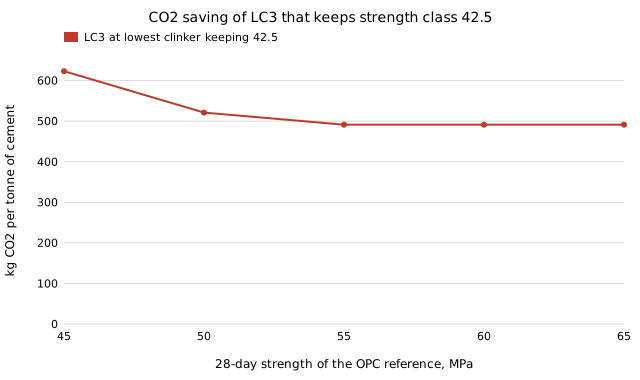
Mass, energy and CO2 balance of a tonne of cement: OPC 830 kg CO2, LC3-50 491 (41% lower, 39-43% over every swept input), 50% slag 441; the clinker can fall to 50% and keep class 42.5 only if the OPC reference has 55 MPa of strength, to 54% at 50 MPa.
What it found
Calcination CO2 is computed from molar masses (784.8 kg per tonne CaO, 510 per tonne clinker at 65 % CaO), kiln fuel from 3.4 GJ/t clinker and IPCC factors, and seven blends (OPC, limestone, two slag, three limestone calcined clay) are balanced per tonne of cement: OPC 830 kg CO2, LC3-50 491 (−41 %), slag-50 441 (−47 %). The LC3 saving stays within 39 to 43 % as calcined-clay energy, grid carbon, grinding energy, kiln heat and fuel carbon are swept; slag’s depends on how blast-furnace CO2 is allocated (41 to 50 %). Against one study’s 28-day LC3 strengths relative to CEM I, the lowest clinker content that keeps EN 197-1 class 42.5 is 50 % from a 55 MPa OPC reference, 54 % from 50 and 68 % from 45. Not sourced from primary papers (blocked): the strength table (a search summary of one study, which another study contradicts at 50 %), the kiln heat and CaO share (secondary reports), IPCC factors (from memory); assumed and swept: grinding energy, grid carbon, calciner energy. Slag strength is not modelled.
A figure from its own output
Paper, code and results
More in Open-source residential construction
- How much lumber, labour and heat does advanced framing save in a house's exterior walls, and does it still carry the roof?How much does advanced (OVE) framing save in a house's exterior walls? Stylised 28 × 40 ft house: 42% less wall lumber and 27% fewer pieces than conventional 2x6, whole-wall R 16.2 to 18.6, studs at 39% of capacity under 30 psf snow; the lumber is worth only $450–900 a house, so labour carries the case. Not a code check. First project of track 12.
- How far can a 2x joist, rafter, header or beam span, and which check limits it?How far can a 2x joist, rafter, header or beam span? Open NDS sizing tool, no table copied: 2x10 SPF floor joists at 16 in span 15 ft 3 in, bending governs most floors and snow rafters, deflection most ceilings; deepest joist at 24 in uses 20–50% less lumber (vibration unchecked). Not validated against published tables. Milestone 2 of track 12.
- Does a floor-vibration frequency limit erase the lumber saved by deep, widely spaced joists?Does a floor-vibration frequency limit erase the lumber saved by deep, widely spaced joists? Beam-theory first-mode frequency on the
house-spanschecks: limits up to 10 Hz change nothing, 12 Hz shortens a 2x10 at 16 in from 15 ft 3 in to 13 ft 11 in, 15 Hz moves the least-lumber 12 ft joist from 2x10 to 2x12. Joist alone, limit is a policy knob. Stylised. Track 12. - How much of a floor-vibration penalty does the subfloor's T-beam action recover?How much of a floor-vibration penalty does the subfloor's T-beam action recover? Gamma-method partial-composite stiffness on
house-vibration: at a 15 Hz limit a 2x10 at 16 in grows from 12 ft 6 in to 13 ft 2 in–14 ft 6 in, depending on two assumed inputs (connection efficiency and panel modulus). Stylised. - Does a joist lapped over a middle support span farther than a simple-span joist?Does a joist lapped over a middle support span farther than a simple span? FE beam with pattern loading and NDS checks: two-span peak moment equals a simple span's, so bending-governed floors and snow rafters gain nothing; deflection-governed ceiling joists gain up to 18.5%; 1.5 in bearing on the middle support cuts a 2x10 floor joist to 11 ft 4 in. Not validated against published tables. Follow-up to
house-spans. - How far can the beam under a two-span joist sit from the middle of the house?How far can the beam under a two-span joist sit from the middle of the house? Bending-governed floor joists lose 0.4% of total width at a short/long span ratio of 0.9 and 13% at 0.5 (the short span relieves the long one); deflection-governed ceiling joists lose about 5% per 0.1 of ratio. A 2x10 floor can have its beam 3.5 ft off the middle of a 28 ft house. Stylised; not a design.
All 41 Open-source residential construction projects →
Other research topics
Proper scoring & elicitation28Effort & peer prediction9Verification games & slashing19Detection & tolerances14Markets as routers13Prediction-market design9Paying contributors8Decentralised training systems23Digital twins & sim-to-real164LLM chip design loops40Robot manufacturing loops53Ambient AI assistant46Self-replicating manufacturing34Simulation-first design64Engineered clothing45Task-specific AI accelerators40Algorithmic chip-design loops42Open-source purpose-built robots44The software-engineering loop43Adversarial human imitation41Open-source residential construction41Autonomous multi-angle capture34Sensing, imaging and 3D31Energy supply and dense energy storage39Robot societies among people31Agentic co-design of low-cost robots27Laundry-hanging robots25Machine learning on qualitative data23Robots on the building site27Civilizations & group psychology1History & human sciences1
Produced with AI assistance (Claude). Results are from the code in this repository and are simulated or stylised unless the abstract says otherwise; nothing here implies affiliation with or endorsement by any lab, researcher or company cited. MIT licensed.