Does a fabric lever still pay once you weight it by where the garment is worn?
research/garment-wearmix
Weights garment-comfortcost's fabric levers by wearing time and adds a gated infrared lever: a fixed infrared-transparent shell pays only with a warm-room majority (above 75.5% of time against the cool room), white never harms, and the gate is chosen only when it costs about the fixed shell's premium or less. Stylised; premiums and wearing shares assumed.
What it found
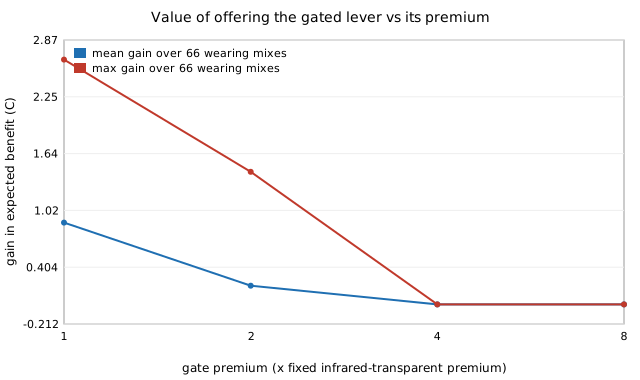
Weights the comfort benefit of fabric levers by wearing time across a warm room, sunny outdoors and a cool room, and adds an idealised gated infrared lever. A fixed infrared-transparent shell has positive expected benefit only if the warm room takes more than 75.5% of wearing time (against the cool room); white never harms and has the best benefit per dollar in all four mixes tried. Across 66 wearing mixes the best garment changes with the mix, and the gate is chosen in 65 of 66 mixes at the fixed shell's premium but in 18 of 66 at twice it and none at four times. Stylised: premiums, gate cost and wearing shares are assumed, and the gate is an upper bound.
A figure from its own output
Paper, code and results
More in Engineered clothing
- How many home-sewn coats before the labour cost per coat settles?How many home-sewn replica coats until labour cost settles? On a Wright learning curve (assumed first coat 4× an experienced operator, rate 0.85) it takes 20 coats to get within 2× of factory time; the first coat stays under $50 only if your time is valued at ≤$1.45/h. Learning parameters assumed. Stylised.
- How much longer must a $2,850 coat last to beat a $56 replica on cost per wear?How much longer must a $2,850 coat last than a $56 replica to win on cost per wear? About 46× with no resale and equal care; needs a median life near 3,100 wears to win half the time. Lifetimes, care and resale assumed. Stylised.
- Is a second garment better than a dearer single one?Is a second garment better than a dearer single one? A shell-and-layer pair beats the best single garment at the same budget in 54 of 66 wearing mixes at $50 and $100 (mean +0.49 C and +1.02 C) once thin cloth is removed; the apparent $20 gain is an artefact of thin cloth's negative assumed cost. Stylised; premiums and wearing shares assumed.
- How often can a wearer pick the wrong garment before a second garment stops paying?How often can a wearer pick the wrong garment before a second garment stops paying? With random wrong picks the pair's edge over one garment holds (+0.57 C at 30% error, $100); if every mistake is the worst option it falls from +0.55 to +0.09 C (stylised).
- How much conductive yarn does an RF-shielding fabric need, and how fast does breakage ruin it?RF-shielding weave model: 54–87 dB sheet shielding but the aperture bound caps it (36 dB at 2.4 GHz for 1 mm pitch, ~15 dB at 28 GHz); yarn breakage tracks 1/(1−2f) and conduction fails near 50% broken. Stylised; plane wave, ideal crossings, RF part only.
- Does contact resistance at yarn crossings matter for an RF-shielding fabric?Contact resistance at yarn crossings in the RF-shielding weave: no effect on an intact fabric, but with 20% of yarns broken a contact equal to one segment raises sheet resistance 22% and ten segments 2.3×. Stylised; contact values are a sweep, not measured.
All 45 Engineered clothing projects →
Other research topics
Proper scoring & elicitation28Effort & peer prediction9Verification games & slashing19Detection & tolerances14Markets as routers13Prediction-market design9Paying contributors8Decentralised training systems23Digital twins & sim-to-real164LLM chip design loops40Robot manufacturing loops53Ambient AI assistant46Self-replicating manufacturing34Simulation-first design64Engineered clothing45Task-specific AI accelerators40Algorithmic chip-design loops42Open-source purpose-built robots44The software-engineering loop43Adversarial human imitation41Open-source residential construction41Autonomous multi-angle capture34Sensing, imaging and 3D31Energy supply and dense energy storage39Robot societies among people31Agentic co-design of low-cost robots27Laundry-hanging robots25Machine learning on qualitative data23Robots on the building site27Civilizations & group psychology1History & human sciences1
Produced with AI assistance (Claude). Results are from the code in this repository and are simulated or stylised unless the abstract says otherwise; nothing here implies affiliation with or endorsement by any lab, researcher or company cited. MIT licensed.