What does a degree of comfort cost in fabric?
research/garment-comfortcost
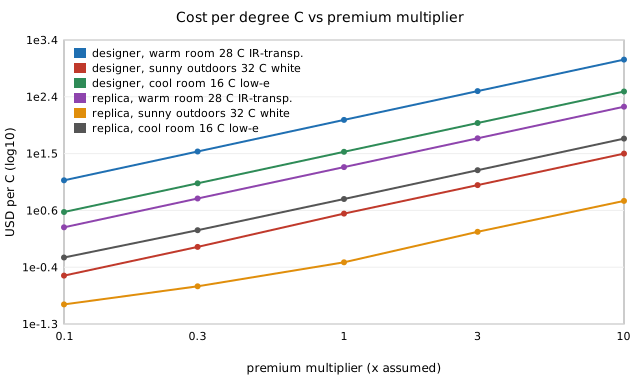
Joins garment-thermal comfort shifts to garment-teardown costs: only one fabric treatment helps in each scenario, levers combine sub-additively, and at assumed premiums a degree costs $0.5 to $19 on a replica trench but $3 to $114 on a designer one. Stylised; premiums assumed.
What it found
Joins the thermal comfort model to the garment cost chain for five fabric levers (infrared transmittance, low emissivity, white, thinner, thicker cloth). Levers combine sub-additively (infrared-transparent plus thin: +2.58 °C jointly, +3.25 summed), and in each scenario only one treatment helps, so a price premium sets cost, not ranking. At assumed premiums the treatments cost $0.5 to $19 per °C on a $20–50 replica trench and $3 to $114 on a designer one, because the retail chain multiplies the premium about 6×. Stylised: every premium and the thickness pricing are assumed, not quoted, and the comfort model has no reference for its optical extension.
A figure from its own output
Paper, code and results
More in Engineered clothing
- Does a fabric lever still pay once you weight it by where the garment is worn?Weights
garment-comfortcost's fabric levers by wearing time and adds a gated infrared lever: a fixed infrared-transparent shell pays only with a warm-room majority (above 75.5% of time against the cool room), white never harms, and the gate is chosen only when it costs about the fixed shell's premium or less. Stylised; premiums and wearing shares assumed. - How many home-sewn coats before the labour cost per coat settles?How many home-sewn replica coats until labour cost settles? On a Wright learning curve (assumed first coat 4× an experienced operator, rate 0.85) it takes 20 coats to get within 2× of factory time; the first coat stays under $50 only if your time is valued at ≤$1.45/h. Learning parameters assumed. Stylised.
- How much longer must a $2,850 coat last to beat a $56 replica on cost per wear?How much longer must a $2,850 coat last than a $56 replica to win on cost per wear? About 46× with no resale and equal care; needs a median life near 3,100 wears to win half the time. Lifetimes, care and resale assumed. Stylised.
- Is a second garment better than a dearer single one?Is a second garment better than a dearer single one? A shell-and-layer pair beats the best single garment at the same budget in 54 of 66 wearing mixes at $50 and $100 (mean +0.49 C and +1.02 C) once thin cloth is removed; the apparent $20 gain is an artefact of thin cloth's negative assumed cost. Stylised; premiums and wearing shares assumed.
- How often can a wearer pick the wrong garment before a second garment stops paying?How often can a wearer pick the wrong garment before a second garment stops paying? With random wrong picks the pair's edge over one garment holds (+0.57 C at 30% error, $100); if every mistake is the worst option it falls from +0.55 to +0.09 C (stylised).
- How much conductive yarn does an RF-shielding fabric need, and how fast does breakage ruin it?RF-shielding weave model: 54–87 dB sheet shielding but the aperture bound caps it (36 dB at 2.4 GHz for 1 mm pitch, ~15 dB at 28 GHz); yarn breakage tracks 1/(1−2f) and conduction fails near 50% broken. Stylised; plane wave, ideal crossings, RF part only.
All 45 Engineered clothing projects →
Other research topics
Proper scoring & elicitation28Effort & peer prediction9Verification games & slashing19Detection & tolerances14Markets as routers13Prediction-market design9Paying contributors8Decentralised training systems23Digital twins & sim-to-real164LLM chip design loops40Robot manufacturing loops53Ambient AI assistant46Self-replicating manufacturing34Simulation-first design64Engineered clothing45Task-specific AI accelerators40Algorithmic chip-design loops42Open-source purpose-built robots44The software-engineering loop43Adversarial human imitation41Open-source residential construction41Autonomous multi-angle capture34Sensing, imaging and 3D31Energy supply and dense energy storage39Robot societies among people31Agentic co-design of low-cost robots27Laundry-hanging robots25Machine learning on qualitative data23Robots on the building site27Civilizations & group psychology1History & human sciences1
Produced with AI assistance (Claude). Results are from the code in this repository and are simulated or stylised unless the abstract says otherwise; nothing here implies affiliation with or endorsement by any lab, researcher or company cited. MIT licensed.