Does contact resistance at yarn crossings matter for an RF-shielding fabric?
research/garment-contactres
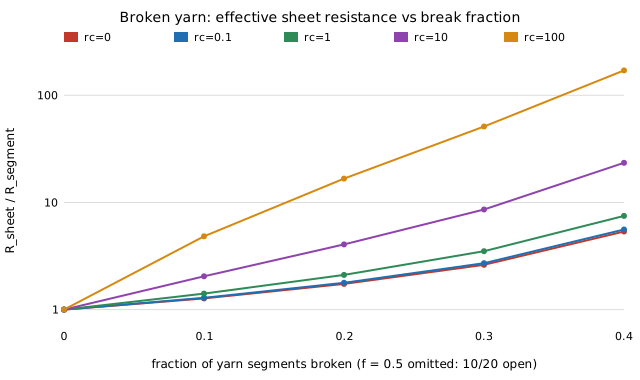
Contact resistance at yarn crossings in the RF-shielding weave: no effect on an intact fabric, but with 20% of yarns broken a contact equal to one segment raises sheet resistance 22% and ten segments 2.3×. Stylised; contact values are a sweep, not measured.
What it found
A two-layer resistor network of a conductive weave: warp and weft touch only through a contact resistor at each crossing, and yarn segments break at random. On an intact fabric the contacts carry no current, so they have no effect at all. Once yarns break they carry the bypass currents: with 20% of segments broken, the median sheet resistance is 1.74 segment-resistances with perfect contacts, 2.11 with contacts equal to one segment, 4.07 at ten and 16.7 at a hundred. For a stylised stainless weave that is 59.6 dB against 52.3 dB at ten segments (thin-sheet only, aperture limit excluded). Stylised: contact values are a sweep, not measurements; one lattice size, 20 draws, independent breaks.
A figure from its own output
Paper, code and results
More in Engineered clothing
- Does it matter where an RF-shielding fabric is damaged, and whether worn contacts go with the breaks?Correlated damage in the RF-shielding weave: worn contacts next to breaks (rc×10) raise the median sheet resistance at 20% broken from 2.05 to 3.03 segments; a fold band across the current direction at the same mean breakage leaves 57 of 60 draws open, while a fold along it helps. Stylised; wear multiplier is a sweep, not measured.
- How thin must a coating be to colour a fibre without dye, and how fragile is that colour?Thin-film transfer-matrix structural colour on a nylon-like substrate: 6-pair stacks reach 99% reflectance with 2–3 g/m² of oxide but blue-shift 48 ΔE by 60° incidence, and 10% layer-thickness error moves hue by ΔE≈10. Stylised; flat substrate, no dispersion.
- Can an optimiser cut the angle shift of a structural-colour coating, and what does it give up?Optimising 8-layer thin-film stacks for low angle shift at fixed colour: Nelder–Mead restarts cut mean ΔE76 shift from 12.4 to 1.4 (red) and 25.9 to 5.6 (blue) at 3000 evaluations, beating random search and differential evolution, at the cost of chroma and ~1.8–2.5× oxide mass. Stylised; flat substrate, no tolerance.
- Does an angle-stable structural-colour stack survive layer-thickness error?Thickness-error robustness of the
garment-stackoptangle-stable stacks: the nominal optimum (J 1.4) degrades to 24.9 at 3% layer error and loses to the quarter-wave stack; a sampled robust objective at equal cost recovers part of it (red, 3%: 11.7 vs 13.2 quarter-wave) but not colour drift. Stylised; independent Gaussian errors, 10 seeds. - Does a tail-risk objective, or a correlated-error model, rescue the angle-stable structural-colour stack?Negative follow-up to
garment-stackrobust: a CVaR (worst-quarter) training objective and a correlated rate-drift error model do not rescue the optimised angle-stable stacks; none beats the quarter-wave stack (red, iid error: mean J 14.1 vs best optimised 16.5). CVaR trims Nelder-Mead's 90th-percentile cost (47.1 to 43.1) at the price of the mean. Stylised; no coating measured. - How much angle shift can a structural-colour coating shed at a given chroma and oxide mass?Shift against chroma and oxide mass for the
garment-stackopt8-layer coating: on a grid of chroma floors and mass caps, the best red-target shift is 0.68 at a 4.0 g/m² cap but 2.71 at 3.0 and no feasible run at 2.0 or below (floor C* 40); mass binds before chroma. Stylised; 5 seeds per cell, one optimiser.
All 45 Engineered clothing projects →
Other research topics
Proper scoring & elicitation28Effort & peer prediction9Verification games & slashing19Detection & tolerances14Markets as routers13Prediction-market design9Paying contributors8Decentralised training systems23Digital twins & sim-to-real164LLM chip design loops40Robot manufacturing loops53Ambient AI assistant46Self-replicating manufacturing34Simulation-first design64Engineered clothing45Task-specific AI accelerators40Algorithmic chip-design loops42Open-source purpose-built robots44The software-engineering loop43Adversarial human imitation41Open-source residential construction41Autonomous multi-angle capture34Sensing, imaging and 3D31Energy supply and dense energy storage39Robot societies among people31Agentic co-design of low-cost robots27Laundry-hanging robots25Machine learning on qualitative data23Robots on the building site27Civilizations & group psychology1History & human sciences1
Produced with AI assistance (Claude). Results are from the code in this repository and are simulated or stylised unless the abstract says otherwise; nothing here implies affiliation with or endorsement by any lab, researcher or company cited. MIT licensed.