Does an angle-stable structural-colour stack survive layer-thickness error?
research/garment-stackrobust
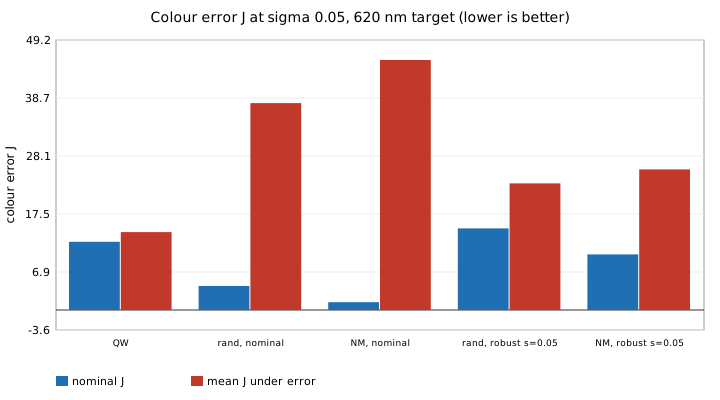
Thickness-error robustness of the garment-stackopt angle-stable stacks: the nominal optimum (J 1.4) degrades to 24.9 at 3% layer error and loses to the quarter-wave stack; a sampled robust objective at equal cost recovers part of it (red, 3%: 11.7 vs 13.2 quarter-wave) but not colour drift. Stylised; independent Gaussian errors, 10 seeds.
What it found
The 8-layer stacks optimised in garment-stackopt are fabricated virtually with independent Gaussian thickness error (3 and 5%) and scored on 200 held-out draws. The nominal optimum (angle shift 1.4 ΔE76) degrades to a mean cost of 24.9 at 3% error, worse than the plain quarter-wave stack (13.2), and only about half of draws keep an acceptable colour. A robust objective averaged over six error draws, at equal total cost, recovers part of this (red target, 3%: 11.7 against 13.2) but not the colour drift, and at 5% error or the blue target the quarter-wave stack is hard to beat. Stylised: flat substrate, no dispersion, uncorrelated errors, 10 seeds, no significance tests, two optimisers.
A figure from its own output
Paper, code and results
More in Engineered clothing
- Does a tail-risk objective, or a correlated-error model, rescue the angle-stable structural-colour stack?Negative follow-up to
garment-stackrobust: a CVaR (worst-quarter) training objective and a correlated rate-drift error model do not rescue the optimised angle-stable stacks; none beats the quarter-wave stack (red, iid error: mean J 14.1 vs best optimised 16.5). CVaR trims Nelder-Mead's 90th-percentile cost (47.1 to 43.1) at the price of the mean. Stylised; no coating measured. - How much angle shift can a structural-colour coating shed at a given chroma and oxide mass?Shift against chroma and oxide mass for the
garment-stackopt8-layer coating: on a grid of chroma floors and mass caps, the best red-target shift is 0.68 at a 4.0 g/m² cap but 2.71 at 3.0 and no feasible run at 2.0 or below (floor C* 40); mass binds before chroma. Stylised; 5 seeds per cell, one optimiser. - Does adding layers cut the angle shift of a structural-colour coating at fixed chroma and oxide mass?Layer-count sweep (2 to 12) of the constrained structural-colour coating: six to ten layers reach best angle shifts under 1 dE at C* 40 and 4 g/m2 where 2 and 4 layers stay near 3.4, but 12 layers did not search well at the same budget (stylised, 8 seeds).
- Does an assistive garment pay for its own mass?One-joint ankle exosuit model: active assist cuts modelled whole-body cost 3–14% (gain 0.1–0.5) but a few kg of garment mass erases it; break-even mass ∝ 1/(mass sensitivity). Stylised; assumed constants, no OpenSim/MyoSuite.
- Is it the motor or the battery that decides whether an exosuit pays for its own mass?Adds a motor and battery mass model to the ankle exosuit: at an assumed 8 N m/kg the motor (about 8 kg) makes a gain-0.3 suit raise cost 0.2–1.9%; the sign flips between 8 and 20 N m/kg, battery hours matter little. Stylised; assumed constants.
- Does it pay to move an exosuit's motor and battery from the shank to the waist?Moves the exosuit's motor and battery from shank to waist: the waist layout wins once a shank kg costs more than 1.03–1.39× a waist kg (assumed ratio, swept); at ratio 3 and 8 N m/kg shank +20.7% vs waist +3.3%. Stylised.
All 45 Engineered clothing projects →
Other research topics
Proper scoring & elicitation28Effort & peer prediction9Verification games & slashing19Detection & tolerances14Markets as routers13Prediction-market design9Paying contributors8Decentralised training systems23Digital twins & sim-to-real164LLM chip design loops40Robot manufacturing loops53Ambient AI assistant46Self-replicating manufacturing34Simulation-first design64Engineered clothing45Task-specific AI accelerators40Algorithmic chip-design loops42Open-source purpose-built robots44The software-engineering loop43Adversarial human imitation41Open-source residential construction41Autonomous multi-angle capture34Sensing, imaging and 3D31Energy supply and dense energy storage39Robot societies among people31Agentic co-design of low-cost robots27Laundry-hanging robots25Machine learning on qualitative data23Robots on the building site27Civilizations & group psychology1History & human sciences1
Produced with AI assistance (Claude). Results are from the code in this repository and are simulated or stylised unless the abstract says otherwise; nothing here implies affiliation with or endorsement by any lab, researcher or company cited. MIT licensed.