Does an assistive garment pay for its own mass?
research/garment-assist
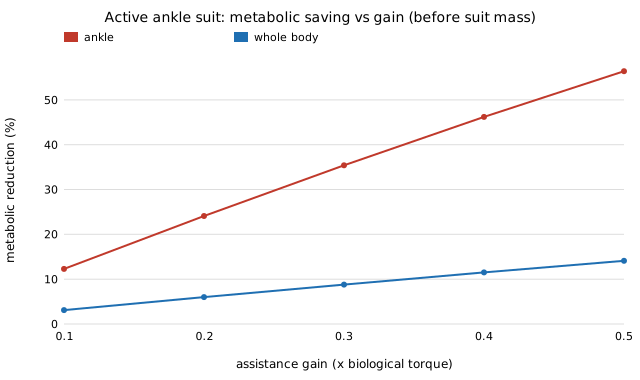
One-joint ankle exosuit model: active assist cuts modelled whole-body cost 3–14% (gain 0.1–0.5) but a few kg of garment mass erases it; break-even mass ∝ 1/(mass sensitivity). Stylised; assumed constants, no OpenSim/MyoSuite.
What it found
A one-joint ankle model of an exosuit-style garment: a suit adding a fraction of the biological push-off torque cuts modelled whole-body metabolic cost by 3.1, 8.8 and 14.1% at gains 0.1, 0.3 and 0.5, but a delay of 0.25 of the gait cycle removes the benefit and a stiff passive spring raises ankle cost 17%. Added mass erases the saving at 8.9 kg if each kg costs 1% of whole-body power and at 1.8 kg if it costs 5%; the break-even scales as 1/sensitivity, a number the project does not supply. Stylised: lumped muscle, prescribed gait, assumed constants; not OpenSim or MyoSuite.
A figure from its own output
Paper, code and results
More in Engineered clothing
- Is it the motor or the battery that decides whether an exosuit pays for its own mass?Adds a motor and battery mass model to the ankle exosuit: at an assumed 8 N m/kg the motor (about 8 kg) makes a gain-0.3 suit raise cost 0.2–1.9%; the sign flips between 8 and 20 N m/kg, battery hours matter little. Stylised; assumed constants.
- Does it pay to move an exosuit's motor and battery from the shank to the waist?Moves the exosuit's motor and battery from shank to waist: the waist layout wins once a shank kg costs more than 1.03–1.39× a waist kg (assumed ratio, swept); at ratio 3 and 8 N m/kg shank +20.7% vs waist +3.3%. Stylised.
- How much cable bend can a waist-mounted exosuit power train tolerate before the shank layout wins?Replaces the assumed Bowden efficiency with the capstan law
exp(-mu*theta): at ratio 3 and mu 0.1 the waist layout beats the shank layout until the cable bends through about 31 rad, so friction loss alone does not decide the layout (hysteresis not modelled). Stylised. - What would a suit-like protective garment weigh and cost, and what limits it?Cunniff-style scaling for nylon, aramid and UHMWPE: at equal weight UHMWPE gives 1.49× aramid's V50 and needs 0.20–0.67× the areal density depending on an unknown exponent; a 3 mm, 1 kg suit-like panel falls short of a 4 kg/m² aramid reference except under optimistic assumptions. Stylised; recalled formula, assumed properties and prices, no protection claim.
- Which sensors in a smart garment recognise what you are doing, and how fragile is that to garment slip?Activity recognition from simulated chest/thigh/wrist IMUs and knee/elbow strain: two sensors reach ~99% and all five 99.9% on easy synthetic classes, but a clean-trained model falls to 45% under 1 rad garment slip (94% when trained with slip). Stylised; invented signals, no real dataset.
- Where does a designer coat's price go, and what does a $20 to $50 replica keep?Bottom-up cost model for a lined coat applied to two reported designer prices: modelled factory cost is under 15% of price, the assumed markup chain does not close the gap, and a $20–50 replica needs very cheap cloth and labour. All inputs assumed. Stylised.
All 45 Engineered clothing projects →
Other research topics
Proper scoring & elicitation28Effort & peer prediction9Verification games & slashing19Detection & tolerances14Markets as routers13Prediction-market design9Paying contributors8Decentralised training systems23Digital twins & sim-to-real164LLM chip design loops40Robot manufacturing loops53Ambient AI assistant46Self-replicating manufacturing34Simulation-first design64Engineered clothing45Task-specific AI accelerators40Algorithmic chip-design loops42Open-source purpose-built robots44The software-engineering loop43Adversarial human imitation41Open-source residential construction41Autonomous multi-angle capture34Sensing, imaging and 3D31Energy supply and dense energy storage39Robot societies among people31Agentic co-design of low-cost robots27Laundry-hanging robots25Machine learning on qualitative data23Robots on the building site27Civilizations & group psychology1History & human sciences1
Produced with AI assistance (Claude). Results are from the code in this repository and are simulated or stylised unless the abstract says otherwise; nothing here implies affiliation with or endorsement by any lab, researcher or company cited. MIT licensed.