Where does a designer coat's price go, and what does a $20 to $50 replica keep?
research/garment-teardown
Bottom-up cost model for a lined coat applied to two reported designer prices: modelled factory cost is under 15% of price, the assumed markup chain does not close the gap, and a $20–50 replica needs very cheap cloth and labour. All inputs assumed. Stylised.
What it found
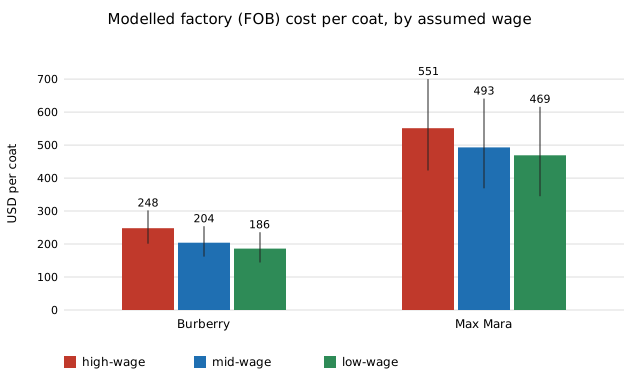
A bottom-up cost model for a lined woven coat (fabric from pattern area and marker efficiency, trims, sewing minutes times wage, overhead, brand and retail multipliers) applied to two reported designer prices. Under assumed inputs the factory cost is $186–248 for a $2,850 trench and $469–551 for a $3,850 coat, under 15% of the price in every wage scenario, and the assumed multipliers do not close the gap. A cheap-cloth replica costs $46–100 to make; only a very lean case reaches $29–34. Stylised: every cost input is assumed, prices are from search snippets, and fit and durability are not scored.
A figure from its own output
Paper, code and results
More in Engineered clothing
- Can a cheap cloth drape score how well a flat pattern fits a body, and is a fitted pattern body-specific?Position-based cloth drape scores a flat skirt-tube pattern on two synthetic elliptical bodies by strain and waist ease; the best waist is near the body's waist perimeter and a pattern fitted to one body fits the other clearly worse. Stylised; strains depend on mesh and solver.
- How much cloth does marker making waste, and do annealing and exact methods beat greedy nesting?Marker making as strip packing: on 20 random 8-box markers, shelf heuristics leave 17–20% extra length vs the exact optimum, annealing 0.5%; on two stylised garments, polygon nesting beats box packing at equal budget. Stylised; no seam allowance or multi-ply.
- What do seam allowance and mixed sizes do to marker efficiency, and what does that do to a garment's cloth cost?A 1 cm seam allowance cut the stylised shirt's marker efficiency from 0.69 to 0.63 and the skirt's from 0.71 to 0.51; mixing three sizes in one marker shortened it 9%; swapped into the cost model, trench cloth rises from $26 to $33–41 at $7/m². Stylised; sensitivity, not a coat measurement.
- How much cloth does a cutting plan save by mixing sizes in one marker, and is the saving real?Cutting-order planning for a 3-size stylised shirt: laying several garments per marker saves 9–11% of cloth over one per marker; mixing sizes adds 0.4–3.7% in sample, but re-nesting the chosen markers with fresh seeds leaves +0.09%, so it is within nesting noise. Stylised; invented shapes.
- How far is a fixed 0.80 marker efficiency from a nested coat, and what does the difference do to the cost model?Nesting a stylised coat's 10 shell and 5 lining pieces with a 1.5 cm seam allowance gives marker efficiencies of 0.68–0.73 (shell) and 0.59–0.68 (lining) at three cloth widths, below the fixed 0.80 in
garment-teardown; its trench FOB moves +9% to +15% at the teardown's own areas. Stylised, preliminary. - How many clothing sizes does it take to fit a population, and does a regular S-M-L grid waste them?How many sizes fit a population? On a stylised synthetic bust/hip population (+-4 cm), an exact size run beats a regular grid by 12 to 25 points at correlation 0.9 but not on fresh people at correlation 0; greedy is within 3.7 points of optimal (stylised, preliminary).
All 45 Engineered clothing projects →
Other research topics
Proper scoring & elicitation28Effort & peer prediction9Verification games & slashing19Detection & tolerances14Markets as routers13Prediction-market design9Paying contributors8Decentralised training systems23Digital twins & sim-to-real164LLM chip design loops40Robot manufacturing loops53Ambient AI assistant46Self-replicating manufacturing34Simulation-first design64Engineered clothing45Task-specific AI accelerators40Algorithmic chip-design loops42Open-source purpose-built robots44The software-engineering loop43Adversarial human imitation41Open-source residential construction41Autonomous multi-angle capture34Sensing, imaging and 3D31Energy supply and dense energy storage39Robot societies among people31Agentic co-design of low-cost robots27Laundry-hanging robots25Machine learning on qualitative data23Robots on the building site27Civilizations & group psychology1History & human sciences1
Produced with AI assistance (Claude). Results are from the code in this repository and are simulated or stylised unless the abstract says otherwise; nothing here implies affiliation with or endorsement by any lab, researcher or company cited. MIT licensed.