How many clothing sizes does it take to fit a population, and does a regular S-M-L grid waste them?
research/garment-sizeset
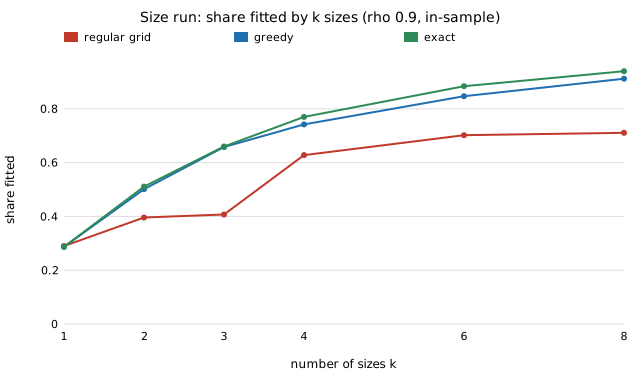
How many sizes fit a population? On a stylised synthetic bust/hip population (+-4 cm), an exact size run beats a regular grid by 12 to 25 points at correlation 0.9 but not on fresh people at correlation 0; greedy is within 3.7 points of optimal (stylised, preliminary).
What it found
Stylised and preliminary: a synthetic bust and hip population (assumed means 95 and 100 cm, sd 8 cm, no survey data) with a fit tolerance of ±4 cm. Choosing k sizes to fit the most people is maximum coverage; solved exactly (integer program), greedily and as a regular grid on 300 people, 3 seeds. At bust–hip correlation 0.9, exact sizes fit 12–25 points more people than the best grid and 6 sizes reach 80%; greedy is within 3.7 points of exact. At correlation 0 the gap is small, and on 20,000 fresh people the exact set is no better than the grid, so the optimiser overfits small samples. Limits: Gaussian two-measurement population, pass/fail box fit, no cost of extra sizes.
A figure from its own output
Paper, code and results
More in Engineered clothing
- How many clothing sizes does a stretch fabric save?How many sizes does a stretch fabric save? On a stylised synthetic bust/hip population, 10% usable stretch cuts the sizes needed for 80% fit from 6 to more than 8 down to 2 or 3; an idealised upper bound (preliminary).
- How much comfort can an infrared-transparent or gating textile buy, and which fabric properties matter?Fanger/ISO PMV and a two-node model extended with fabric infrared transmittance, emissivity and solar absorptance: indoors, transmittance 0→0.8 is worth ~2.4 °C of comfort at 28 °C; in sun, absorptance dominates. Stylised; assumed fabric properties, no reference for the optical extension.
- How far is the repository's two-node thermal model from an open-source implementation of the Gagge model?Cross-checks
garment-thermal's two-node model againstpythermalcomfortover 108 conditions: core temperature within 0.25 °C, skin temperature mean 0.6 °C (up to 2.1 °C) apart; a comparison of implementations, not of people. - Which design choices explain the gap between the repository's two-node model and an open-source Gagge implementation?Switches nine design choices one at a time between
garment-thermal's two-node model andpythermalcomfort's: variable skin mass fraction, convection coefficient and vasodilation gain explain most of the 0.58 °C skin-temperature gap; a comparison of implementations, not of people. - Do the fabric-optics conclusions of the thermal-comfort model survive a different two-node implementation?Adds
garment-thermal's fabric optics (infrared transmittance, emissivity, solar absorptance) to the switchable two-node model and re-runs the comparisons underpythermalcomfort's choices: property rankings agree in all four scenarios, sizes within 3% at 28 °C but up to ~2× apart in cool air and in sun; a comparison of implementations, not of people. - Do the fabric-optics effects on thermal comfort change once the two-node model reaches steady state?The fabric-optics comparison of
garment-twonodeopticsrun to steady state instead of one hour: the cool-room disagreement between design choices mostly vanishes (stylised).
All 45 Engineered clothing projects →
Other research topics
Proper scoring & elicitation28Effort & peer prediction9Verification games & slashing19Detection & tolerances14Markets as routers13Prediction-market design9Paying contributors8Decentralised training systems23Digital twins & sim-to-real164LLM chip design loops40Robot manufacturing loops53Ambient AI assistant46Self-replicating manufacturing34Simulation-first design64Engineered clothing45Task-specific AI accelerators40Algorithmic chip-design loops42Open-source purpose-built robots44The software-engineering loop43Adversarial human imitation41Open-source residential construction41Autonomous multi-angle capture34Sensing, imaging and 3D31Energy supply and dense energy storage39Robot societies among people31Agentic co-design of low-cost robots27Laundry-hanging robots25Machine learning on qualitative data23Robots on the building site27Civilizations & group psychology1History & human sciences1
Produced with AI assistance (Claude). Results are from the code in this repository and are simulated or stylised unless the abstract says otherwise; nothing here implies affiliation with or endorsement by any lab, researcher or company cited. MIT licensed.