Which design choices explain the gap between the repository's two-node model and an open-source Gagge implementation?
research/garment-twonodealign
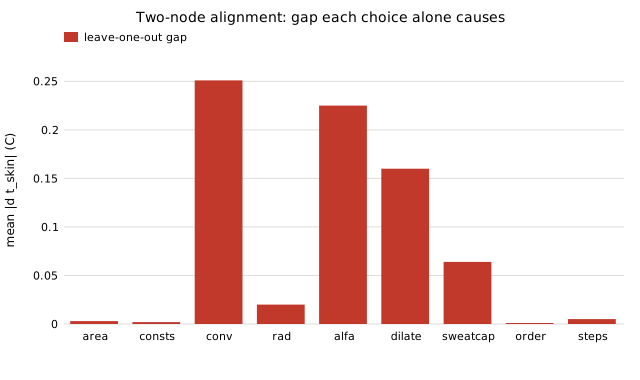
Switches nine design choices one at a time between garment-thermal's two-node model and pythermalcomfort's: variable skin mass fraction, convection coefficient and vasodilation gain explain most of the 0.58 °C skin-temperature gap; a comparison of implementations, not of people.
What it found
Rebuilds the two-node model with nine switchable choices (body area, constants, convection, clothing radiation, skin mass fraction, vasodilation gain, sweat caps, update order, step count), each set to the repository's version or to the pythermalcomfort version read from its source. With all nine set to the reference's, the model matches it to 0.008 in every output over 108 conditions. Switching one at a time, the skin-temperature gap (mean 0.58 °C) falls most with the variable skin mass fraction (to 0.36), the convection coefficient (0.43) and the vasodilation gain (0.44); body area, constants, update order and step count each change it by under 0.01 °C. A comparison of two implementations, not of either against people; the effects interact, so the attribution depends on the order.
A figure from its own output
Paper, code and results
More in Engineered clothing
- Do the fabric-optics conclusions of the thermal-comfort model survive a different two-node implementation?Adds
garment-thermal's fabric optics (infrared transmittance, emissivity, solar absorptance) to the switchable two-node model and re-runs the comparisons underpythermalcomfort's choices: property rankings agree in all four scenarios, sizes within 3% at 28 °C but up to ~2× apart in cool air and in sun; a comparison of implementations, not of people. - Do the fabric-optics effects on thermal comfort change once the two-node model reaches steady state?The fabric-optics comparison of
garment-twonodeopticsrun to steady state instead of one hour: the cool-room disagreement between design choices mostly vanishes (stylised). - Do the closed and open bounds of an infrared-gating textile survive other two-node design choices and steady state?The closed-to-open bounds of an infrared-gating textile from
garment-thermalhold under both two-node choice sets and at steady state: opening the gate cools skin by 0.20–0.25 C at 31 C and keeps it 1.4–1.5 C cooler at 16 C; stylised, preliminary. - What does a thermostat-driven infrared-gating textile do that its fixed closed and open states do not?A skin-temperature-triggered infrared-gating textile with hysteresis and actuation lag settles to a fixed closed or open state under constant rooms (no chatter, lag only delays the start); gains need changing conditions; stylised, preliminary, mostly null.
- When the room temperature steps, does a thermostat-driven infrared-gating textile beat its fixed states and approach an oracle?Under a single step in room temperature, a thermostat-driven infrared-gating textile beats both fixed states after a step up and tracks an oracle schedule closely (stylised).
- When the metabolic rate steps from rest to walking, does a thermostat-driven infrared-gating textile beat its fixed states?A step in metabolic rate (rest to walking) instead of room temperature for the thermostat infrared-gating textile: at 24 C the gate beats both fixed states under one choice set and ties fixed closed under the other, at 28 C staying open is as good as any policy, and a 10 min lag erases the gain after walking stops; stylised, preliminary.
All 45 Engineered clothing projects →
Other research topics
Proper scoring & elicitation28Effort & peer prediction9Verification games & slashing19Detection & tolerances14Markets as routers13Prediction-market design9Paying contributors8Decentralised training systems23Digital twins & sim-to-real164LLM chip design loops40Robot manufacturing loops53Ambient AI assistant46Self-replicating manufacturing34Simulation-first design64Engineered clothing45Task-specific AI accelerators40Algorithmic chip-design loops42Open-source purpose-built robots44The software-engineering loop43Adversarial human imitation41Open-source residential construction41Autonomous multi-angle capture34Sensing, imaging and 3D31Energy supply and dense energy storage39Robot societies among people31Agentic co-design of low-cost robots27Laundry-hanging robots25Machine learning on qualitative data23Robots on the building site27Civilizations & group psychology1History & human sciences1
Produced with AI assistance (Claude). Results are from the code in this repository and are simulated or stylised unless the abstract says otherwise; nothing here implies affiliation with or endorsement by any lab, researcher or company cited. MIT licensed.