Do the fabric-optics effects on thermal comfort change once the two-node model reaches steady state?
research/garment-twonodesteady
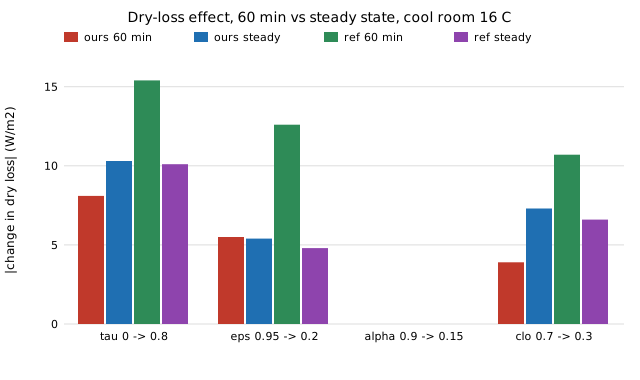
The fabric-optics comparison of garment-twonodeoptics run to steady state instead of one hour: the cool-room disagreement between design choices mostly vanishes (stylised).
What it found
Re-runs the switchable two-node comparison of fabric optics (infrared transmittance, emissivity, solar absorptance, insulation) for 24 h of model time instead of one hour (stylised, preliminary). In the 28 C room, with hot walls and in sun the one-hour effects are already steady. In the 16 C room the one-hour disagreement between the repository’s design choices and those of pythermalcomfort (ratio 1.9–2.7) shrinks to 0.89–0.98 at steady state, so it was mostly a transient-speed difference. A model fixed point, not a claim about people; no fabric or person was measured.
A figure from its own output
Paper, code and results
More in Engineered clothing
- Do the closed and open bounds of an infrared-gating textile survive other two-node design choices and steady state?The closed-to-open bounds of an infrared-gating textile from
garment-thermalhold under both two-node choice sets and at steady state: opening the gate cools skin by 0.20–0.25 C at 31 C and keeps it 1.4–1.5 C cooler at 16 C; stylised, preliminary. - What does a thermostat-driven infrared-gating textile do that its fixed closed and open states do not?A skin-temperature-triggered infrared-gating textile with hysteresis and actuation lag settles to a fixed closed or open state under constant rooms (no chatter, lag only delays the start); gains need changing conditions; stylised, preliminary, mostly null.
- When the room temperature steps, does a thermostat-driven infrared-gating textile beat its fixed states and approach an oracle?Under a single step in room temperature, a thermostat-driven infrared-gating textile beats both fixed states after a step up and tracks an oracle schedule closely (stylised).
- When the metabolic rate steps from rest to walking, does a thermostat-driven infrared-gating textile beat its fixed states?A step in metabolic rate (rest to walking) instead of room temperature for the thermostat infrared-gating textile: at 24 C the gate beats both fixed states under one choice set and ties fixed closed under the other, at 28 C staying open is as good as any policy, and a 10 min lag erases the gain after walking stops; stylised, preliminary.
- If a thermostat infrared-gating band is tuned on some rooms, does it still help in rooms it never saw?Tuning the thermostat infrared-gating band on training rooms and testing on held-out rooms: a narrow band just below 33.7 C carries over (about 0.01 to 0.06 C better than the untuned band) but chatters, up to 24 switches in 180 min (stylised).
- Does a tuned infrared-gating thermostat survive an actuation lag and a cost per switch?Retuning the thermostat infrared-gating band with an actuation lag (0 to 10 min) and a cost per switch: lag cuts the gain over never switching from 0.23 to 0.15 C (stylised), a switch penalty widens the band and stops the chatter, and under one choice set the tuned band can lose to the untuned one.
All 45 Engineered clothing projects →
Other research topics
Proper scoring & elicitation28Effort & peer prediction9Verification games & slashing19Detection & tolerances14Markets as routers13Prediction-market design9Paying contributors8Decentralised training systems23Digital twins & sim-to-real164LLM chip design loops40Robot manufacturing loops53Ambient AI assistant46Self-replicating manufacturing34Simulation-first design64Engineered clothing45Task-specific AI accelerators40Algorithmic chip-design loops42Open-source purpose-built robots44The software-engineering loop43Adversarial human imitation41Open-source residential construction41Autonomous multi-angle capture34Sensing, imaging and 3D31Energy supply and dense energy storage39Robot societies among people31Agentic co-design of low-cost robots27Laundry-hanging robots25Machine learning on qualitative data23Robots on the building site27Civilizations & group psychology1History & human sciences1
Produced with AI assistance (Claude). Results are from the code in this repository and are simulated or stylised unless the abstract says otherwise; nothing here implies affiliation with or endorsement by any lab, researcher or company cited. MIT licensed.