Does a proportional infrared-gating textile beat the on/off thermostat gate?
research/garment-twonodeprop
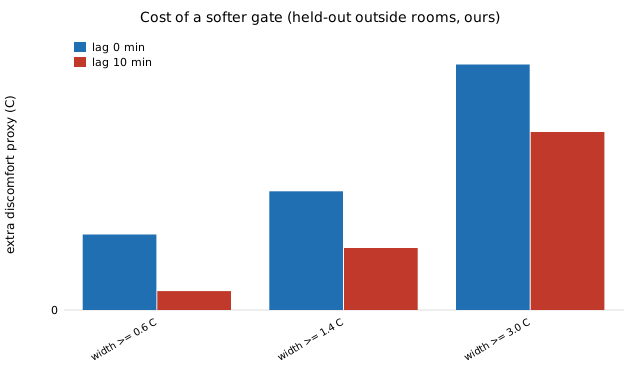
A proportional infrared-gating transmittance against the tuned on/off thermostat gate: a negative result, within 0.010 C in every cell because the tuned ramp collapses to nearly on/off, and a softer ramp costs 0.02 to 0.07 C (stylised).
What it found
A stylised, preliminary, negative follow-up to garment-twonodelag. A transmittance that ramps linearly with skin temperature is tuned by exhaustive search (72 bands) for each actuation lag (0 to 10 min) and scored on held-out rooms against the tuned on/off gate. Proportional wins in 5 of 16 cells and every difference is within 0.010 C: the search picks bands only 0.1 to 0.2 C wide, i.e. nearly on/off. Forcing a softer ramp (at least 1.4 C wide) costs 0.02 to 0.07 C. Switching is free in this run, so a switch penalty could change the answer. Six training and eight held-out scenarios; no real fabric or person.
A figure from its own output
Paper, code and results
More in Engineered clothing
- At what switching penalty does a proportional infrared gate beat the on/off thermostat gate?Prices actuation in equal units (one full close-open swing = 1) and asks when a proportional infrared gate beats the on/off gate: it wins in 52 of 80 held-out cells, by tenths of a degree at most, and the gain reverses in the outside rooms at the highest penalty (stylised, preliminary).
- Is the outside-room reversal of the proportional infrared gate a training-range artefact?Retunes both infrared gates on a wider set of rooms: the proportional gate's outside-room reversal is partly a training-range artefact
- Does an infrared-gating band tuned for one person and clothing level still work for other clothing and body sizes?Tunes both infrared gates on one person and clothing level and scores them on other clothing and body sizes; clothing matters, body size barely does
- How far is the thermostat-driven infrared-gating textile from the best possible switching schedule when the room temperature steps?A grid search for the best open/closed switching schedule under a room-temperature step shows one toggle suffices and the thermostat gate sits within 0.02 °C of it after a step up, but up to 0.11 °C after a step down (stylised).
- What does a degree of comfort cost in fabric?Joins
garment-thermalcomfort shifts togarment-teardowncosts: only one fabric treatment helps in each scenario, levers combine sub-additively, and at assumed premiums a degree costs $0.5 to $19 on a replica trench but $3 to $114 on a designer one. Stylised; premiums assumed. - Does a fabric lever still pay once you weight it by where the garment is worn?Weights
garment-comfortcost's fabric levers by wearing time and adds a gated infrared lever: a fixed infrared-transparent shell pays only with a warm-room majority (above 75.5% of time against the cool room), white never harms, and the gate is chosen only when it costs about the fixed shell's premium or less. Stylised; premiums and wearing shares assumed.
All 45 Engineered clothing projects →
Other research topics
Proper scoring & elicitation28Effort & peer prediction9Verification games & slashing19Detection & tolerances14Markets as routers13Prediction-market design9Paying contributors8Decentralised training systems23Digital twins & sim-to-real164LLM chip design loops40Robot manufacturing loops53Ambient AI assistant46Self-replicating manufacturing34Simulation-first design64Engineered clothing45Task-specific AI accelerators40Algorithmic chip-design loops42Open-source purpose-built robots44The software-engineering loop43Adversarial human imitation41Open-source residential construction41Autonomous multi-angle capture34Sensing, imaging and 3D31Energy supply and dense energy storage39Robot societies among people31Agentic co-design of low-cost robots27Laundry-hanging robots25Machine learning on qualitative data23Robots on the building site27Civilizations & group psychology1History & human sciences1
Produced with AI assistance (Claude). Results are from the code in this repository and are simulated or stylised unless the abstract says otherwise; nothing here implies affiliation with or endorsement by any lab, researcher or company cited. MIT licensed.