Does an infrared-gating band tuned for one person and clothing level still work for other clothing and body sizes?
research/garment-twonodeperson
Tunes both infrared gates on one person and clothing level and scores them on other clothing and body sizes; clothing matters, body size barely does
What it found
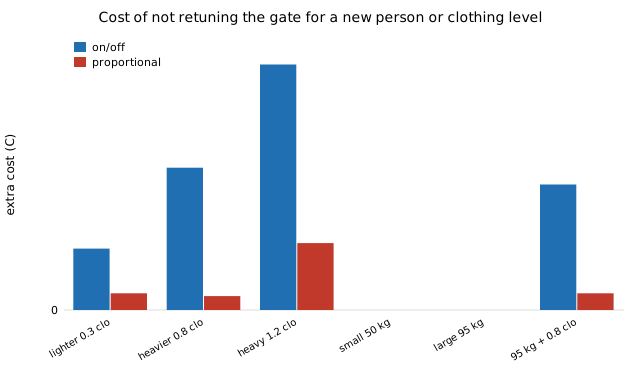
A stylised, preliminary follow-up to garment-twonodewide. Both gates are tuned on one person (0.5 clo, 70 kg) and scored unchanged on other clothing levels and body sizes. Body size barely matters (retuning gains at most 0.002 C), clothing does: retuning an on/off band for 1.2 clo gains up to 0.375 C, while the proportional gate's gap stays at most 0.075 C. Proportional wins every cell except three at 0.3 clo and penalty 0.1. Mass and height enter the model only through body area and heat capacity; simulated comfort, not a claim about any real garment.
A figure from its own output
Paper, code and results
More in Engineered clothing
- How far is the thermostat-driven infrared-gating textile from the best possible switching schedule when the room temperature steps?A grid search for the best open/closed switching schedule under a room-temperature step shows one toggle suffices and the thermostat gate sits within 0.02 °C of it after a step up, but up to 0.11 °C after a step down (stylised).
- What does a degree of comfort cost in fabric?Joins
garment-thermalcomfort shifts togarment-teardowncosts: only one fabric treatment helps in each scenario, levers combine sub-additively, and at assumed premiums a degree costs $0.5 to $19 on a replica trench but $3 to $114 on a designer one. Stylised; premiums assumed. - Does a fabric lever still pay once you weight it by where the garment is worn?Weights
garment-comfortcost's fabric levers by wearing time and adds a gated infrared lever: a fixed infrared-transparent shell pays only with a warm-room majority (above 75.5% of time against the cool room), white never harms, and the gate is chosen only when it costs about the fixed shell's premium or less. Stylised; premiums and wearing shares assumed. - How many home-sewn coats before the labour cost per coat settles?How many home-sewn replica coats until labour cost settles? On a Wright learning curve (assumed first coat 4× an experienced operator, rate 0.85) it takes 20 coats to get within 2× of factory time; the first coat stays under $50 only if your time is valued at ≤$1.45/h. Learning parameters assumed. Stylised.
- How much longer must a $2,850 coat last to beat a $56 replica on cost per wear?How much longer must a $2,850 coat last than a $56 replica to win on cost per wear? About 46× with no resale and equal care; needs a median life near 3,100 wears to win half the time. Lifetimes, care and resale assumed. Stylised.
- Is a second garment better than a dearer single one?Is a second garment better than a dearer single one? A shell-and-layer pair beats the best single garment at the same budget in 54 of 66 wearing mixes at $50 and $100 (mean +0.49 C and +1.02 C) once thin cloth is removed; the apparent $20 gain is an artefact of thin cloth's negative assumed cost. Stylised; premiums and wearing shares assumed.
All 45 Engineered clothing projects →
Other research topics
Proper scoring & elicitation28Effort & peer prediction9Verification games & slashing19Detection & tolerances14Markets as routers13Prediction-market design9Paying contributors8Decentralised training systems23Digital twins & sim-to-real164LLM chip design loops40Robot manufacturing loops53Ambient AI assistant46Self-replicating manufacturing34Simulation-first design64Engineered clothing45Task-specific AI accelerators40Algorithmic chip-design loops42Open-source purpose-built robots44The software-engineering loop43Adversarial human imitation41Open-source residential construction41Autonomous multi-angle capture34Sensing, imaging and 3D31Energy supply and dense energy storage39Robot societies among people31Agentic co-design of low-cost robots27Laundry-hanging robots25Machine learning on qualitative data23Robots on the building site27Civilizations & group psychology1History & human sciences1
Produced with AI assistance (Claude). Results are from the code in this repository and are simulated or stylised unless the abstract says otherwise; nothing here implies affiliation with or endorsement by any lab, researcher or company cited. MIT licensed.