Does diagnostic feedback help a gripper design loop once the task has headroom?
research/codesign-headroom
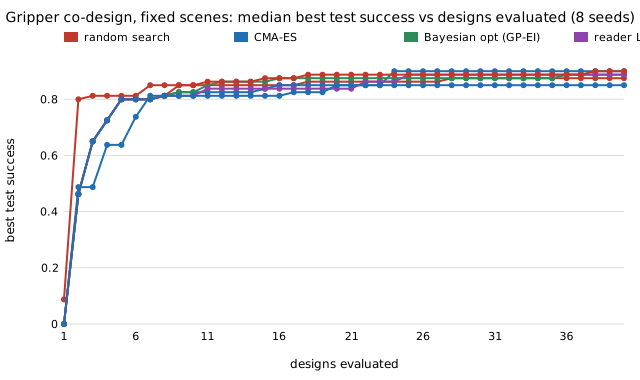
Does diagnostic feedback help a gripper design loop once the scene generator is fixed? Still no: every method gains only 0.00 to 0.05 (best test success 0.85 to 0.90) and the failure-summary and rollout-log readers do not beat random search, CMA-ES or Bayesian optimisation (stylised, rule-based readers, not an LLM).
What it found
Re-runs the codesign-diagnose ablation after fixing the scene generator that codesign-ceiling blamed for the 0.85 plateau (hand height capped at the object’s centre). Three rule-based readers (score only, failure summary, full rollout logs) and random search, CMA-ES and Bayesian optimisation, 8 seeds × 40 designs in MuJoCo. Every method gains only 0.00–0.05 (median best test success 0.85–0.90) and the ranking is not resolved at 40 test scenes (standard error about 0.05); feedback still does not beat blind search, and the best designs still lose 0.05–0.06 on fresh scenes. Stylised; readers are rules, not an LLM.
A figure from its own output
Paper, code and results
More in Agentic co-design of low-cost robots
- Which gripper co-design method finds the best design when designs are scored on 600 scenes instead of 40?Does the ranking of co-design methods survive 600 test scenes? No: re-scoring the 144 final designs of codesign-headroom gives 0.82 to 0.85 true success for every method, random search ties CMA-ES and Bayesian optimisation, and the rollout-log reader trails by 0.03 (interval includes 0)
- Do 24 runs per method rank gripper co-design methods that 8 runs could not?Do more seeds separate the gripper co-design methods? Not yet: with 24 runs per method CMA-ES leads random search by 0.025 (interval -0.007 to +0.056), the rollout-log reader trails by 0.022, and a 0.02 gap would need about 140 runs per method
- Which printable two-finger gripper holds eight different objects for the least plastic, and can an agent beat CMA-ES and Bayesian optimisation at 40 simulations?Which printable two-finger gripper holds eight objects for the least plastic, and can an agent beat CMA-ES and Bayesian optimisation at 40 MuJoCo evaluations? Median best objective 0.991 (Bayesian opt) vs 0.979 (CMA-ES), 0.965 (random) and 0.963 (session agent, one run); the cheapest winners (0.5 g flat fingers) are also the most fragile when object offsets triple. Stylised, no learned policy.
- Which cheap wheel-legged rover covers the most stylised rubble under a 120 USD parts cap, and does a session agent beat CMA-ES and Bayesian optimisation?Which cheap wheel-legged rover covers the most stylised rubble under a 120 USD cap, and can an agent beat CMA-ES and Bayesian optimisation at 40 evaluations? Wheel radius at its bound plus about 0.5 N m torque reaches the ceiling (J 0.783, 69 USD); Bayesian opt and CMA-ES 0.782, session agent 0.783, random 0.716; stylised, falls never occurred.
- Which three-finger pad design picks the most unbruised strawberry-like fruit under a 60 USD cap, and does a session agent beat CMA-ES and Bayesian optimisation?Which three-finger pad design picks the most unbruised strawberry-like fruit under a 60 USD cap, and can an agent beat CMA-ES and Bayesian optimisation at 40 evaluations? Bayesian optimisation did (median J 0.635 against the agent's 0.618); about 20% of fruit are lost to clutter collisions no pad setting changes. Stylised, assumed constants.
- Which suction gripper picks the most of a stylised mixed tote under an 80 USD cap, and does a session agent beat CMA-ES and Bayesian optimisation?Which suction gripper picks the most of a stylised mixed tote (boxes, polybags, bottles) under an 80 USD cap, and can an agent beat CMA-ES and Bayesian optimisation at 40 evaluations? The agent's best J was 0.519 against 0.478 for Bayesian optimisation (median of 20 seeds); the best design is two 18.5 mm cups at 80 kPa and 60 L/min, and a catalogue-default single 30 mm cup scores 0.075. Stylised, assumed constants.
All 27 Agentic co-design of low-cost robots projects →
Other research topics
Proper scoring & elicitation28Effort & peer prediction9Verification games & slashing19Detection & tolerances14Markets as routers13Prediction-market design9Paying contributors8Decentralised training systems23Digital twins & sim-to-real164LLM chip design loops40Robot manufacturing loops53Ambient AI assistant46Self-replicating manufacturing34Simulation-first design64Engineered clothing45Task-specific AI accelerators40Algorithmic chip-design loops42Open-source purpose-built robots44The software-engineering loop43Adversarial human imitation41Open-source residential construction41Autonomous multi-angle capture34Sensing, imaging and 3D31Energy supply and dense energy storage39Robot societies among people31Agentic co-design of low-cost robots27Laundry-hanging robots25Machine learning on qualitative data23Robots on the building site27Civilizations & group psychology1History & human sciences1
Produced with AI assistance (Claude). Results are from the code in this repository and are simulated or stylised unless the abstract says otherwise; nothing here implies affiliation with or endorsement by any lab, researcher or company cited. MIT licensed.