Which three-finger pad design picks the most unbruised strawberry-like fruit under a 60 USD cap, and does a session agent beat CMA-ES and Bayesian optimisation?
research/codesign-agri
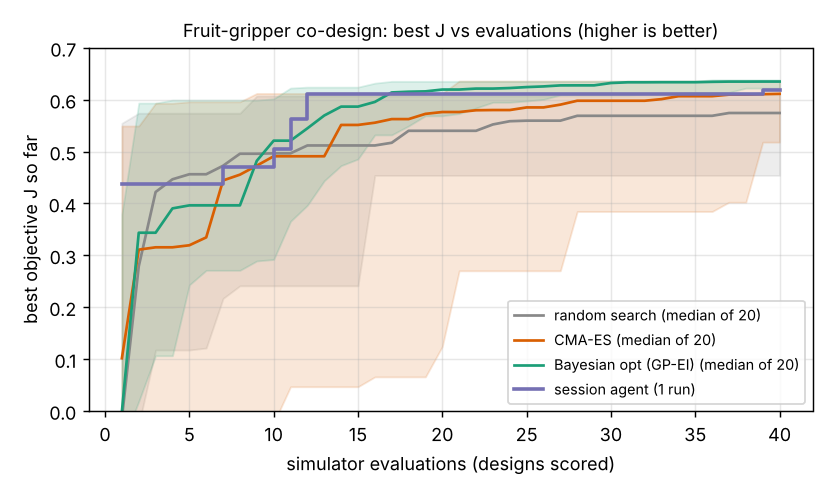
Which three-finger pad design picks the most unbruised strawberry-like fruit under a 60 USD cap, and can an agent beat CMA-ES and Bayesian optimisation at 40 evaluations? Bayesian optimisation did (median J 0.635 against the agent's 0.618); about 20% of fruit are lost to clutter collisions no pad setting changes. Stylised, assumed constants.
What it found
Five design variables (pad width, pad length, pad modulus, grip force, finger count) are scored on 600 simulated fruit with ripeness-dependent bruise thresholds, wet and dry friction and placement error, using closed-form line-contact pressure, friction hold and a capture-and-clutter law. At 40 evaluations the median best objective is 0.635 for Bayesian optimisation, 0.618 for a session agent’s hand-written proposals (one run, by the model’s own author), 0.611 for CMA-ES and 0.574 for random search; all 20 Bayesian-optimisation seeds matched or beat the agent. The best design (25 mm pads, 0.19 MPa, 8 N, three fingers) picks 74% clean; about 20% of fruit are lost to clutter collisions that no pad setting can change. Stylised, with assumed constants and no learned policy.
A figure from its own output
Paper, code and results
More in Agentic co-design of low-cost robots
- Which suction gripper picks the most of a stylised mixed tote under an 80 USD cap, and does a session agent beat CMA-ES and Bayesian optimisation?Which suction gripper picks the most of a stylised mixed tote (boxes, polybags, bottles) under an 80 USD cap, and can an agent beat CMA-ES and Bayesian optimisation at 40 evaluations? The agent's best J was 0.519 against 0.478 for Bayesian optimisation (median of 20 seeds); the best design is two 18.5 mm cups at 80 kPa and 60 L/min, and a catalogue-default single 30 mm cup scores 0.075. Stylised, assumed constants.
- Should a quadrotor’s airframe and its learned attitude controller be sized together, or one after the other?Should a quadrotor's airframe and its learned roll controller be sized together? Yes in this stylised model: joint CMA-ES reaches 5.25° RMS roll error, equal to the grid optimum, against 7.06° for lightest-airframe-first; a controller reused across airframes is worse on 41% of them.
- Does the best quadrotor airframe stay best when motor strength, mass and motor lag are randomised?Does the best quadrotor airframe stay best under widened motor-strength, mass and lag randomisation? Mostly: top five unchanged (Spearman 0.75), but retuning gains helps the median airframe 0.91° (stylised).
- Should a quadrotor’s airframe and controller gains be searched jointly when the plant is uncertain?Should airframe and gains be searched jointly under an uncertain plant? Yes in this stylised model: joint CMA-ES at 960 evaluations (5.75° median held-out, 8 seeds) beats random search and a 4800-evaluation grid-then-tune best cell (6.00°).
- Is the quadrotor airframe ranking from one tuning run reproducible, or is it tuning noise?Is the airframe ranking from one tuning run reproducible? With wide-tuned gains yes (Spearman 0.99 over six replicates); with nominal-tuned gains it is noisier (0.84) and the earlier 0.17° regret was within noise (stylised).
- Does the ranking of printable soft-fruit gripper designs survive a shift in friction, fruit, placement error and print tolerance?Does the ranking of soft-fruit gripper designs survive a shift in friction, fruit, placement error and print tolerance? Yes in this model (Spearman 0.993 over 600 designs), but the nominal optimum loses 13% of its J and a robust optimum gains only about 0.015 on average; sim-to-sim, assumed ranges.
All 27 Agentic co-design of low-cost robots projects →
Other research topics
Proper scoring & elicitation28Effort & peer prediction9Verification games & slashing19Detection & tolerances14Markets as routers13Prediction-market design9Paying contributors8Decentralised training systems23Digital twins & sim-to-real164LLM chip design loops40Robot manufacturing loops53Ambient AI assistant46Self-replicating manufacturing34Simulation-first design64Engineered clothing45Task-specific AI accelerators40Algorithmic chip-design loops42Open-source purpose-built robots44The software-engineering loop43Adversarial human imitation41Open-source residential construction41Autonomous multi-angle capture34Sensing, imaging and 3D31Energy supply and dense energy storage39Robot societies among people31Agentic co-design of low-cost robots27Laundry-hanging robots25Machine learning on qualitative data23Robots on the building site27Civilizations & group psychology1History & human sciences1
Produced with AI assistance (Claude). Results are from the code in this repository and are simulated or stylised unless the abstract says otherwise; nothing here implies affiliation with or endorsement by any lab, researcher or company cited. MIT licensed.