Was the thrust-to-weight ceiling of 4 what made rotor cant look good?
research/codesign-aero-cant-twrceil
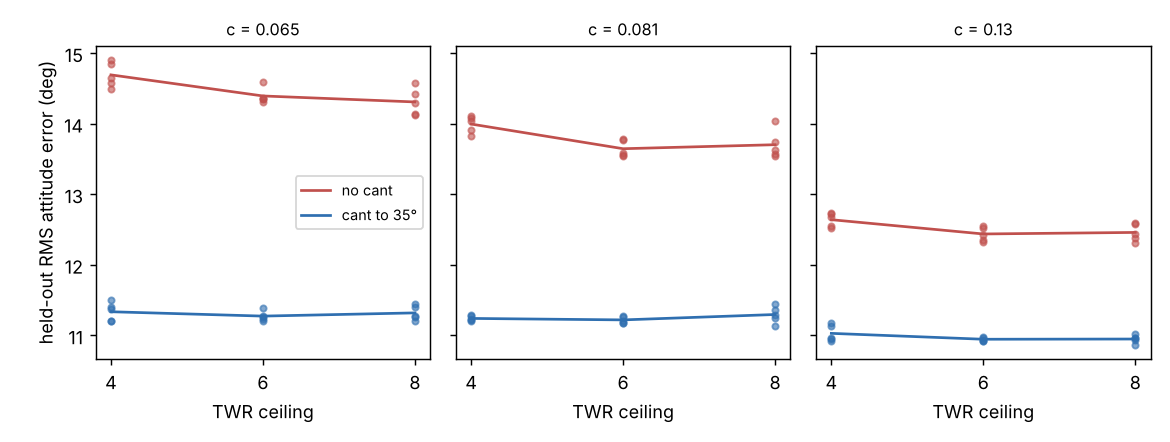
Does raising the TWR ceiling from 4 to 6 and 8 erase the cant advantage? No: cant to 35° still beats no cant in 5 of 5 seeds at three measured propeller c values, by 1.5–3.0° at ceiling 8 (1.6–3.4° at 4); the optimiser stops near TWR 5 without cant.
What it found
Follow-up to codesign-aero-cant-twr, whose no-cant design sat on its assumed TWR ceiling of 4. Same joint CMA-ES co-design (1920 evaluations, 5 seeds, 64 held-out episodes, $300 cap, c at the 10th, 50th and 90th percentile of measured UIUC propeller data) with the ceiling at 4, 6 and 8. Raising it from 4 to 6 improves the no-cant design by 0.2–0.35° and the optimiser then picks TWR 4.9–5.1; from 6 to 8 nothing changes (within ±0.1°). Cant to 35° still beats no cant in 5 of 5 seeds at every c and ceiling, by 1.5–3.0° at ceiling 8, so the earlier gap was overstated by 0.1–0.4°. Limits: the interior optimum comes from inherited, assumed motor mass and cost fits (not a catalogue), attitude steps only, no position hold, no hardware.
A figure from its own output
Paper, code and results
More in Agentic co-design of low-cost robots
- Does a neural residual help a quadrotor attitude controller once roll, pitch and yaw are coupled?Does a residual network or analytic gyroscopic compensation beat per-axis PID on a coupled three-axis quadrotor? No: the residual is worse than PID in 26 of 30 pairs (+0.32° held out) and compensation changes the error by 0.001°; yaw authority sets the error.
- Does a small neural roll controller beat the three-gain PID on a randomised quadrotor, and does it change which airframe is best?Does a 31-parameter neural roll controller beat the three-gain PID on a randomised quadrotor? Not at equal evaluations (7.7° PID against 9.0°); with 10× the evaluations it only matches it (7.6°), and the airframe ranking is unchanged (Spearman 1.00).
- Does a neural residual on top of the tuned PID get a quadrotor roll controller below the PID error floor?Does a zero-initialised neural residual on the tuned PID beat the PID on a randomised quadrotor? No at equal evaluations (7.68° against 7.58°, better in 7 of 18 pairs); the airframe ranking is unchanged (Spearman 1.00).
- Does the strawberry gripper co-design survive the measured range of stem pull-off force?Does the strawberry-gripper co-design of codesign-agri survive measured stem pull-off forces (3.17 N bending and pulling, 13.94 N pulling alone) instead of an assumed 3.5 N? Partly: the optimiser ranking holds in 8 of 10 cells, but the best achievable objective falls from 0.665 to 0.075 as the median pull-off rises from 3.17 to 13.94 N, and at 13.94 N no 40-evaluation run finds a gripper that picks anything
- Do the codesign-agri conclusions survive when its assumed constants change?Does the optimiser ranking of codesign-agri survive a sweep of its 12 invented constants? Mostly: Bayesian optimisation beats CMA-ES beats random search in 82 of 100 worlds, but the best gripper has 2, 3 or 4 fingers depending on stem strength and the nominal winner loses 0.06 J or goes over budget in most worlds
- Does diagnostic feedback help a gripper design loop once the task has headroom?Does diagnostic feedback help a gripper design loop once the scene generator is fixed? Still no: every method gains only 0.00 to 0.05 (best test success 0.85 to 0.90) and the failure-summary and rollout-log readers do not beat random search, CMA-ES or Bayesian optimisation (stylised, rule-based readers, not an LLM).
All 27 Agentic co-design of low-cost robots projects →
Other research topics
Proper scoring & elicitation28Effort & peer prediction9Verification games & slashing19Detection & tolerances14Markets as routers13Prediction-market design9Paying contributors8Decentralised training systems23Digital twins & sim-to-real164LLM chip design loops40Robot manufacturing loops53Ambient AI assistant46Self-replicating manufacturing34Simulation-first design64Engineered clothing45Task-specific AI accelerators40Algorithmic chip-design loops42Open-source purpose-built robots44The software-engineering loop43Adversarial human imitation41Open-source residential construction41Autonomous multi-angle capture34Sensing, imaging and 3D31Energy supply and dense energy storage39Robot societies among people31Agentic co-design of low-cost robots27Laundry-hanging robots25Machine learning on qualitative data23Robots on the building site27Civilizations & group psychology1History & human sciences1
Produced with AI assistance (Claude). Results are from the code in this repository and are simulated or stylised unless the abstract says otherwise; nothing here implies affiliation with or endorsement by any lab, researcher or company cited. MIT licensed.